Table of Contents
Water Intake Calculator for Dogs · Daily Hydration Guide
How much water should your dog actually be drinking each day? As a general guideline, healthy dogs need about 50 to 60 milliliters of water per kilogram of body weight per day roughly 1 ounce per pound. But that baseline shifts with activity level, weather, whether they eat dry or wet food, and health conditions like kidney disease or pregnancy. Knowing your dog’s target range makes it much easier to spot when something is genuinely off.
50–60 ml/kg
Typical daily water need per kg of body weight
~1 oz/lb
Simple imperial rule of thumb
5%+
Fluid loss where dehydration signs typically appear
+20–50%
Possible increase in hot weather or after exercise
~75%
Approximate moisture content of most wet dog foods
<2 Sec
Normal skin-tent snap-back time when well hydrated
Whether you’re tracking hydration after surgery, managing a kidney condition, or simply want to know if your dog is drinking a healthy amount, precision matters. Our interactive Water Intake Calculator for Dogs below estimates a daily target in milliliters, ounces, and cups based on your dog’s weight, activity level, diet type, and any special health situation.
Interactive Water Intake Calculator for Dogs
Enter your dog’s weight, typical activity level, diet type, and any special situation below to calculate a personalized daily water target in real time.
How Much Water Should a Dog Drink?
Unlike calorie needs, which scale with metabolic rate rather than weight alone, daily water intake in dogs is most commonly estimated using a straightforward milliliters-per-kilogram guideline, as referenced in veterinary nutrition resources from the WSAVA Global Nutrition Committee. What varies most from dog to dog is how much of that water comes from the bowl versus from food.
| Method | Formula | Example (20 kg / 44 lb dog) | Best Used For |
|---|---|---|---|
| ml per kg (standard) | 50–60 ml × body weight (kg) | 1,000 – 1,200 ml/day | Quick daily estimates for healthy adult dogs. |
| oz per lb (imperial) | ~1 fl oz × body weight (lb) | ~44 fl oz/day | A simple rule of thumb without converting units. |
| Calorie-based (RER) | ~1 ml water per kcal of Resting Energy Requirement | ~900 – 1,000 ml/day | Cross-checking against a dog's calorie needs, especially for weight management. |
Clinical Note: According to fluid-therapy guidance summarized in the Merck Veterinary Manual, total water intake includes both drinking water and the moisture naturally present in food. A dog eating only wet food may drink visibly less from the bowl while still meeting its total daily fluid needs.
Early and Severe Signs of Dehydration
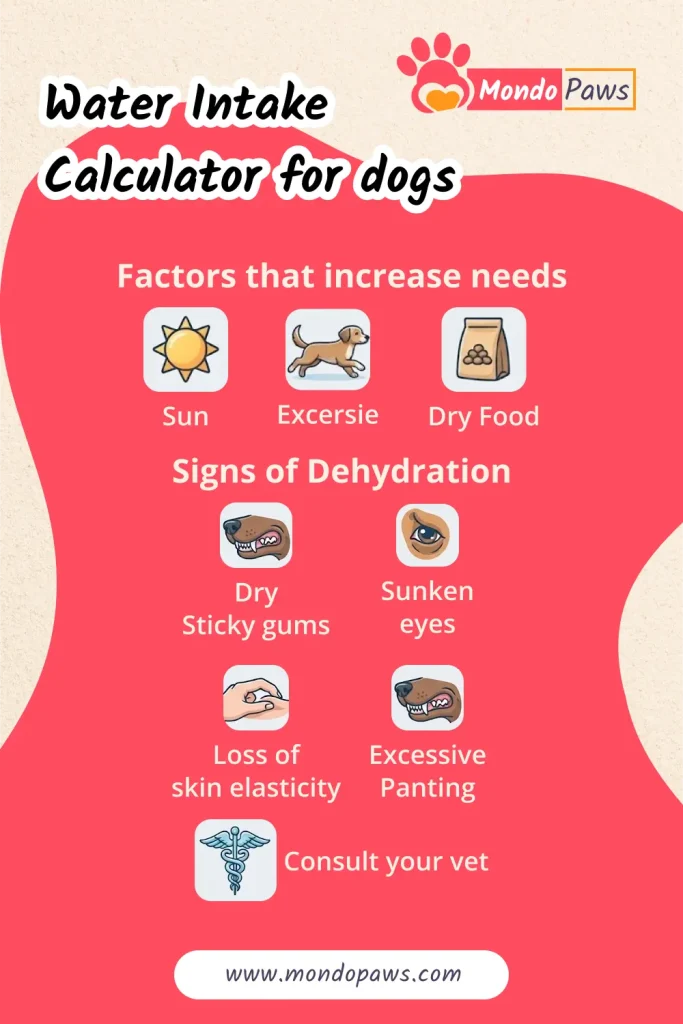
Dehydration signs become more obvious as fluid loss increases. Catching the early, subtle signs means you can intervene before a mild issue becomes an emergency.
Mild (Under 5% Loss)
Slightly tacky (rather than wet) gums, mild lethargy, and a skin tent that snaps back a bit slower than usual.
Moderate (5–10% Loss)
Dry, sticky gums, sunken eyes, noticeable lethargy, and a skin tent that takes several seconds to flatten.
Severe (10%+ Loss)
Weakness, collapse, rapid heart rate, and skin that stays tented — this is a veterinary emergency.
Water Needs by Life Stage and Activity
A dog's relative water needs shift across life stages and activity levels, largely driven by metabolic rate, growth, and how much heat their body needs to dissipate.
Puppies
Higher Relative Needs. Faster metabolism and smaller body reserves mean puppies can dehydrate more quickly than adults — offer water frequently.
Healthy Adults
Standard Baseline. The 50–60 ml/kg/day guideline applies most reliably here, adjusted for activity and diet.
Senior Dogs
Watch More Closely. Kidney function naturally declines with age, so tracking intake helps catch early changes before they become clinical.
Working & Sporting Dogs
Significantly Higher. Heavy exercise can push needs well above baseline — offer water breaks every 15–20 minutes during activity.
Hot & Humid Weather
Panting Increases Loss. Dogs cool themselves mainly by panting, which increases water loss well beyond the standard baseline.
Pregnant & Nursing
Elevated Throughout. Fluid needs rise steadily through gestation and increase substantially during nursing.
Water Needs in Special Health Situations
Certain health conditions and life events change how much water a dog needs, sometimes significantly. To track weight alongside hydration during any of these situations, pair this calculator with our Dog Calorie Calculator and our Dog Weight Calculator.
| Situation | Typical Effect on Water Needs | Key Guidance |
|---|---|---|
| Kidney Disease | Often increases (sometimes significantly) | Never restrict water in a dog with kidney disease — increased thirst is usually the body compensating. Follow your vet's fluid plan. |
| Diabetes | Often increases | Excessive thirst is a hallmark sign; report any sudden increase in drinking to your veterinarian. |
| Pregnancy / Nursing | Increases steadily, then substantially during nursing | Free access to water at all times is essential, especially in the final trimester and while nursing. |
| Post-Surgery | Slightly increases; offered gradually at first | Small, frequent sips are safer than large amounts right after anesthesia — follow your vet's specific timeline. |
| Vomiting or Diarrhea | Increases, but intake must be managed carefully | Fluid loss is rapid; contact your vet if a dog can't keep water down, as this can escalate quickly. |
| Hot Weather / Travel | Increases, sometimes by 20–50% | Offer water more frequently and never leave a dog without access to water and shade in the heat. |
Dog Breed Water Needs Reference Table
Below is our reference table listing 25 popular dog breeds with their typical adult weight and an estimated daily water range based on the standard 50–60 ml/kg guideline at moderate activity.
| Breed | Adult Weight (lbs / kg) | Estimated Daily Water | Notes |
|---|---|---|---|
| Beagle | 20 – 30 lbs (9.1 – 13.6 kg) | 460 – 820 ml | Moderate energy; scent-driven activity can raise needs on active days. |
| Bernese Mountain Dog | 70 – 115 lbs (31.8 – 52.2 kg) | 1,590 – 3,130 ml | Heavy coat raises heat sensitivity; watch intake closely in warm weather. |
| Border Collie | 30 – 45 lbs (13.6 – 20.4 kg) | 680 – 1,220 ml | High working drive means intake often runs above baseline. |
| Boston Terrier | 12 – 25 lbs (5.4 – 11.3 kg) | 270 – 680 ml | Brachycephalic breed; monitor for heat sensitivity during exercise. |
| Boxer | 50 – 70 lbs (22.7 – 31.8 kg) | 1,130 – 1,900 ml | Active breed; offer water breaks during play and exercise. |
| Bulldog (English) | 40 – 55 lbs (18.1 – 24.9 kg) | 910 – 1,500 ml | Brachycephalic breed prone to overheating — extra caution in summer. |
| Cavalier King Charles Spaniel | 13 – 18 lbs (5.9 – 8.2 kg) | 300 – 490 ml | Typically falls right within the standard baseline. |
| Chihuahua | 3 – 6 lbs (1.4 – 2.7 kg) | 65 – 165 ml | Small body size means dehydration can develop more quickly — monitor closely. |
| Cocker Spaniel | 20 – 30 lbs (9.1 – 13.6 kg) | 460 – 820 ml | Typically falls right within the standard baseline. |
| Dachshund | 11 – 32 lbs (5.0 – 14.5 kg) | 250 – 870 ml | Wide weight range across standard and miniature varieties. |
| Doberman Pinscher | 60 – 100 lbs (27.2 – 45.4 kg) | 1,360 – 2,720 ml | Lean, active breed; needs often run toward the higher end. |
| French Bulldog | 16 – 28 lbs (7.3 – 12.7 kg) | 365 – 760 ml | Brachycephalic breed prone to overheating — extra caution in summer. |
| German Shepherd | 50 – 90 lbs (22.7 – 40.8 kg) | 1,130 – 2,450 ml | Active, working breed; intake often runs above baseline. |
| German Shorthaired Pointer | 45 – 70 lbs (20.4 – 31.8 kg) | 1,020 – 1,900 ml | High-energy sporting breed; offer frequent water breaks during exercise. |
| Golden Retriever | 55 – 75 lbs (24.9 – 34.0 kg) | 1,250 – 2,040 ml | Active family breed; needs rise noticeably with exercise and heat. |
| Great Dane | 110 – 175 lbs (49.9 – 79.4 kg) | 2,500 – 4,760 ml | Giant breed; large water intake volume is normal — monitor for sudden changes. |
| Havanese | 7 – 13 lbs (3.2 – 5.9 kg) | 160 – 355 ml | Typically falls right within the standard baseline. |
| Labrador Retriever | 55 – 80 lbs (24.9 – 36.3 kg) | 1,250 – 2,180 ml | Active breed prone to heat sensitivity; monitor closely during exercise. |
| Maltese | 4 – 7 lbs (1.8 – 3.2 kg) | 90 – 190 ml | Small body size means dehydration can develop more quickly — monitor closely. |
| Miniature Schnauzer | 11 – 20 lbs (5.0 – 9.1 kg) | 250 – 545 ml | Typically falls right within the standard baseline. |
| Newfoundland | 100 – 150 lbs (45.4 – 68.0 kg) | 2,270 – 4,080 ml | Giant breed with a heavy coat; watch closely for overheating in warm weather. |
| Pomeranian | 3 – 7 lbs (1.4 – 3.2 kg) | 65 – 190 ml | Small body size means dehydration can develop more quickly — monitor closely. |
| Poodle (Standard) | 45 – 70 lbs (20.4 – 31.8 kg) | 1,020 – 1,900 ml | Active breed; typically falls right within the standard baseline. |
| Rottweiler | 80 – 135 lbs (36.3 – 61.2 kg) | 1,810 – 3,670 ml | Large, muscular breed; monitor water intake alongside weight trends. |
| Siberian Husky | 35 – 60 lbs (15.9 – 27.2 kg) | 790 – 1,630 ml | Cold-climate breed that can overheat quickly; extra water needed in warm weather. |
| Yorkshire Terrier | 4 – 7 lbs (1.8 – 3.2 kg) | 90 – 190 ml | Small body size means dehydration can develop more quickly — monitor closely. |
Signs You Need a Vet
Both drinking far too little and drinking far too much water can signal an underlying problem. These three signs, especially in combination, warrant a same-week or same-day vet visit depending on severity:
Refusing Water
A dog that won't drink at all for over 24 hours, especially alongside lethargy or vomiting, needs prompt veterinary attention.
Excessive Thirst
Drinking noticeably more than usual (polydipsia) can signal kidney disease, diabetes, or other metabolic conditions.
Physical Warning Signs
Sunken eyes, dry sticky gums, a slow skin tent, or sudden weakness point toward dehydration needing same-day care.
A Daily Hydration Routine
Build hydration tracking into your dog's normal daily rhythm so changes are easy to notice before they become a problem:
Morning:
Refill the water bowl with fresh water and take a quick mental note of yesterday's level as a baseline.
After Exercise or Play:
Offer water within 15–20 minutes of activity, especially in warm weather, rather than waiting until the next scheduled refill.
Hot Afternoons:
Add a second water station in shade if your dog spends time outdoors, and check ice or cooling mats during heat waves.
Evening:
Do a quick gum-and-skin check if anything seemed off during the day, and log any noticeable increase or decrease in drinking.
Frequently Asked Questions
A healthy dog generally needs about 50 to 60 milliliters of water per kilogram of body weight each day, which works out to roughly 1 ounce per pound. Activity level, weather, diet, and health conditions can shift that number higher or lower, which is why our calculator gives a personalized range rather than one fixed number.
Early signs of dehydration include dry or tacky gums, reduced skin elasticity (a slow "skin tent" when gently pinched), lethargy, and sunken eyes. Severe cases can show weakness or collapse and warrant immediate veterinary care.
Dogs with kidney disease often need to drink more than the standard baseline, not less, since increased thirst is frequently the body's way of compensating for reduced kidney function. Water should never be restricted in these dogs — always follow your veterinarian's specific fluid recommendations.
Most dogs should be offered small amounts of water frequently in the hours after surgery rather than large amounts all at once, since anesthesia can affect nausea and coordination. Always follow the specific post-operative instructions given by your veterinary team.
Yes. Wet or canned dog food is typically around 75% moisture, so dogs eating a wet-food diet often drink noticeably less from the bowl while still meeting their total daily fluid needs. Dogs on dry kibble need to get nearly all their water from drinking.
Behind the Research: How We Built This Water Intake Calculator & Guide
At Mondo Paws, our mission is to empower pet owners with scientifically accurate, veterinary-reviewed tools. To create this calculator and canine hydration guide:
- Applied Standard Hydration Guidelines: Daily water targets use the widely cited 50–60 ml per kg of body weight guideline, adjusted for activity level, diet moisture content, and special health situations.
- Cross-Referenced Veterinary Literature: Dehydration staging, special-situation guidance, and fluid-therapy context were checked against resources from the Merck Veterinary Manual and nutrition guidance from the WSAVA Global Nutrition Committee.
- Compiled Breed-Specific Water Estimates: Applied the standard formula across typical adult weight ranges for 25 recognized dog breeds, noting breeds with elevated heat sensitivity or activity needs.
Final Thoughts
Knowing your dog's personalized daily water target makes it much easier to spot the difference between normal day-to-day variation and something that genuinely needs a vet's attention. Use our Water Intake Calculator for Dogs to establish a baseline range, then keep an eye on gums, energy level, and bowl levels as part of your regular routine.
Remember that every dog is different. If you notice a sudden, unexplained increase or decrease in drinking, or any signs of moderate to severe dehydration, contact your veterinarian rather than waiting to see if it resolves on its own.