
Table of Contents
Sporting Breed · Newfoundland, Canada
The Labrador Retriever is the world’s best-known sporting breed — a short-coated, athletic companion first developed by fishermen in Newfoundland before being refined into a retrieving gundog in 19th-century England. Bred for centuries as a working water dog, it is friendly, energetic, endlessly food-motivated, and famous for the easygoing temperament that made it America’s favorite family dog for over three decades.
55–80 lbs
Weight
21.5–24.5″
Height
10–12 years
Lifespan
~12 mph
Typical Retrieving Speed
1830s
Origin Era
Rank #7
Intelligence
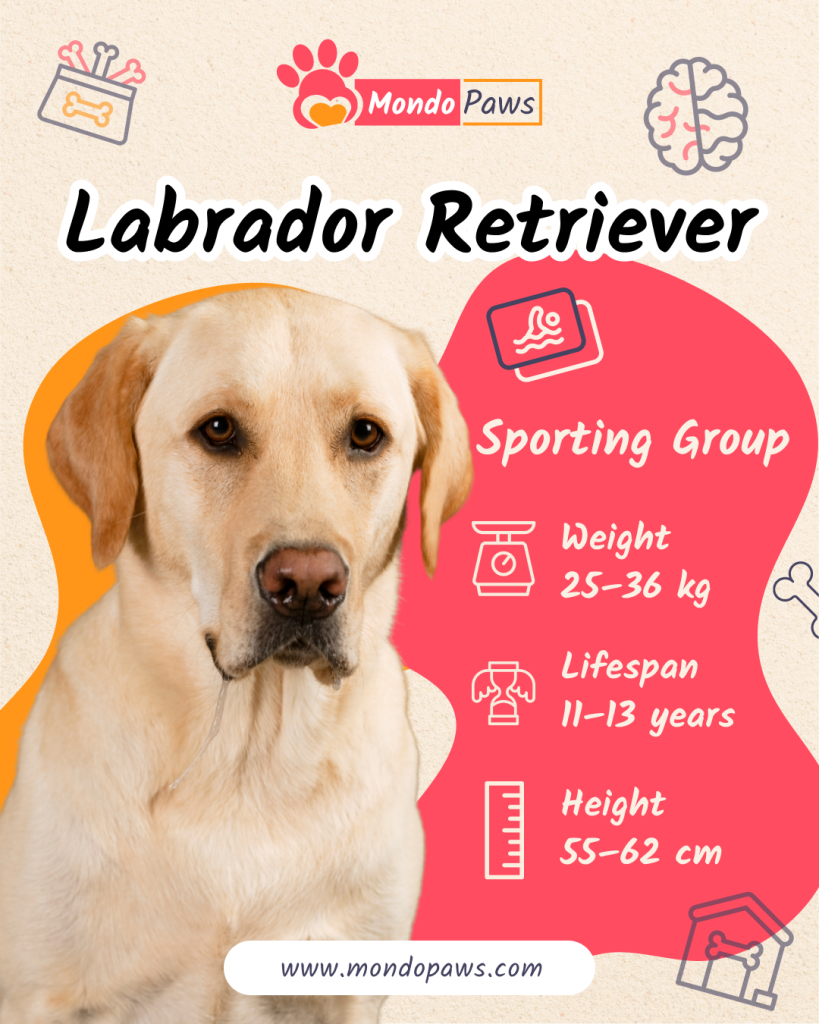
Labs have an athletic, well-balanced build — a broad skull, “otter tail” that acts as a rudder in water, a short dense water-resistant double coat, and webbed feet built for swimming. Their soft, expressive eyes and ever-wagging tail give the breed its unmistakable friendly expression.
They are outgoing, high-energy, and firmly food-driven — Labradors would rather be retrieving a ball than sitting still. They ask for exercise and company in equal measure, dislike being left alone for long stretches, and reward an active household with boundless enthusiasm and loyalty.
Temperament & Personality
The Labrador Retriever personality is best described as outgoing, eager-to-please, and relentlessly social. They are friendly with nearly everyone, vocal when excited, and happiest with a job to do — carrying a toy, fetching a ball, or greeting the mail carrier like a long-lost friend. Female Labs are often a little more focused and independent, while males tend to be more openly goofy and affectionate.
Real Owner Insights: What Daily Life with a Labrador Is Actually Like
“Nobody tells you how much this breed thinks with its stomach. Our Lab, ‘Bear,’ will counter-surf for a stray crust of bread the second you turn your back. Measured meals and a sturdy dog gate saved us — free-feeding was not an option.”
— As shared by a Labrador owner on r/Labrador on Reddit
“Ours is the friendliest dog I’ve ever owned — genuinely no aggression in him, ever. But the energy is real. Skip his morning run and he’ll happily rearrange the couch cushions by 10am.”
— Shared by a Labrador owner in a breed group on Facebook
Core Performance Metrics
Breed comparison data breakdown — Labrador Retriever vs. standard breed benchmark.
With Family
Devoted Family Dog
Seeks constant company and enthusiastic play
With Strangers
Instant Friend
Greets nearly everyone with a wagging tail
Energy Level
High
Needs 60+ mins daily exercise
Trainability
High
Learns commands and retrieving work quickly
Behind the famous grin is a dog that asks for very little except exercise, purpose, and a family to shadow all day long.
Consistent, reward-based training is highly recommended. Resources from the American Society for the Prevention of Cruelty to Animals emphasize positive reinforcement for best results.
Trait Ratings
Personality Traits
Care Requirements
Labrador Retriever Summary Table
| Category | Verdict | Best for |
|---|---|---|
| Families with kids | Excellent | Sturdy, playful, and famously patient with children |
| First-time owners | Good | Easy to train, but needs real daily exercise |
| Apartment living | Not Ideal | High energy and size make a yard preferable |
| Allergy sufferers | Not Suitable | Heavy, year-round shedding double coat |
| Guard / watchfulness | Poor | Too friendly to be an effective guard dog |
| Active outdoor lifestyles | Excellent | Bred to work all day in water and field |
| Multi-pet households | Good | Sociable with other dogs when properly introduced |
| Budget-conscious owners | Moderate | Food volume and joint-related vet care add up |
Labrador Retriever Living Needs
Labradors suit almost any home as long as it comes with daily exercise, secure fencing, and space for an energetic body to move.
Space
Yard Preferred
Room to run matters more than square footage indoors
Children
Great With Kids
Sturdy and tolerant, though boisterous as a puppy
Heat Tolerance
Moderate
Dense double coat means shade and water breaks in summer
Other Pets
Generally Easy
Sociable and non-confrontational with most other animals
A Labrador does not need a mansion — it needs a fenced yard, a long walk, and a job to put its nose to.
Training and Exercise Needs
Labradors are working retrievers at heart. They pick up obedience, recall, and retrieving games quickly, and thrive on structured play — fetch, swimming, and scent games all channel their drive productively. Because they are food-motivated and prone to weight gain, aim for 60–90 minutes of real exercise daily, split into a mix of walks, off-leash play, and mental enrichment like puzzle feeders.
Exercise Allocation Profile (Weekly Ideal)
With Family
Devoted Family Dog
Picks up commands and retrieving games fast when started young
With Strangers
Instant Friend
Rarely wary of new people or noisy situations
Grooming & Coat Care
The Labrador coat is low-maintenance in length but high-volume in shedding: short, dense, and water-resistant, it blows out heavily twice a year and sheds steadily the rest of the time. Most owners settle into a weekly brushing routine, stepping up to daily during seasonal coat blows.
Coat Type
Short & Double
Brush weekly with a slicker brush or deshedding tool
Coat Colors
Three Recognized Colours
Black, yellow, and chocolate — sometimes in the same litter
Shedding
Heavy & Seasonal
Constant year-round, worst during spring and fall coat blows
Other Needs
Ears & Nails
Weekly ear checks (especially after swimming), fortnightly nails, regular dental care
A weekly brush and a dry-out after every swim does more for a Labrador’s coat and ears than any single grooming appointment.
Calm, positive routines are highly recommended. Resources from the American Society for the Prevention of Cruelty to Animals emphasize low-stress handling for best results.
Health & Common Concerns
The Labrador is a generally robust breed, but its size, activity level, and appetite create predictable issues. The main watch-points are joints, weight, ears, and eyes — all of which are far easier to manage with a responsibly bred, health-tested dog kept at a lean weight.
Hip & Elbow Dysplasia
Orthopedic · Structural
Obesity
Metabolic · Very Common
Exercise-Induced Collapse
Genetic · DNA Testing Advised
Ear Infections
Otic · Care-Sensitive
AKC & The Kennel Club Standards
According to official breed standards from the American Kennel Club (AKC) and The Kennel Club, the Labrador is defined by its strongly built, short-coupled body, broad skull, “otter” tail, dense water-resistant double coat, and kind, friendly expression.
Veterinary Genetics & Joint Screening
Feline and canine health resources such as the Orthopedic Foundation for Animals (OFA) note that hip and elbow dysplasia have historically been common in larger, fast-growing breeds like the Labrador. Responsible breeders now screen breeding dogs with hip and elbow evaluations and EIC/PRA DNA panels, so puppies from tested lines should come with documented clearances for their parents.
Relative Health Risk by Condition
Regular veterinary checkups and responsible breeding help reduce these risks.
Nutrition & Feeding
Labradors are high-activity dogs with a famously strong appetite and a genetic tendency toward weight gain, so calorie control, joint-supporting nutrients, and portion discipline matter more than for most breeds.
High-quality protein
Joint-support glucosamine
Weight-control formulas
Labradors are prone to gobbling food quickly, so many owners use slow-feeder bowls or puzzle feeders to reduce bloat risk and add mental stimulation to mealtime.
Measured meals beat free-feeding for this breed. According to PetMD, controlled-calorie diets, joint-supporting nutrients, and consistent portions support healthy weight, mobility, and long-term joint health in active dogs.
to find out more about dogs weight visit Dog Weight Calculator.
Ownership Cost Calculator
Labrador puppies from registered breeders typically sell for $1,000–$2,500, with field-trial and show lines running higher — food volume and joint care are the real long-term cost, not the purchase price. Adjust the inputs below for a personalised annual running-cost estimate. All figures are in USD and reflect US market averages.
Pros & Cons
Strengths
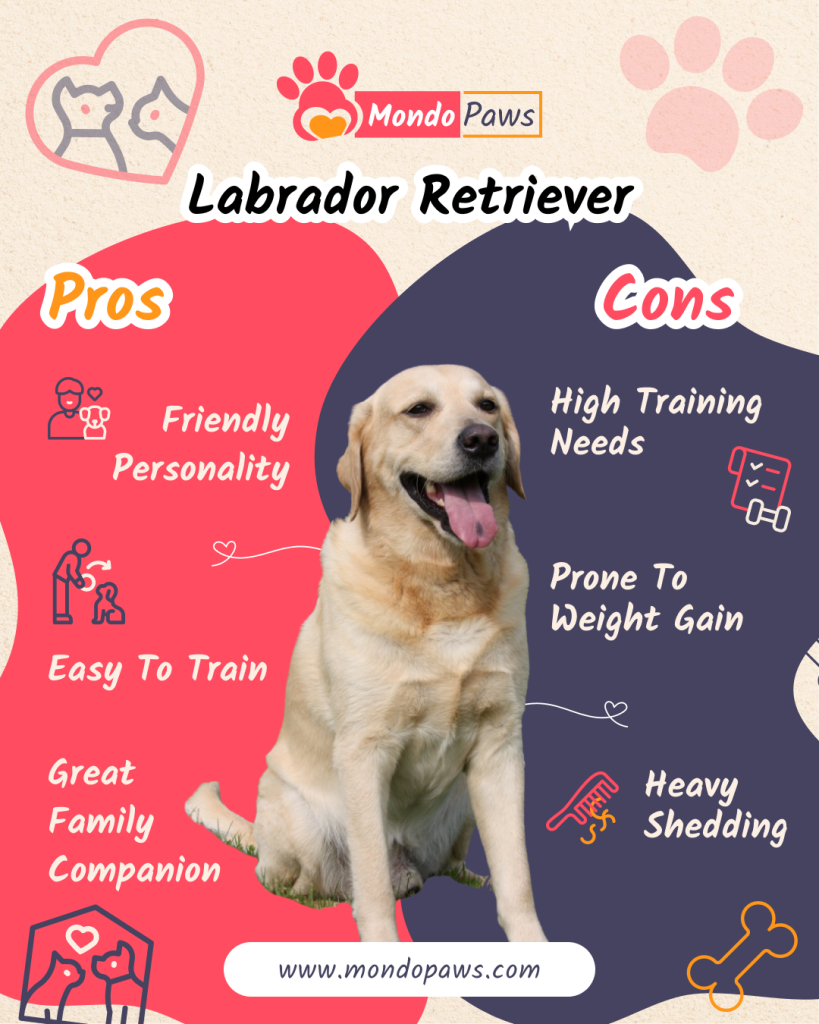
- Exceptionally friendly — rarely aggressive toward people or other dogs
- Highly trainable and eager to please
- Ideal active-family and outdoor-lifestyle companion
- Sturdy and low-maintenance short coat
- Excellent with children and most other pets
Challenges
- Needs 60+ minutes of real exercise daily — not a low-energy breed
- Strong, food-driven appetite makes weight management a lifelong task
- Heavy year-round shedding around the home
- Prone to hip, elbow, and other joint issues as they age
History of the Labrador Retriever
The Labrador’s origins trace back to Newfoundland, Canada, where a working water dog known as the St. John’s Water Dog helped local fishermen haul nets, retrieve fish, and pull lines through icy water — English trading ships are usually credited with carrying the breed’s ancestors across the Atlantic in the early 1800s.
Early imports were refined by English aristocrats into a dedicated retrieving gundog before the modern breed was fixed. Historians generally credit the breed’s development to:
Newfoundland fishing dogs, English sporting estates, and the Earls of Malmesbury’s breeding program
Refined on English shooting estates and later across America, the Labrador became the defining retriever of the modern gundog world. Selective breeding in the 20th century produced today’s field-line and show-line types, alongside the all-purpose family dog most owners know.
Here is a brief timeline of the Labrador Retriever’s history:
Early 1800s
The St. John’s Water Dog works alongside fishermen in Newfoundland, retrieving nets and fish from cold coastal waters.
1830s
English nobility, including the Earls of Malmesbury, import the dogs and begin developing them as retrieving gundogs.
1903
The Labrador Retriever is officially recognized by the Kennel Club in England.
1917
The American Kennel Club formally recognizes the breed, and it spreads quickly through American sporting and family homes.
1991–2022
The Labrador holds the AKC’s Most Popular Breed title for 31 consecutive years, becoming America’s default family dog.
Today:
The Labrador remains one of the world’s most popular purebred dogs, valued as a family companion, service and guide dog, and hunting retriever alike.
Modern breeding increasingly emphasizes health-tested hips, elbows, and eyes, keeping the breed’s working ability and temperament intact while managing its known joint and weight risks.
Fun Facts
Three Types
Labradors come in English (blockier show-line) and American (leaner field-line) types, in black, yellow, or chocolate
31-Year Reign
Held the AKC’s Most Popular Breed title from 1991 to 2022, longer than any other breed on record
Webbed Feet
Slightly webbed toes and an otter-like tail make Labradors natural, powerful swimmers
Working Roles
Widely used as guide dogs, search-and-rescue dogs, and detection dogs thanks to their trainability and nose
Still a Top Breed
Ranked #2 on the AKC’s 2025 most-popular-breeds list, behind only the French Bulldog
Frequently Asked Questions
Labrador puppies from registered breeders usually cost between $1,000 and $2,500, with field-trial and show-quality lines higher. Budget a further $1,500–$2,800 a year for food, vet care, and supplies — food volume and joint-related vet visits are the biggest ongoing expenses.
At least 60 to 90 minutes daily. Labradors are working retrievers bred for stamina, and without enough exercise and mental stimulation they can become destructive or gain excess weight. A mix of walks, fetch, and swimming works well.
Females are often slightly more independent and focused, maturing a bit faster than males. Males tend to be larger, more openly goofy, and more consistently affectionate — though both sexes are friendly, energetic, and highly trainable.
English (show-line) Labradors are blockier, stockier, and calmer, bred toward the breed standard for conformation shows. American (field-line) Labradors are leaner, taller, and higher-energy, bred for stamina in hunting and field trials. Both are the same breed, but energy level and build can differ noticeably.
Not ideally for apartments — their size, energy, and exercise needs are much better suited to a house with a yard. For families, they are outstanding: sturdy, patient, and endlessly playful with children, provided owners commit to daily exercise and weight management.
Behind the Research: How We Created This Labrador Retriever Guide
At Mondopaws, we believe pet guides should be grounded in both hard science and real-world care. To compile this Labrador Retriever profile, our editorial team:
- Cross-referenced official breed standards: Analyzed official documentation and care guidelines directly from the American Kennel Club (AKC), The Kennel Club, and long-established Labrador breed clubs.
- Consulted veterinary & clinical research: Verified breed-relevant conditions (such as hip and elbow dysplasia, exercise-induced collapse, and obesity) using material from the Orthopedic Foundation for Animals (OFA) along with clinical insights from the ASPCA and PetMD.
- Gathered authentic owner experiences: Evaluated real feedback, exercise routines, and temperament observations shared by verified Labrador owners across active pet forums and social media communities.
Final Thoughts
The Labrador Retriever is one of the friendliest, most versatile purebred dogs you can live with: outgoing, trainable, endlessly enthusiastic, and equally at home in the field, the water, or on the living room floor. The trade-offs are real — daily exercise, heavy shedding, a hearty appetite that needs managing, and the joint issues that come with poorly bred, fast-growing lines.
For people who want an active, sociable companion and can commit to daily exercise, a health-tested Labrador Retriever — ideally from hip- and elbow-screened parents — is one of the most rewarding dogs in the world.
Written by the Mondo Paws Team
At Mondo Paws, we simply love pets! For this guide, we gathered and cross-checked key data on this breed from across the web, organizing everything in the clearest, most practical way possible so you can find what you need at a glance.