
Table of Contents
Working Breed · Germany
The Rottweiler is a powerfully built, deep-chested guardian breed descended from the drover dogs Roman legions brought across the Alps. Refined in the German town of Rottweil as a cattle-driving and cart-pulling dog, it is confident, self-assured, and famously devoted to its family — a serious working dog that still ranks among the most popular breeds in the world.
80–135 lbs
Weight
22–27″
Height
8–10 years
Lifespan
25 mph
Top Speed
Roman Era
Origin Era
Rank #9
Intelligence
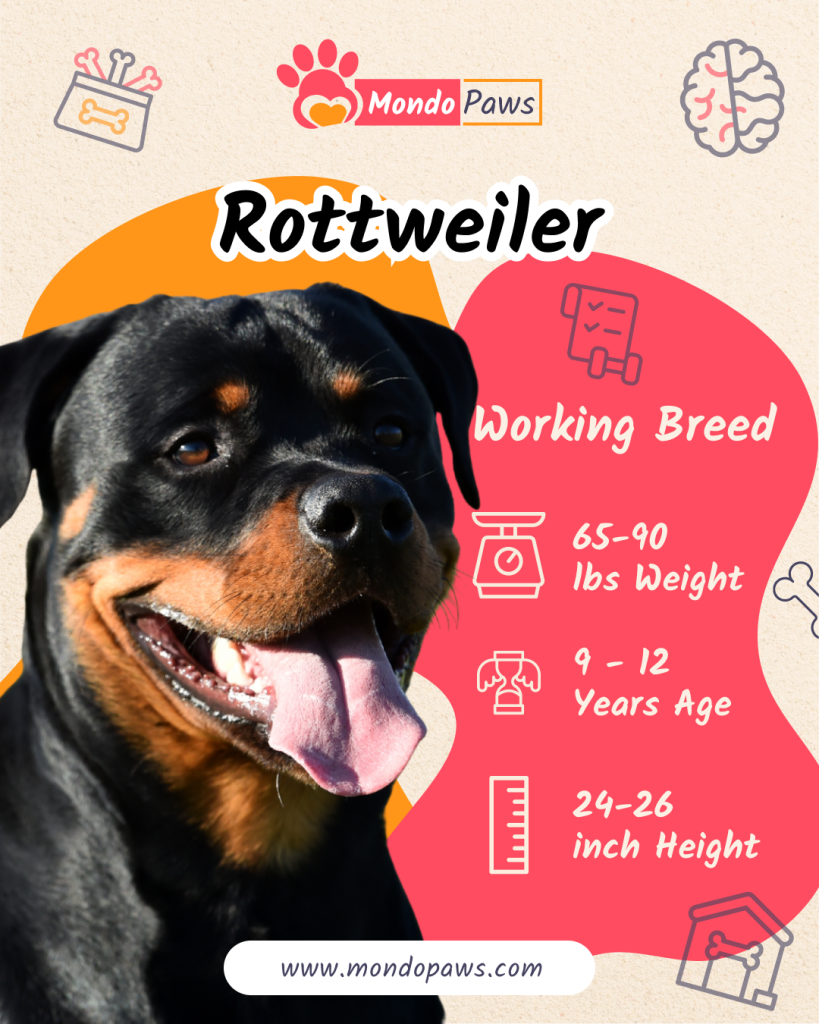
Rottweilers have a broad-skulled, muscular build — a deep chest, thick straight back, and heavily boned legs designed for pulling and endurance work. The dark, medium-sized eyes and alert, level expression give the breed its unmistakable air of quiet confidence.
They are calm and self-assured rather than hyperactive, but they are not couch dogs — Rottweilers are happiest with a job to do, a routine to follow, and a family to watch over. They bond intensely with their people, are naturally aloof with strangers, and reward structured training with steady, reliable loyalty.
Temperament & Personality
The Rottweiler personality is best described as confident, calm, and deeply loyal to its own family, with a natural wariness toward strangers. They are not naturally aggressive when well bred and properly socialized, but their size and protective instinct mean training and structure are non-negotiable. Females often mature a little faster and can be more independent, while males tend to be larger, more openly affectionate, and slower to settle mentally until 2–3 years old.
Real Owner Insights: What Daily Life with a Rottweiler Is Actually Like
“Nobody warned me how much of a velcro dog he’d be. Our Rottweiler, ‘Bruno,’ follows me from room to room and leans his whole body weight against my leg. He’s a total goofball at home but goes quiet and watchful the second a stranger walks up the driveway.”
— As shared by a Rottweiler owner on r/Rottweiler on Reddit
“Ours needed a real obedience class before six months old — not optional with a dog this strong. Once the training clicked, he turned into the calmest, most reliable dog we’ve ever owned. The shedding twice a year is the only real surprise.”
— Shared by a Rottweiler owner in a breed group on Facebook
Core Performance Metrics
Breed comparison data breakdown — Rottweiler vs. standard breed benchmark.
With Family
Loyal Guardian
Bonds fiercely and stays close to its people
With Strangers
Reserved, Not Shy
Watchful and aloof until properly introduced
Energy Level
Moderate–High
Needs 45–60 mins daily structured exercise
Trainability
High
Excels at obedience, protection, and service work
Behind the imposing frame is a dog that asks for structure, purpose, and a family it can watch over.
Early, consistent, reward-based training is highly recommended. Resources from the American Kennel Club emphasize positive reinforcement and structured socialization for best results.
Trait Ratings
Personality Traits
Care Requirements
Rottweiler Summary Table
| Category | Verdict | Best for |
|---|---|---|
| Families with kids | Good | Loyal and protective, but needs supervision given its size |
| First-time owners | Not Ideal | Strength and drive call for an experienced, confident handler |
| Apartment living | Moderate | Manageable indoors if daily exercise needs are met |
| Allergy sufferers | Not Suitable | Moderate year-round shedding and dander |
| Guard / watchfulness | Excellent | Naturally alert, territorial, and protective |
| Quiet indoor lifestyles | Not Ideal | Needs real daily activity and mental work |
| Multi-pet households | Moderate | Fine with early socialization and calm housemates |
| Budget-conscious owners | Not Ideal | Training, food volume, and orthopedic care add up |
Rottweiler Living Needs
Rottweilers do best in a home with a fenced yard, a consistent routine, and an owner willing to keep up with training and daily exercise.
Space
Needs Room to Move
A yard or regular access to open space is strongly preferred
Children
Supervised Only
Gentle and loyal once trained, but powerful enough to knock a child over
Heat Tolerance
Moderate
Dark, dense coat means shade and water are essential in summer
Other Pets
Needs Socialization
Can live peacefully with other pets when raised together and introduced early
A Rottweiler does not need a mansion — it needs a fence, a job, and a family that trains what it teaches.
Training and Exercise Needs
Rottweilers are working dogs at heart and pick up commands quickly, but their size makes early obedience training essential rather than optional. Puppy socialization classes, consistent boundaries, and reward-based handling from eight weeks on prevent the pushiness the breed can develop without structure. Aim for 45–60 minutes of real exercise daily — brisk walks, structured play, or activities like tracking, weight-pulling, or obedience sport — split across the day to keep both body and mind engaged.
Exercise Allocation Profile (Weekly Ideal)
With Family
Loyal Guardian
Thrives on structured play and clear leadership
With Strangers
Reserved, Not Shy
Relaxes once it reads the room as safe
Grooming & Coat Care
The Rottweiler coat is one of the breed’s lower-maintenance traits: short, straight, and dense, it sheds moderately year-round with two heavier seasonal blowouts. Most owners settle into a weekly brushing routine with a rubber curry brush or deshedding tool, stepping up to a few times a week during spring and fall.
Coat Type
Short & Double
Brush weekly with a rubber curry brush
Coat Colors
Black & Tan/Mahogany
The only markings recognized by the breed standard
Shedding
Seasonal Blowout
Moderate year-round, heavier in spring and fall
Other Needs
Ears, Nails & Teeth
Weekly ear checks, fortnightly nails, regular dental care
Five minutes of brushing a week is plenty — the real grooming challenge is keeping up with the vacuum during shedding season.
Calm, positive handling routines are highly recommended. Resources from the American Kennel Club emphasize low-stress handling and early coat-care conditioning for best results.
Health & Common Concerns
The Rottweiler is a generally sturdy breed, but its large frame and rapid growth create predictable orthopedic and cardiac watch-points. The main areas to monitor are joints, heart, digestion, and weight — all far easier to manage with a responsibly bred dog from health-screened parents.
Hip & Elbow Dysplasia
Orthopedic · Genetic
Osteosarcoma
Bone Cancer · Large-Breed Risk
Bloat (GDV)
Digestive · Emergency Risk
Subaortic Stenosis
Cardiac · Screening Advised
American Kennel Club (AKC) Breed Standard
According to the official breed standard from the American Kennel Club (AKC), the Rottweiler is defined by its medium-large, robust and powerful build, broad skull, dark almond-shaped eyes, and distinctive black coat with rust-to-mahogany markings.
Orthopedic & Cardiac Screening
Veterinary resources such as the Orthopedic Foundation for Animals (OFA) note that hip and elbow dysplasia have historically been common in large working breeds like the Rottweiler. Responsible breeders now screen breeding stock for hips, elbows, and heart before pairing them, so puppies from health-tested lines carry a meaningfully lower risk.
Relative Health Risk by Condition
Regular veterinary checkups and responsible breeding help reduce these risks.
Nutrition & Feeding
Rottweilers are large, heavy-boned dogs prone to obesity and joint strain, so calorie control, joint-supporting nutrients, and careful puppy growth management matter more than for most breeds.
Large-breed protein
Joint-support nutrients
Controlled puppy growth
Rottweiler puppies grow fast, so a large-breed puppy formula with controlled calcium and phosphorus helps prevent developmental joint problems. Many owners split meals into two servings a day rather than one large one, and avoid vigorous exercise right before or after eating, to reduce bloat risk.
According to the American Kennel Club, weight-appropriate portions, joint-friendly supplements such as glucosamine and chondroitin, and consistent feeding schedules support mobility, digestion, and long-term joint health in large-breed dogs.
to find out more about dogs weight visit Dog Weight Calculator.
Ownership Cost Calculator
Rottweiler puppies from registered breeders typically sell for $1,500–$3,000, with working- and show-line pedigrees running higher — food volume, training, and orthopedic vet care are the real long-term costs, not the purchase price. Adjust the inputs below for a personalised annual running-cost estimate. All figures are in USD and reflect US market averages.
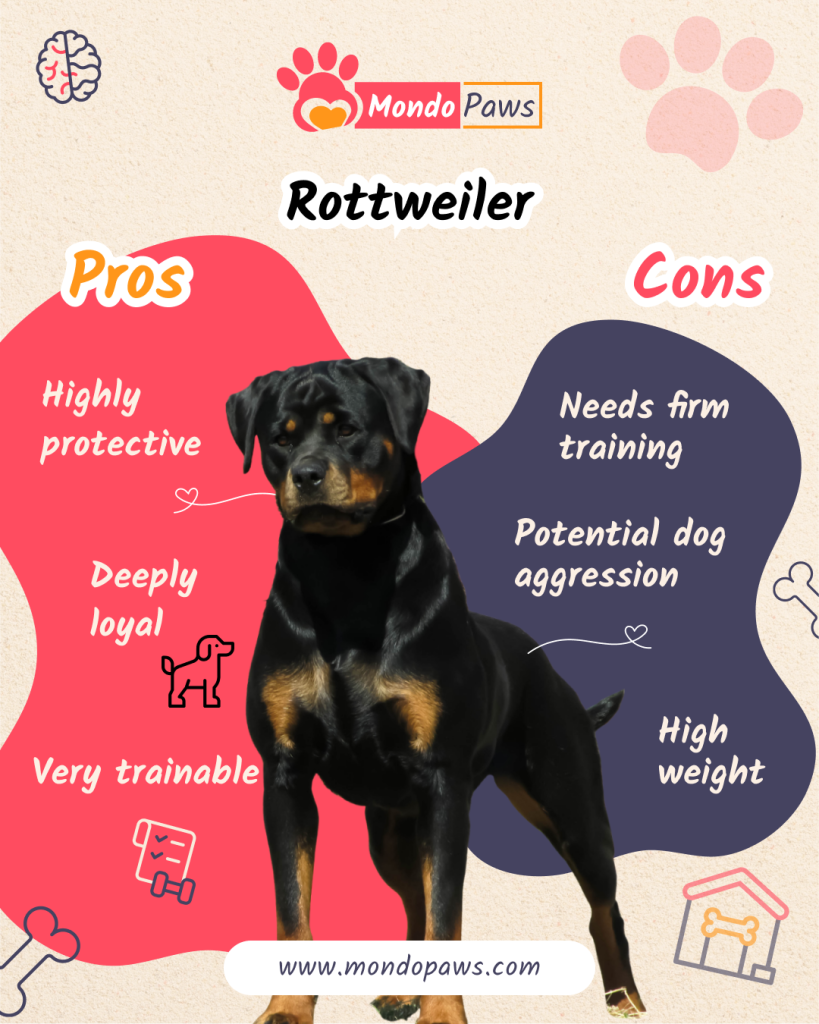
Pros & Cons
Strengths
- Intensely loyal and protective of its family
- Highly trainable — excels at obedience and working roles
- Low-maintenance short coat with minimal grooming needs
- Naturally alert, making it an excellent watchdog
- Calm and steady once mature, from roughly age three onward
Challenges
- Early training and socialization are non-negotiable
- Size and strength make it unsuitable for inexperienced owners
- Prone to hip/elbow dysplasia and other large-breed health issues
- Moderate-to-heavy drooling and a real tendency to gain weight
History of the Rottweiler
The Rottweiler’s origins trace back to Roman drover dogs, mastiff-type cattle-herding dogs that marched with Roman legions across the Alps to supply troops with fresh meat along the way — the trade town of Rottweil, in what is now southern Germany, became the breed’s namesake and heartland.
For centuries these descendants worked as the “Rottweiler Metzgerhund,” or butcher’s dog, driving cattle to market and pulling carts loaded with meat. Historians generally credit the breed’s development to:
Roman mastiff-type drovers, local German herding stock, and centuries of selective working-dog breeding around Rottweil
By the late 1800s, railways had replaced cattle drives and the breed nearly vanished. A small group of enthusiasts revived it in the early 20th century, and the Rottweiler found new purpose as a police, military, and service dog, cementing its reputation as one of the most capable working breeds in the modern world.
Here is a brief timeline of the Rottweiler’s history:
Roman Era
Mastiff-type drover dogs accompany Roman legions across the Alps, herding cattle for food supply.
Middle Ages
Descendants settle around Rottweil, Germany, working as cattle drovers and cart-pulling butcher’s dogs.
Late 1800s
Cattle droving is banned and railways take over transport; the breed’s numbers collapse to near extinction.
1921
The Allgemeiner Deutscher Rottweiler-Klub (ADRK), the German national breed club, is founded to standardize and revive the breed.
1931
The American Kennel Club officially recognizes the Rottweiler as a breed.
Today:
The Rottweiler remains one of the world’s most popular working and companion breeds, valued for its loyalty and versatility in police, service, and family roles.
Modern breeding increasingly favours temperament testing and orthopedic health screening, preserving the breed’s working drive while reducing structural health risks.
Fun Facts
Ancient Roots
Descended from Roman cattle-drover dogs that marched with the legions nearly 2,000 years ago
1921
Germany’s national Rottweiler club (ADRK) is founded to rescue the breed from near-extinction
Working Titles
Widely used as police, military, search-and-rescue, and therapy dogs
One Color Pattern
Unlike many breeds, only black with rust-to-mahogany markings is recognized by breed standards
Top Breed
Consistently ranks among the AKC’s most-registered breeds in the United States
Frequently Asked Questions
Rottweiler puppies from registered breeders usually cost between $1,500 and $3,000, with working- and show-line pedigrees higher. Budget a further $2,000–$3,500 a year for food, training, and veterinary care — food volume and orthopedic care are the biggest ongoing expenses.
At least 45–60 minutes of active exercise daily, plus mental work like obedience training or puzzle toys. Without enough outlet for their energy and drive, Rottweilers can become bored, pushy, or destructive.
Well-bred, properly socialized Rottweilers are confident and self-assured rather than aggressive, though their protective instinct and size make training and early socialization essential. Temperament varies significantly by breeding line and how the individual dog is raised.
Yes, moderately and year-round, with two heavier seasonal blowouts in spring and fall. The short double coat is otherwise low-maintenance — weekly brushing with a rubber curry brush is usually enough outside shedding season.
Generally not recommended for first-time owners — the breed’s size, strength, and drive call for a confident handler committed to consistent training. For experienced families, especially those with older, calm children, a well-socialized Rottweiler can be an exceptionally loyal companion.
Behind the Research: How We Created This Rottweiler Guide
At Mondopaws, we believe pet guides should be grounded in both hard science and real-world care. To compile this Rottweiler breed profile, our editorial team:
- Cross-referenced official breed standards: Analyzed official documentation and care guidelines directly from the American Kennel Club (AKC) and the German national Rottweiler club, the ADRK.
- Consulted veterinary & clinical research: Verified breed-relevant conditions (such as hip and elbow dysplasia, bloat, and osteosarcoma) using material from the Orthopedic Foundation for Animals (OFA) along with clinical insights from AKC and PetMD.
- Gathered authentic owner experiences: Evaluated real feedback, training routines, and temperament observations shared by verified Rottweiler owners across active pet forums and social media communities.
Final Thoughts
The Rottweiler is one of the most capable and devoted working breeds you can live with: confident, protective, low-maintenance to groom, and deeply loyal to its family. The trade-offs are real — consistent training from puppyhood, daily exercise, moderate shedding, and the orthopedic and health issues that come with poorly bred or under-socialized lines.
For experienced owners who want a serious, structured companion and are ready to commit to training and daily activity, a health-tested, well-socialized Rottweiler is one of the most rewarding dogs in the world.
Written by the Mondo Paws Team
At Mondo Paws, we simply love pets! For this guide, we gathered and cross-checked key data on this breed from across the web, organizing everything in the clearest, most practical way possible so you can find what you need at a glance.
