
Table of Contents
Primitive Breed · Thailand
The Thai Ridgeback is one of only three ridgeback breeds in the world — a muscular, medium-sized pariah-type dog that developed naturally in rural Thailand as a hunter, guard dog, and village companion. Best known for the distinctive strip of hair running against the rest of its coat, the breed is fiercely loyal to family, naturally suspicious of strangers, and astonishingly athletic. It is still a rare sight outside its homeland, but its self-cleaning coat, minimal health issues, and striking looks are winning it fans worldwide.
35–55 lbs
Weight
20–24″
Height
12–13 years
Lifespan
30 mph
Top Speed
Antiquity
Origin Era
Rare
Global Availability
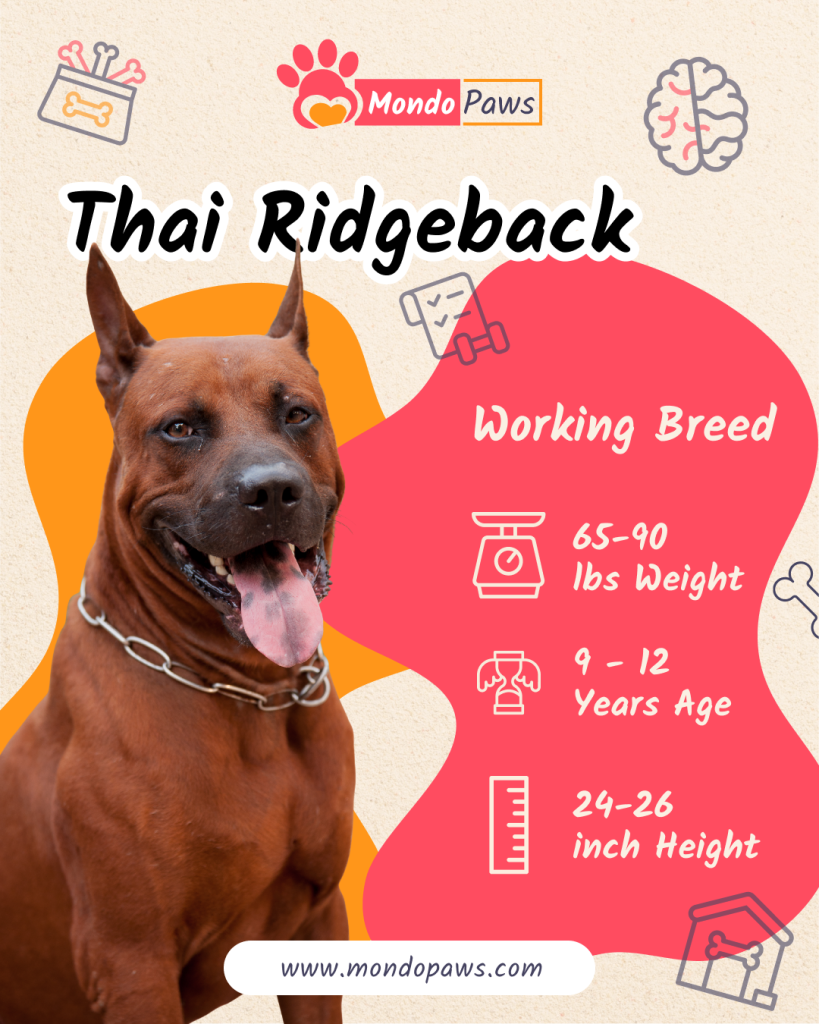
Thai Ridgebacks are square, powerful dogs with a deep chest, tucked-up waist, prick ears, and a wedge-shaped head that gives them an alert, almost feral expression. The ridge itself can form one of eight recognised patterns — from a single needle to a violin shape — and the short, smooth coat comes in blue, black, red, and fawn, often with black masking.
They are intelligent problem-solvers, intensely bonded to their own people, and naturally territorial. A Thai Ridgeback does not want to meet every stranger; it wants to assess them first. That independence, combined with serious jumping and climbing ability, makes the breed a project for an experienced, committed owner.
Temperament & Personality
The Thai Ridgeback personality is best described as confident, watchful, and deeply loyal to a small inner circle. They are calm indoors when exercised, but always aware of their surroundings. Females are often more independent and territorial; males tend to be more openly affectionate and slightly more tolerant of strangers.
Real Owner Insights: What Daily Life with a Thai Ridgeback Is Actually Like
“She is the most loyal dog I’ve ever had, but she owns me, not the other way around. Guests don’t get to pet her until she decides they’re acceptable — usually after three or four visits. And the jumping? She can clear a six-foot fence without a run-up.”
— As shared by a Thai Ridgeback owner on r/dogs on Reddit
“Grooming is basically non-existent. He sheds so little I vacuum once a week and it’s fine. The hard part is the socialisation — if you miss that window, you end up with a beautiful guard dog that doesn’t trust anyone.”
— Shared by a Thai Ridgeback owner in a breed group on Facebook
Core Performance Metrics
Breed comparison data breakdown — Thai Ridgeback vs. standard breed benchmark.
With Family
Devoted & Protective
Fiercely loyal, often following one person in particular
With Strangers
Reserved & Wary
Natural suspicion; early socialisation is essential
Energy Level
High
Needs 60–90 mins daily exercise plus mental work
Trainability
Challenging
Smart but self-directed; needs patient, consistent leader
A Thai Ridgeback is not aloof — it is simply deciding whether you are family, friend, or threat before it commits.
Short, reward-based sessions work far better than repetition drills. Resources from the American Society for the Prevention of Cruelty to Animals emphasize positive reinforcement and extensive early socialisation for independent primitive breeds.
Trait Ratings
Personality Traits
Care Requirements
Thai Ridgeback Summary Table
| Category | Verdict | Best for |
|---|---|---|
| Families with kids | Moderate | Loyal and tolerant with respectful older children |
| First-time owners | Not Ideal | Strong-willed and territorial; needs confident leadership |
| Apartment living | Moderate | Possible if exercise is generous and space is secure |
| Allergy sufferers | Good | Very short coat, minimal shedding and little dog odour |
| Guard / watchfulness | Excellent | Natural watchdog with strong territorial instinct |
| Off-leash freedom | Not Suitable | High prey drive and independent streak — secure areas only |
| Multi-pet households | Not Ideal | Same-sex tension and strong prey drive are common |
| Budget-conscious owners | Good | Low grooming costs and generally robust health |
Thai Ridgeback Living Needs
A Thai Ridgeback suits an active home with secure, high fencing, clear leadership, and plenty of early socialisation.
Space
Secure Fencing First
Six-foot minimum; this breed climbs and jumps with ease
Children
Older Kids Best
Loyal with family, but may not tolerate rough handling
Climate
Warm Climate
Short coat tolerates heat well; needs shelter from cold
Other Pets
Needs Care
High prey drive; cats and small pets are a real risk
A Thai Ridgeback does not need a palace — it needs a fence it cannot clear, a leader it respects, and a job that tires both body and mind.
Training and Exercise Needs
Thai Ridgebacks are athletic, independent dogs bred to hunt and guard without human direction. They learn quickly but question authority constantly, so training must be consistent, fair, and engaging. Recall is rarely trustworthy off-leash, and their vertical leap means physical boundaries matter as much as verbal ones. Plan on 60–90 minutes of daily activity split between brisk walking, free running in a secure area, and mentally demanding work such as tracking, agility, or obedience games.
Exercise Allocation Profile (Weekly Ideal)
With Family
Devoted & Protective
Works for food and respect, not empty praise
With Strangers
Reserved & Wary
Early, repeated socialisation prevents over-guarding
Grooming & Coat Care
Grooming is one of the easiest parts of Thai Ridgeback ownership. The coat is short, tight, and naturally clean, with very little odour and minimal shedding. A weekly wipe-down with a damp cloth or rubber mitt, regular nail trims, and occasional baths are usually all that is needed.
Coat Type
Short & Single
Weekly rub-down with a hound glove or soft cloth
Coat Colours
Four Main Colours
Blue, black, red, and fawn — often with black masking
Shedding
Minimal
Short, fine hair; very little visible hair around the home
The Ridge
Eight Patterns
Needle, feather, arrow, lute, violin, leaf, saddleback, and bowling pin
You will spend far more time checking your fences than you will brushing a Thai Ridgeback.
Calm, positive handling routines are highly recommended. Resources from the American Society for the Prevention of Cruelty to Animals emphasize low-stress nail and ear handling introduced in puppyhood.
Health & Common Concerns
The Thai Ridgeback is generally a robust, healthy breed thanks to its long history as a natural landrace. However, a few conditions are known to occur, and reputable breeders screen for them. Dermoid sinus — a congenital neural tube defect associated with the ridge gene — is the most important puppy-check item.
Dermoid Sinus
Neural Tube · Puppy Screening Essential
Hip Dysplasia
Orthopedic · Screening Recommended
Hypothyroidism
Endocrine · Manageable
Bloat / GDV
Digestive · Deep-Chested Risk
AKC & Breed Club Standards
According to official breed documentation from the American Kennel Club and the Thai Ridgeback Club of the United States, the Thai Ridgeback is defined by its muscular, square outline, prick ears, wedge-shaped head, and the distinctive ridge of hair along the back formed by hairs growing in the opposite direction to the rest of the coat.
Veterinary & Puppy Screening
Canine health resources and breed-specific guidance note that dermoid sinus is the most important congenital issue to rule out in ridgeback puppies. Affected puppies may have a small opening or tract along the ridge that can connect to the spine; responsible breeders have puppies examined by a veterinarian before placement. Routine hip evaluation and thyroid monitoring are also sensible as the dog matures.
Relative Health Risk by Condition
Regular veterinary checkups and responsible, screened breeding help reduce these risks.
Nutrition & Feeding
Thai Ridgebacks are lean, muscular dogs with fast metabolisms. Most adults do well on roughly 1½ to 2½ cups of quality food a day, split into two measured meals. Because the breed is deep-chested, avoiding bloat is important: no vigorous exercise right after eating, and consider a slow feeder.
High-quality protein
Moderate fat & carbs
Bloat prevention
Because the breed is active and naturally lean, sudden weight loss, low energy, or a dull coat should prompt a vet check rather than a simple diet tweak.
Slow feeders and puzzle bowls are worth using a Thai Ridgeback fed too fast is a Thai Ridgeback at higher risk for bloat. According to PetMD, measured portions, age-appropriate formulas, and constant fresh water support lean muscle condition and long-term health in active primitive breeds.
to find out more about dogs weight visit Dog Weight Calculator.
Ownership Cost Calculator
Thai Ridgeback puppies from registered, health-screened breeders typically sell for $1,000–$3,000, and litters are still uncommon outside Thailand. The real long-term costs are secure fencing, professional training, and routine screening rather than grooming. Adjust the inputs below for a personalised annual running-cost estimate. All figures are in USD and reflect US market averages.
Pros & Cons
Strengths
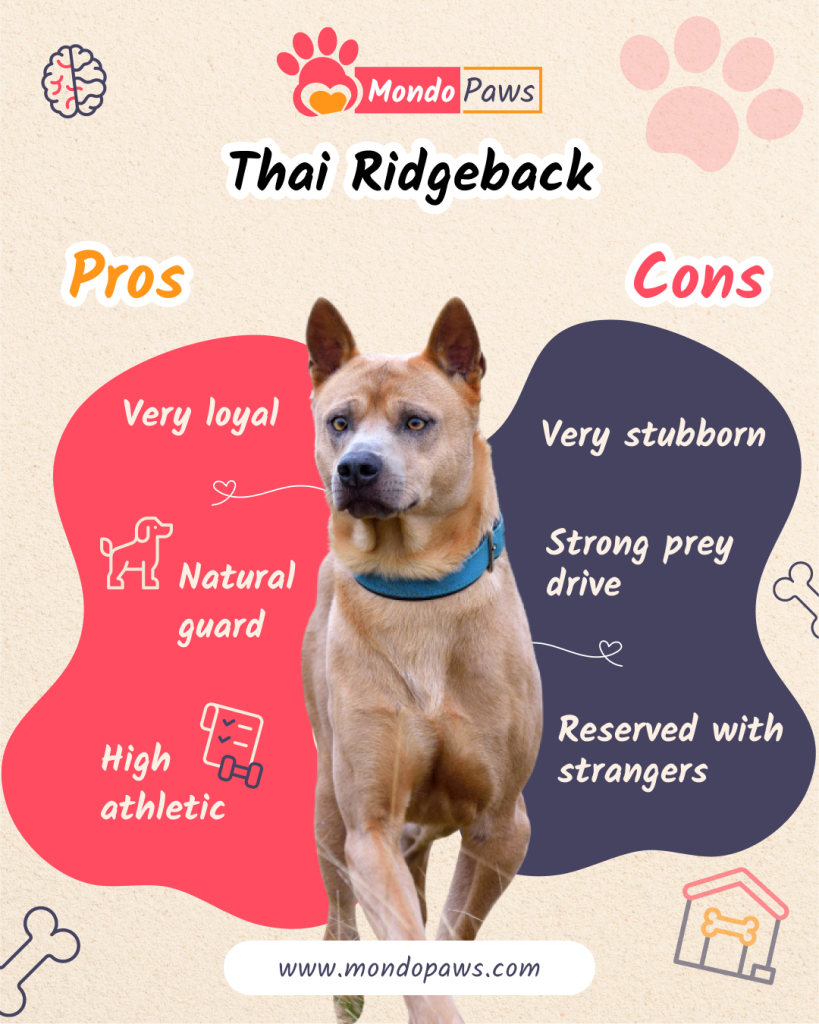
- Minimal grooming and very little shedding
- Natural watchdog with strong territorial instinct
- Generally robust health and long lifespan for a primitive breed
- Clean, odour-free coat that rarely needs bathing
- Intensely loyal and bonded to its own family
Challenges
- Strong-willed and independent — not for passive owners
- Aloof with strangers; can become over-protective without socialisation
- High prey drive and athletic escape ability — secure fencing is essential
- Can be dog-selective, especially same-sex
- Rare outside Thailand, so finding a responsible breeder takes effort
History of the Thai Ridgeback
The Thai Ridgeback’s origins lie in eastern Thailand, where it developed for centuries as an isolated landrace on islands and in rural provinces. Dogs of this type were kept by farmers and fishermen for hunting wild boar, guarding property, and controlling vermin. The breed’s ridge is thought to have arisen from a natural mutation that became fixed through generations of selective local breeding.
Because Thailand was rarely invaded and had limited dog imports for much of its history, the Thai Ridgeback remained remarkably pure and little altered by Western breeding. Modern lines trace back to:
Rural Thailand, particularly the eastern provinces and islands such as Phu Quoc and Koh Chang
Recognised first in Thailand and later by major international kennel clubs, the Thai Ridgeback has become a symbol of the country’s native dog heritage. Its primitive traits — including the ridge, the independent hunting style, and the annual or biannual breeding cycle — mark it as one of the world’s truly ancient dog types.
Here is a brief timeline of the Thai Ridgeback’s history:
Antiquity
Primitive ridged dogs live alongside Thai villagers as hunters, guardians, and companions in isolated rural communities.
1600s–1800s
European travellers note the unusual ridged dogs of Siam, but the breed remains almost unknown outside Thailand.
1950s–1970s
The breed is formally documented and promoted within Thailand; the first breed standard is developed by Thai fanciers.
1993
The FCI (Fédération Cynologique Internationale) recognises the Thai Ridgeback, introducing it to the international show world.
1994
The American Kennel Club adds the Thai Ridgeback to its Foundation Stock Service, and full recognition follows in 1997.
2000s–Present
Small numbers are exported worldwide; breed clubs focus on preserving health, temperament, and the authentic ridge structure.
Today:
The Thai Ridgeback remains a rare breed globally but is treasured in Thailand as a national dog. Modern breeding prioritises dermoid-sinus screening, stable temperament, and keeping the athletic, moderate structure that lets the breed still work as a hunter and guardian.
Enthusiasts outside Thailand are drawn to its low-maintenance coat, striking appearance, and loyal, one-family nature.
Fun Facts
The Ridge
One of only three ridged breeds worldwide, alongside the Rhodesian Ridgeback and Phu Quoc Ridgeback
Eight Patterns
The ridge can form a needle, feather, arrow, lute, violin, leaf, saddleback, or bowling pin shape
Natural Landrace
Developed without Western interference for centuries, so it retains many primitive dog traits
Blue Tongue
Many Thai Ridgebacks have blue or spotted tongues, similar to Chow Chows and Shar-Peis
Jumping Athlete
Known for clearing impressive heights from a standstill — fences are a suggestion, not a barrier
Frequently Asked Questions
Thai Ridgeback puppies from registered, health-screened breeders usually cost between $1,000 and $3,000, and waiting lists are common because litters are still relatively rare outside Thailand. Budget a further $1,800–$2,800 a year for food, insurance, training, and veterinary care.
They can be excellent family dogs for the right household — loyal, calm indoors, and devoted to their people. They do best with older children who understand boundaries and with owners who can provide consistent leadership and early socialisation.
They are intelligent but independent, and they do not respond well to harsh or repetitive training. Short, reward-based sessions with a confident handler work best. Recall is rarely reliable off-leash, so secure areas are essential for free exercise.
No dog is truly hypoallergenic, but the Thai Ridgeback comes closer than many: the coat is very short, shedding is light, and the breed produces little dog odour. Many mild allergy sufferers cope well with one, though a trial visit before committing is always sensible.
They are not typically nuisance barkers, but they are alert watchdogs and will bark to announce strangers or anything unusual around their territory. With good socialisation, this watchdog instinct stays useful rather than excessive.
Behind the Research: How We Created This Thai Ridgeback Guide
At Mondopaws, we believe pet guides should be grounded in both hard science and real-world care. To compile this Thai Ridgeback breed profile, our editorial team:
- Cross-referenced official breed standards: Analyzed official documentation and care guidelines directly from the American Kennel Club (AKC), FCI, and the Thai Ridgeback Club of the United States.
- Consulted veterinary & clinical research: Verified breed-relevant conditions (such as dermoid sinus, hip dysplasia, and hypothyroidism) using material from veterinary genetics resources, OFA screening guidance, and clinical insights from the ASPCA and PetMD.
- Gathered authentic owner experiences: Evaluated real feedback, training struggles, socialisation advice, and temperament observations shared by verified Thai Ridgeback owners across active pet forums and social media communities.
Final Thoughts
The Thai Ridgeback is one of the most striking low-maintenance dogs you can live with: short coat, minimal shedding, natural cleanliness, impressive athleticism, and fierce loyalty to its chosen people. The trade-offs are equally real — a strong will, natural suspicion of strangers, a talent for escaping, and a need for confident, consistent leadership.
If you have the experience to provide firm but fair guidance, secure boundaries, and daily mental and physical exercise, the Thai Ridgeback offers a unique partnership with a dog that feels less like a pet and more like a primitive companion from another century.
Written by the Mondo Paws Team
Explore More Primitive & Hound Dog Breeds
If you enjoyed learning about the Thai Ridgeback, you may also like our guides to the Basenji