Table of Contents
Hound Breed · Central Africa (Congo Basin)
The Basenji is the world’s best-known “barkless dog” — a small, short-coated sighthound-scenthound cross from Central Africa, used for centuries by Congo Basin hunters to drive game into nets. Instead of barking it yodels, a sound owners call the baroo. Elegant, fastidiously clean, and famously independent, it behaves less like a typical dog and more like a cat with a hunting licence.
22–24 lbs
Weight
16–17″
Height
13–14 years
Lifespan
30 mph
Top Speed
Antiquity
Origin Era
Rank #78
Obedience Intelligence
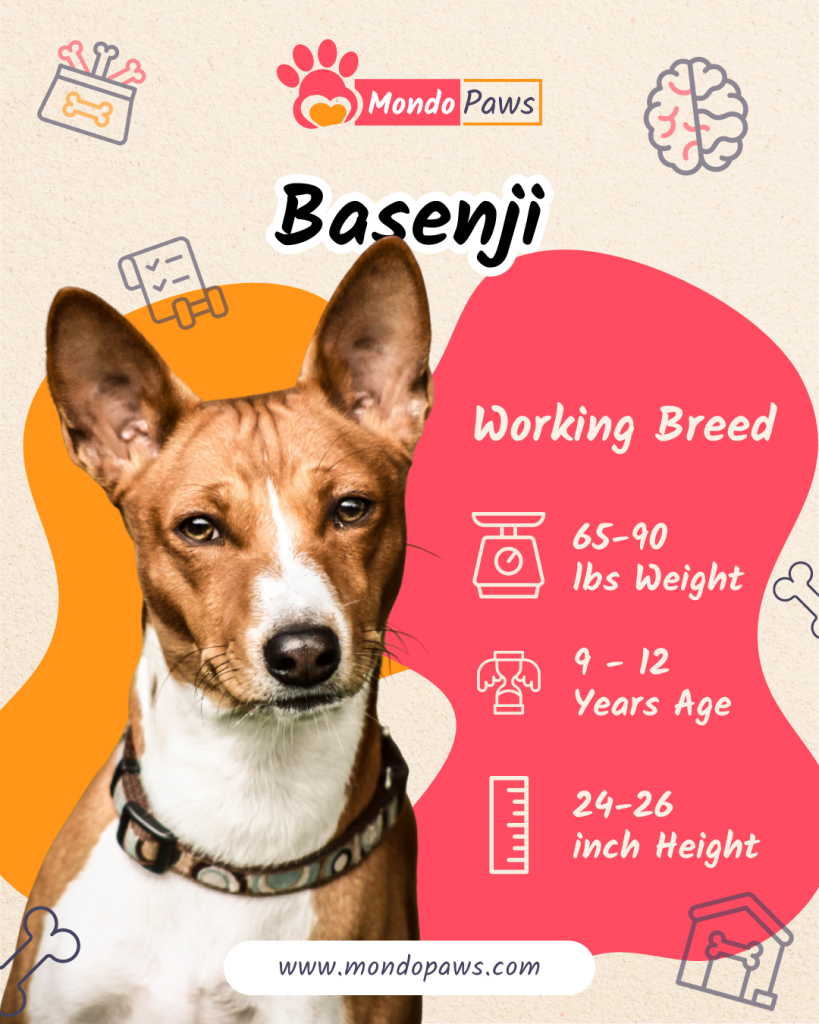
Basenjis are square, lightly built dogs with a level topline, long legs, a tightly curled tail, and a fine wrinkled brow that gives the breed its permanently thoughtful expression. Erect ears, almond eyes, and a short glossy coat in red, black, brindle, or tricolour — always with white feet, chest, and tail tip — complete the picture.
They are affectionate with their own people, aloof with strangers, and relentlessly curious. A Basenji does not work for you; it decides whether your request is worth its time. That independence, combined with a serious prey drive, is what makes the breed so rewarding for the right owner and so frustrating for the wrong one.
Temperament & Personality
The Basenji personality is best described as clever, self-directed, and mischievous. They bond tightly with their household, greet strangers with reserve rather than hostility, and spend a startling amount of the day inventing things to do. Females are often the more decisive and territorial of the two sexes; males tend to be goofier, more openly affectionate, and slightly easier to live with alongside other dogs.
Real Owner Insights: What Daily Life with a Basenji Is Actually Like
“Barkless does not mean quiet. Ours screams like a pterodactyl when the mail comes and yodels every single time we get home. What nobody warns you about is the counter-surfing — our girl opened the bin, the fridge, and a child-locked cupboard in the same week.”
— As shared by a Basenji owner on r/Basenji on Reddit
“He has never once come back when called off-leash, so he simply never goes off-leash outside a fenced field. Inside the house he’s the cleanest, most odourless dog I’ve ever owned — he grooms himself like a cat and I bath him maybe twice a year.”
— Shared by a Basenji owner in a breed group on Facebook
Core Performance Metrics
Breed comparison data breakdown — Basenji vs. standard breed benchmark.
With Family
Devoted but Wilful
Close, affectionate, and permanently up to something
With Strangers
Aloof & Watchful
Polite distance rather than instant friendship
Energy Level
High
Needs 60–90 mins daily exercise plus mental work
Trainability
Challenging
Learns fast, complies only when it suits them
A Basenji is not disobedient — it has simply weighed your instruction against its own plan and found yours less interesting.
Short, reward-based sessions work far better than repetition drills. Resources from the American Society for the Prevention of Cruelty to Animals emphasize positive reinforcement and early socialisation for independent hound breeds.
Trait Ratings
Personality Traits
Care Requirements
Basenji Summary Table
| Category | Verdict | Best for |
|---|---|---|
| Families with kids | Moderate | Playful and sturdy, but dislikes rough or clumsy handling |
| First-time owners | Not Ideal | Escape-prone, selectively deaf, needs experienced handling |
| Apartment living | Good | Small, odourless and barkless — if exercise needs are met |
| Allergy sufferers | Good | Very short coat, minimal shedding and almost no dog odour |
| Guard / watchfulness | Moderate | Alert and observant, but will not bark a warning |
| Off-leash freedom | Not Suitable | Strong prey drive and unreliable recall — fenced areas only |
| Multi-pet households | Not Ideal | Risky with cats and small pets; same-sex dog friction is common |
| Budget-conscious owners | Good | Low grooming costs, though Fanconi screening is essential |
Basenji Living Needs
A Basenji suits almost any size of home as long as it is securely fenced, warm, mentally stimulating, and Basenji-proofed.
Space
Secure Fencing First
Six-foot fences and no climbable furniture near them
Children
Older Kids Best
Fun and energetic, but has limited patience for pestering
Cold Tolerance
Low
Thin coat and little body fat — coats needed in winter
Other Pets
Needs Care
High prey drive; cats and small pets are a real risk
A Basenji does not need a big home — it needs a fence it cannot beat, a job for its brain, and a warm bed to burrow into.
Training and Exercise Needs
Basenjis learn quickly and comply selectively. They were bred to hunt independently, out of sight of the handler, so recall is the hardest skill of all — most experienced owners simply never trust it outdoors. Keep sessions to five or ten minutes, pay generously in food, and end while the dog is still interested. Plan on 60–90 minutes of daily activity split between a long walk, a sprint in a fenced space, and scent games or puzzle feeders indoors.
Exercise Allocation Profile (Weekly Ideal)
With Family
Devoted but Wilful
Works happily for food, rarely for praise alone
With Strangers
Aloof & Watchful
Early, repeated socialisation prevents suspicion hardening
Grooming & Coat Care
Grooming is the easiest part of Basenji ownership. The coat is short, fine, and tight, the breed grooms itself like a cat, and it carries almost no dog odour. A weekly rubber-mitt session, regular nail trims, and a bath two or three times a year is genuinely the whole routine.
Coat Type
Short & Single
Weekly rub-down with a rubber mitt or hound glove
Coat Colours
Four Recognised
Red, black, brindle, and tricolour — all with white markings
Shedding
Minimal
Light and short-haired; little visible hair around the home
Other Needs
Nails, Ears & Teeth
Fortnightly nails, weekly ear checks, regular dental care
You will spend more time proofing your bins against a Basenji than you will ever spend brushing one.
Calm, positive handling routines are highly recommended. Resources from the American Society for the Prevention of Cruelty to Animals emphasize low-stress nail and ear handling introduced in puppyhood.
Health & Common Concerns
The Basenji is a hardy, naturally built breed with no exaggerated features, but it carries a small set of well-documented genetic conditions. Fanconi syndrome is the one every buyer should ask about — a DNA test exists, and reputable breeders use it.
Fanconi Syndrome
Kidney · DNA Testing Essential
Progressive Retinal Atrophy
Ocular · Genetic · Testable
Hypothyroidism
Endocrine · Manageable
IPSID (Malabsorption)
Digestive · Breed-Associated
AKC & Breed Club Standards
According to official breed documentation from the American Kennel Club and the Basenji Club of America, the Basenji is defined by its square, balanced outline, wrinkled forehead, erect ears, tightly curled tail, and a smooth, effortless double-suspension gallop.
Veterinary Genetics & Kidney Screening
Canine health resources such as the Cornell Riney Canine Health Center and the OFA’s breed testing requirements note that Fanconi syndrome — a kidney tubule defect causing sugar and protein loss in the urine — is strongly associated with the Basenji. A direct DNA test is now available, so puppies should come from parents documented as clear or from a clear-by-parentage line, and many owners also run monthly urine glucose strips from around three years of age.
Relative Health Risk by Condition
Regular veterinary checkups and responsible, DNA-tested breeding help reduce these risks.
Nutrition & Feeding
Basenjis are lean, athletic dogs with fast metabolisms and famously determined appetites for anything left on a counter. Roughly 1 to 1½ cups of quality food a day, split into two measured meals, suits most adults.
High-quality protein
Highly digestible carbs
Kidney-friendly hydration
Because malabsorption and Fanconi syndrome both occur in the breed, sudden weight loss, excessive drinking, or persistently loose stools always warrant a vet visit rather than a diet change.
Slow feeders and puzzle bowls are worth using a Basenji fed too fast is a Basenji looking for a second dinner. According to PetMD, measured portions, age-appropriate formulas, and constant fresh water support lean body condition and long-term kidney health in active hound breeds.
to find out more about dogs weight visit Dog Weight Calculator.
Ownership Cost Calculator
Basenji puppies from registered, health-tested breeders typically sell for $1,500–$2,500, and litters are uncommon enough that waiting lists are normal — the real long-term costs are secure fencing, training help, and Fanconi monitoring rather than grooming. Adjust the inputs below for a personalised annual running-cost estimate. All figures are in USD and reflect US market averages.
Pros & Cons
Strengths
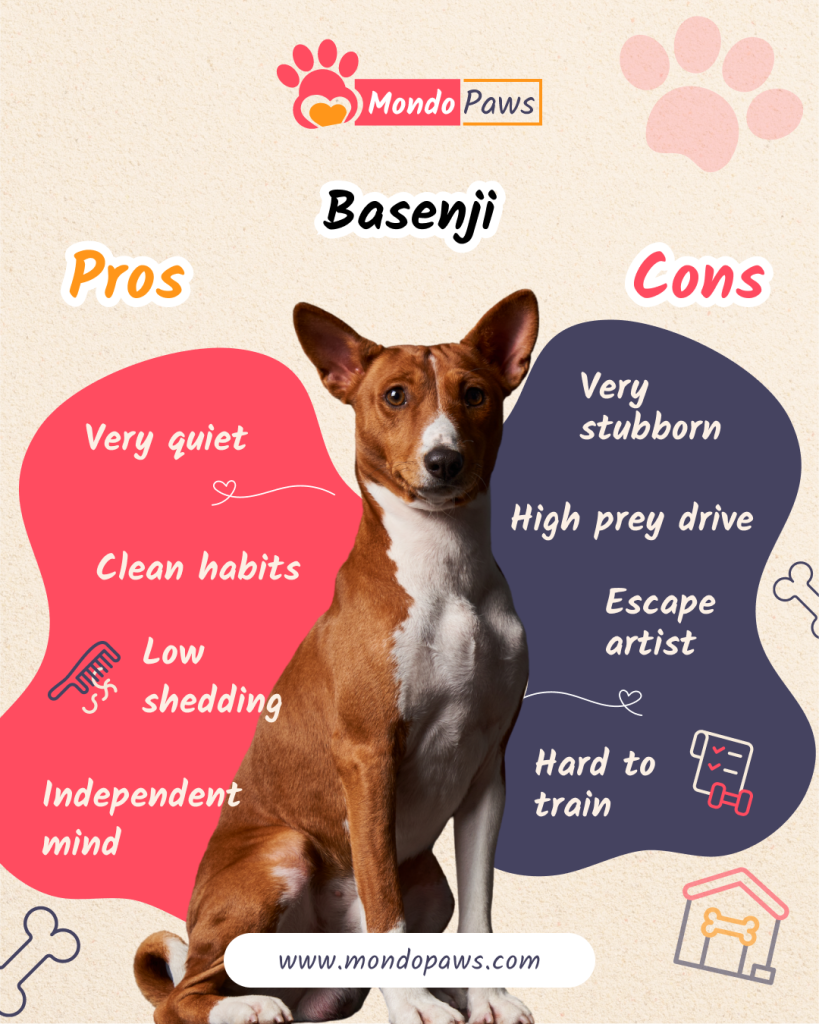
- Barkless — no nuisance barking, ideal for close neighbours
- Exceptionally clean and virtually odour-free, grooms itself like a cat
- Minimal shedding and almost no grooming cost
- Small, athletic, and long-lived — often 13–14 years
- Clever, entertaining, and deeply bonded to its own household
Challenges
- Recall is unreliable — off-leash freedom is rarely safe
- Expert escape artist: climbs, digs, and opens doors and bins
- Strong prey drive makes cats and small pets a genuine risk
- Destructive when bored, and intolerant of cold, wet weather
- Fanconi syndrome means health-tested lines are non-negotiable
History of the Basenji
The Basenji’s origins lie in Central Africa, in the forests and savannahs of the Congo Basin and southern Sudan, where village hunters used small, silent, curly-tailed dogs to flush game into nets. The name is usually translated from Lingala as “village dog”, and dogs of this type appear in ancient Egyptian art thousands of years before the breed reached Europe.
Nineteenth-century European explorers described the dogs repeatedly, but early attempts to import them failed when the animals died of distemper. Modern Basenji lines trace back to a small number of successful imports from:
The Congo Basin, southern Sudan, Liberia, and later expedition stock collected in the 1980s
Established in Britain and America in the mid-20th century, the Basenji became the classic “primitive” show and companion hound. Unusually, the breed retains a single annual breeding season rather than the twice-yearly cycle of most domestic dogs — one of several signs of its ancient, little-altered ancestry.
Here is a brief timeline of the Basenji’s history:
Antiquity
Small, prick-eared, curl-tailed hunting dogs appear in Egyptian tomb art and remain the working dogs of Central African villages.
1895
European explorers formally document the dogs in the Congo; the first imports to Britain fail when the dogs succumb to distemper.
1937
A successful group of imports is exhibited at Crufts under the name “Basenji” and causes a sensation.
1943
The American Kennel Club recognises the Basenji, and the Basenji Club of America follows soon after.
1987–1990
New African stock is imported to widen the gene pool, and the brindle colour is added to the standard.
2007
A direct DNA test for Fanconi syndrome becomes available, transforming health screening across the breed.
Today:
The Basenji remains an uncommon but devoted-following breed, admired for its silence, cleanliness, and ancient look, and genetic studies consistently place it among the oldest, most basal dog lineages.
Modern breeding focuses on Fanconi-clear lines, eye testing, and preserving the sound, moderate structure that lets the breed still move like a hunting dog.
Fun Facts
The Baroo
An unusually shaped larynx means Basenjis yodel, chortle, and scream instead of barking
1937
Shown at Crufts as the “barkless dog from the Congo” and mobbed by crowds
One Season a Year
Females typically come into season only once annually, like wild canids rather than most domestic breeds
Cat-Like Habits
They wash themselves, hate rain, climb furniture and fences, and sunbathe for hours
Ancient Lineage
DNA studies repeatedly rank the Basenji among the most genetically ancient dog breeds alive
Frequently Asked Questions
Basenji puppies from registered, health-tested breeders usually cost between $1,500 and $2,500, and waiting lists are common because litters are relatively rare. Budget a further $1,500–$2,500 a year for food, insurance, training, and veterinary care.
They almost never bark, because the shape of the larynx produces a yodel instead. But barkless is not silent — Basenjis yodel, chortle, growl, whine, and let out a startlingly loud scream when excited or frustrated.
They are intelligent but famously independent, and they rank near the bottom of obedience-response league tables — not from stupidity, but because they were bred to hunt without direction. Short, food-rewarded sessions work; drilling and harsh corrections do not. Assume recall will never be fully reliable outdoors.
No dog is truly hypoallergenic, but the Basenji comes closer than most: the coat is very short, shedding is light, and the breed produces little dog odour thanks to its cat-like self-grooming. Many mild allergy sufferers cope well with one, though a trial visit before committing is always sensible.
Yes for apartments, provided they get an hour or more of daily exercise — they are small, clean, and do not bark. For families they suit active homes with older children who understand that a Basenji is not a cuddle-on-demand dog, and they are a poor match for households with cats or small pets.
Behind the Research: How We Created This Basenji Guide
At Mondopaws, we believe pet guides should be grounded in both hard science and real-world care. To compile this Basenji breed profile, our editorial team:
- Cross-referenced official breed standards: Analyzed official documentation and care guidelines directly from the American Kennel Club (AKC), The Kennel Club (UK), and the Basenji Club of America.
- Consulted veterinary & clinical research: Verified breed-relevant conditions (such as Fanconi syndrome, progressive retinal atrophy, and hypothyroidism) using material from the Cornell Riney Canine Health Center and OFA breed testing requirements, along with clinical insights from the ASPCA and PetMD.
- Gathered authentic owner experiences: Evaluated real feedback, training struggles, escape stories, and temperament observations shared by verified Basenji owners across active pet forums and social media communities.
Final Thoughts
The Basenji is one of the cleanest, quietest, and most genuinely interesting dogs you can live with: small, odourless, barkless, low-maintenance to groom, and endlessly entertaining. The trade-offs are equally real — an unreliable recall, a serious prey drive, a talent for escaping, and a habit of redecorating the house when it gets bored.
For people who want an independent, cat-like companion, enjoy negotiating rather than commanding, and can offer secure fencing plus daily exercise, a Fanconi-tested Basenji from a responsible breeder is one of the most rewarding dogs in the world.
Written by the Mondo Paws Team
At Mondo Paws, we simply love pets! For this guide, we gathered and cross-checked key data on this breed from across the web, organizing everything in the clearest, most practical way possible so you can find what you need at a glance.