Table of Contents
Canine Pregnancy & Whelping · Clinical Due Date Guide
How long is a dog pregnant, and when exactly will she go into labor? Canine gestation averages 63 days from ovulation, but because sperm can remain viable inside the female for several days, the whelping date can fall anywhere from 58 to 68 days after breeding. Pinpointing the correct window matters: whelping too early or too late without veterinary awareness can put both mother and puppies at risk.
63 Days
Average canine gestation from ovulation
58–68 Days
Full breeding-to-whelping date range
12–24 Hrs
Temperature-drop warning window before labor
1–12
Typical litter size range across breeds
3 Stages
Roughly 21-day trimesters of gestation
~1–2°F Drop
Body temperature decline that signals labor is near
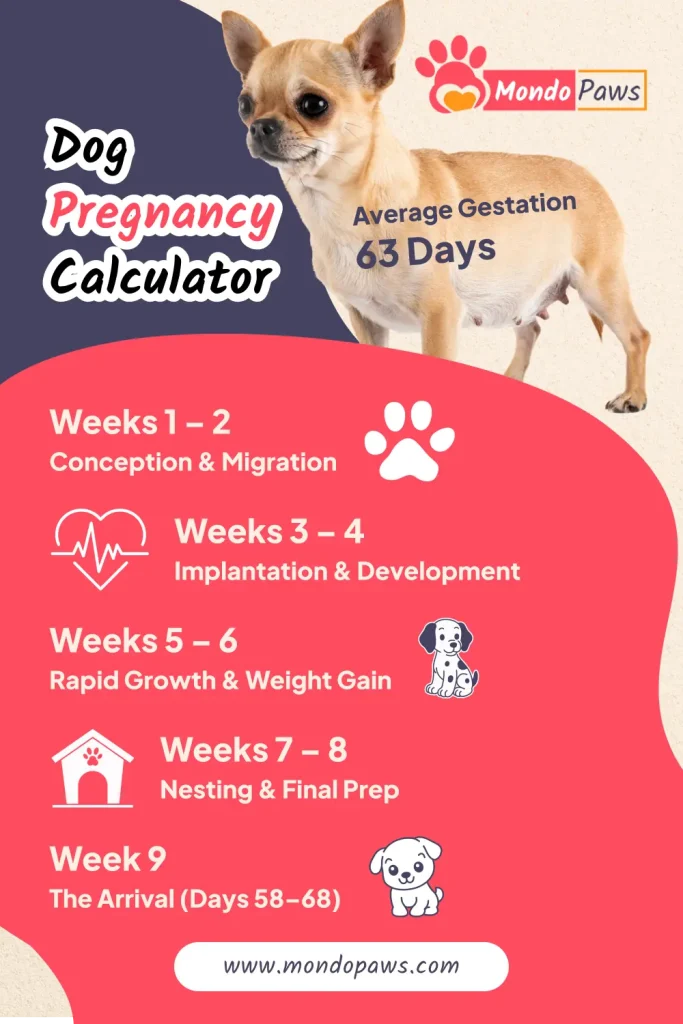
Whether you know the exact breeding date, a confirmed progesterone-tested ovulation date, or simply suspect your dog may be pregnant, precision matters. Our interactive Dog Pregnancy Calculator below estimates her due date window, current day of pregnancy, trimester, and the veterinary milestones (ultrasound, X-ray, whelping prep) that fall along the way.
Interactive Dog Pregnancy Calculator
Enter your dog’s breeding date (or a confirmed ovulation date) and her approximate adult size below to calculate her estimated due date window, current day of pregnancy, trimester, and the next recommended vet-visit milestone in real time.
How Long Are Dogs Pregnant?
Unlike gestation length in many species, canine pregnancy duration barely changes with breed or body size — a 4 lb Chihuahua and a 150 lb Newfoundland both carry their litters for roughly the same amount of time. What varies is how precisely you know the starting point, as detailed in canine reproduction standards published by the American Kennel Club (AKC).
| Reference Point | Average Gestation | Typical Range | Why the Range Varies |
|---|---|---|---|
| From Ovulation (LH surge / progesterone test) | 63 days | 61 – 65 days | Ovulation is a precise biological event, so the window is tight. |
| From Breeding / Mating Date | 63 days | 58 – 68 days | Sperm can survive inside the female for several days, so mating doesn’t always align with ovulation. |
| From First Visible Signs | ~40 days remaining | 35 – 45 days remaining | Visible signs (belly enlargement, nipple changes) typically appear around day 25–35. |
Clinical Reproduction Tip: According to clinical guidelines in the Merck Veterinary Manual, performing serum progesterone testing during estrus confirms exact ovulation dates. Narrowing the due-date window from a 10-day spread down to 4 days is critical for arranging elective Cesarean sections or supervising high-risk whelpings.
Early and Late Signs of Pregnancy in Dogs
Physical signs of pregnancy are subtle in the first three weeks and become much clearer as gestation progresses. Because false (phantom) pregnancy can mimic several of these signs, veterinary confirmation is always the most reliable route.
Days 1–21: Subtle Signs
A brief drop in appetite or mild vomiting (“morning sickness”) around day 21, along with slight behavioral changes like increased affection or lethargy.
Days 22–35: Confirmable Signs
Nipples enlarge and darken, appetite increases, and a veterinary ultrasound can now reliably confirm pregnancy and detect fetal heartbeats.
Days 36–63: Obvious Signs
Visible abdominal enlargement, weight gain, nesting behavior, and eventually mammary gland development in preparation for nursing.
Trimester-by-Trimester Development
Veterinary theriogenologists commonly divide the 63-day canine gestation into three roughly 21-day trimesters, each with distinct developmental milestones and different care priorities.
1st Trimester (Days 1–21)
Fertilization & Implantation. Embryos travel to the uterus and implant around day 17–20. No visible changes yet; maintain normal diet and activity.
2nd Trimester (Days 22–42)
Organ Formation & Confirmation. Ultrasound confirms pregnancy and heartbeats around day 25–35. Begin gradually transitioning to a higher-calorie puppy or performance formula.
3rd Trimester (Days 43–63)
Rapid Growth & Whelping Prep. Skeletons calcify enough for an X-ray puppy count around day 45–55. Set up the whelping box and begin temperature monitoring by day 58.
Nutrition and Care During Pregnancy
A pregnant dog’s caloric and nutrient needs change dramatically as gestation progresses, especially in the final trimester when growing puppies leave little room in the stomach for large meals. To accurately adjust meal plans as weight increases, use our interactive Dog Calorie Calculator alongside our Dog Weight Calculator to prevent over- or under-feeding.
| Trimester | Caloric Increase | Feeding Frequency | Key Focus |
|---|---|---|---|
| 1st Trimester (Days 1–21) | None — maintenance calories | Normal schedule (1–2 meals/day) | Avoid stress, unnecessary medications, and vaccines; confirm pregnancy with your vet. |
| 2nd Trimester (Days 22–42) | +10% to 25% by day 42 | 2 meals/day | Gradually transition to a puppy or performance formula; begin tracking weekly weight gain. |
| 3rd Trimester (Days 43–63) | +25% to 50% by whelping | 3–4 smaller meals/day | Frequent small meals accommodate reduced stomach capacity; avoid excess calcium supplementation. |
Dog Breed Litter Size & Whelping Reference Table
Below is our reference table listing 30 popular dog breeds with their typical litter size and breed-specific whelping considerations, including which breeds are commonly delivered by planned Cesarean section.
| Breed | Adult Weight (lbs / kg) | Typical Litter Size | Whelping Considerations |
|---|---|---|---|
| Beagle | 20 – 30 lbs (9.1 – 13.6 kg) | 4 – 6 puppies | Generally whelps naturally with routine supervision. |
| Bernese Mountain Dog | 70 – 115 lbs (31.8 – 52.2 kg) | 6 – 9 puppies | Large litters in a giant breed; monitor closely for eclampsia (low calcium). |
| Border Collie | 30 – 45 lbs (13.6 – 20.4 kg) | 4 – 8 puppies | Typically whelps naturally without complications. |
| Boston Terrier | 12 – 25 lbs (5.4 – 11.3 kg) | 3 – 5 puppies | Large heads and a narrow pelvis mean a high planned C-section rate. |
| Boxer | 50 – 70 lbs (22.7 – 31.8 kg) | 5 – 8 puppies | Usually natural whelping; monitor for prolonged labor with large litters. |
| Bulldog (English) | 40 – 55 lbs (18.1 – 24.9 kg) | 3 – 5 puppies | One of the highest C-section rates of any breed due to oversized puppy heads. |
| Cavalier King Charles Spaniel | 13 – 18 lbs (5.9 – 8.2 kg) | 3 – 5 puppies | Usually whelps naturally with routine monitoring. |
| Chihuahua | 3 – 6 lbs (1.4 – 2.7 kg) | 1 – 3 puppies | Small litters raise dystocia risk from a single oversized puppy — monitor closely. |
| Cocker Spaniel | 20 – 30 lbs (9.1 – 13.6 kg) | 4 – 6 puppies | Typically whelps naturally without complications. |
| Dachshund | 11 – 32 lbs (5.0 – 14.5 kg) | 3 – 5 puppies | Manage weight gain carefully to avoid added strain on the long spine. |
| Doberman Pinscher | 60 – 100 lbs (27.2 – 45.4 kg) | 6 – 8 puppies | Natural whelping is common; watch for postpartum low calcium. |
| French Bulldog | 16 – 28 lbs (7.3 – 12.7 kg) | 2 – 4 puppies | Near-universal planned C-section due to disproportionately large puppy heads. |
| German Shepherd | 50 – 90 lbs (22.7 – 40.8 kg) | 6 – 8 puppies | Generally whelps naturally; large litters are common for the breed. |
| German Shorthaired Pointer | 45 – 70 lbs (20.4 – 31.8 kg) | 6 – 8 puppies | Typically whelps naturally without complications. |
| Golden Retriever | 55 – 75 lbs (24.9 – 34.0 kg) | 6 – 8 puppies | Natural whelping is typical; large litters mean a longer labor to monitor. |
| Great Dane | 110 – 175 lbs (49.9 – 79.4 kg) | 6 – 10 puppies | Giant breed; monitor closely for eclampsia and uterine inertia from oversized litters. |
| Havanese | 7 – 13 lbs (3.2 – 5.9 kg) | 3 – 5 puppies | Usually whelps naturally with routine supervision. |
| Labrador Retriever | 55 – 80 lbs (24.9 – 36.3 kg) | 6 – 8 puppies | Natural whelping is typical; among the larger average litter sizes. |
| Maltese | 4 – 7 lbs (1.8 – 3.2 kg) | 2 – 4 puppies | Small litters; monitor closely for dystocia given the toy-breed pelvis. |
| Miniature Schnauzer | 11 – 20 lbs (5.0 – 9.1 kg) | 3 – 6 puppies | Typically whelps naturally without complications. |
| Newfoundland | 100 – 150 lbs (45.4 – 68.0 kg) | 6 – 10 puppies | Giant breed; monitor closely for prolonged labor and eclampsia. |
| Pomeranian | 3 – 7 lbs (1.4 – 3.2 kg) | 1 – 3 puppies | Small litters raise dystocia risk from a single oversized puppy. |
| Poodle (Standard) | 45 – 70 lbs (20.4 – 31.8 kg) | 5 – 8 puppies | Generally whelps naturally without complications. |
| Poodle (Toy / Miniature) | 4 – 15 lbs (1.8 – 6.8 kg) | 2 – 4 puppies | Smaller litters than Standard Poodles; monitor closely as with other toy breeds. |
| Pug | 14 – 18 lbs (6.4 – 8.2 kg) | 3 – 5 puppies | Brachycephalic build raises the likelihood of a planned C-section. |
| Rottweiler | 80 – 135 lbs (36.3 – 61.2 kg) | 6 – 10 puppies | Large litters common; monitor closely for eclampsia postpartum. |
| Shih Tzu | 9 – 16 lbs (4.1 – 7.3 kg) | 3 – 5 puppies | Brachycephalic build gives a moderately elevated C-section likelihood. |
| Siberian Husky | 35 – 60 lbs (15.9 – 27.2 kg) | 4 – 6 puppies | Typically whelps naturally without complications. |
| Yorkshire Terrier | 4 – 7 lbs (1.8 – 3.2 kg) | 2 – 4 puppies | Small litters raise dystocia risk from a single oversized puppy. |
Signs Labor Is Starting
Around day 58, begin taking your dog’s rectal temperature twice daily at the same times each day. These three signs, especially in combination, mean whelping is likely within 24 hours:
Temperature Drop
Normal body temperature (101–102.5°F) falls below 99°F roughly 12 to 24 hours before active labor begins.
Nesting Behavior
Restlessness, digging or shredding bedding, and seeking out a quiet, secluded spot are classic pre-labor behaviors.
Appetite Loss & Panting
Refusing food, visible panting or pacing, and mild straining signal that active labor is beginning very soon.
A Whelping Prep Timeline for the Final Weeks
Use the final three weeks of pregnancy to get both your dog and your home ready for a calm, well-supervised whelping:
Around Day 42:
Set up the whelping box in a quiet, low-traffic area and let her get comfortable using it ahead of time.
Around Day 49:
Begin twice-daily rectal temperature checks logged at the same times each day to spot the pre-labor drop.
Around Day 56:
Stock supplies: clean towels, a digital thermometer, unscented dental floss or sterile scissors, and your veterinarian’s emergency contact number.
Day 58 Onward:
Monitor temperature closely and contact your veterinarian the moment labor signs appear or if day 68 arrives without labor.
Frequently Asked Questions
Canine gestation averages 63 days from ovulation. Because breeding date and ovulation date rarely line up exactly, whelping can occur anywhere from 58 to 68 days after the mating itself, which is why our calculator gives a date range rather than a single fixed day.
The earliest signs are subtle: a brief dip in appetite or mild vomiting around day 21, followed by nipple enlargement and darkening around day 25–30. These signs are not conclusive on their own, since a false pregnancy can mimic them closely.
Ultrasound can reliably confirm pregnancy and detect fetal heartbeats from around day 25 to day 35. An X-ray later in pregnancy, typically day 45 to 55, is the most accurate way to get an exact puppy count once the skeletons have calcified.
A false pregnancy happens when hormone shifts after a heat cycle cause pregnancy-like symptoms — nesting, mammary development, even mothering behavior toward toys — in a dog that was never actually bred or did not conceive. It is common in intact females and usually resolves on its own within a few weeks, though a veterinary exam is recommended to rule out true pregnancy or other conditions.
The most reliable early sign is a drop in rectal temperature below 99°F, usually 12 to 24 hours before labor. This is typically followed by nesting behavior, restlessness, loss of appetite, and visible panting or straining as contractions begin.
Behind the Research: How We Built This Dog Pregnancy Calculator & Guide
At Mondo Paws, our mission is to empower pet owners with scientifically accurate, veterinary-reviewed tools. To create this calculator and canine pregnancy guide:
- Applied Standard Veterinary Gestation Windows: Due-date calculations use the widely cited 63-day average gestation from ovulation (61–65 day range) and the wider 58–68 day range from breeding date, reflecting sperm survival time inside the female.
- Cross-Referenced Reproduction Literature: Milestones for ultrasound confirmation, X-ray puppy counts, and pre-labor temperature drops were checked against veterinary theriogenology references and guidance shared by the American College of Veterinary Internal Medicine (ACVIM) and nutrition guidance from the WSAVA Global Nutrition Committee.
- Compiled Breed-Specific Litter Data: Analyzed typical litter sizes and whelping considerations, including breeds prone to planned Cesarean delivery, across 30 recognized dog breeds.
Final Thoughts
Knowing roughly when your dog will whelp gives you time to schedule the right vet visits, prepare a safe whelping space, and recognize labor the moment it starts. Use our Dog Pregnancy Calculator to establish a due-date window, book an ultrasound around day 25–35, an X-ray around day 45–55, and begin temperature monitoring by day 58.
Remember that every pregnancy is unique. If your dog shows any signs of distress, prolonged labor without progress, or passes day 68 without whelping, contact your veterinarian immediately.