
Table of Contents
Dog Chocolate Calculator · Toxicity Guide
Did your dog just eat chocolate and you need to know if it’s dangerous? The answer depends on three things: your dog’s weight, the type of chocolate, and how much was eaten. Chocolate contains theobromine, a compound dogs process very slowly. Mild signs can begin at about 20 mg per kilogram of body weight, heart problems at 40 mg/kg, and seizures at 60 mg/kg or more. Our free calculator turns those three inputs into an estimated dose and risk level in seconds.
20 mg/kg
Theobromine dose where mild signs can begin
40 mg/kg
Dose where heart effects become a concern
60 mg/kg+
Dose where tremors and seizures can occur
6–12 Hrs
Typical time before signs appear
Up to 72 Hrs
How long effects can last in affected dogs
~800 mg/oz
Approximate theobromine in dry cocoa powder
Whether you’re checking a dropped brownie, a handful of Halloween candy, or a raided bag of baking chocolate, precision matters. Our interactive Dog Chocolate Calculator below estimates the theobromine dose in mg and mg/kg, assigns a risk level, and tells you what to do next. It is a screening tool, not a diagnosis. If your dog has eaten chocolate and you are worried, call your vet or a pet poison hotline now rather than waiting.
Free Dog Chocolate Calculator
Enter your dog’s weight, the type of chocolate, and the amount eaten to estimate the theobromine dose and risk level in real time.
How Is Dog Chocolate Toxicity Calculated?
The toxic ingredients in chocolate are methylxanthines, mainly theobromine and, to a lesser degree, caffeine. Dogs break theobromine down far more slowly than people do, so it builds up in the bloodstream. Veterinary references such as the Merck Veterinary Manual express risk as milligrams of theobromine per kilogram of body weight, which is exactly what our calculator does in three steps.
| Step | Calculation | Example (10 kg dog, 40 g milk chocolate) |
|---|---|---|
| 1. Convert to ounces | Grams ÷ 28.35 | 40 g ÷ 28.35 = 1.41 oz |
| 2. Total theobromine | Ounces × mg of theobromine per oz | 1.41 oz × 58 mg = ~82 mg |
| 3. Dose per kg | Total mg ÷ dog’s weight (kg) | 82 mg ÷ 10 kg = ~8.2 mg/kg (minimal risk) |
| Dose (mg/kg) | Risk Level | What to Expect |
|---|---|---|
| Under 20 | Low | Signs unlikely, though sensitive dogs may still react. Monitor and call your vet if unsure. |
| 20 – 40 | Mild to moderate | Vomiting, diarrhea, restlessness, increased thirst, and panting. |
| 40 – 60 | Severe | Racing or irregular heartbeat, muscle tremors, and hyperactivity. Emergency care needed. |
| 60 and above | Life-threatening | Seizures and serious cardiac effects. Doses roughly in the 100 to 200 mg/kg range can be fatal. |
Clinical Note: Individual dogs vary. Dogs with heart disease, older dogs, and very small dogs can show signs below the usual thresholds, and many chocolate products also contain xylitol, raisins, macadamia nuts, or coffee, which add separate risks. Always tell your vet the full ingredient list.
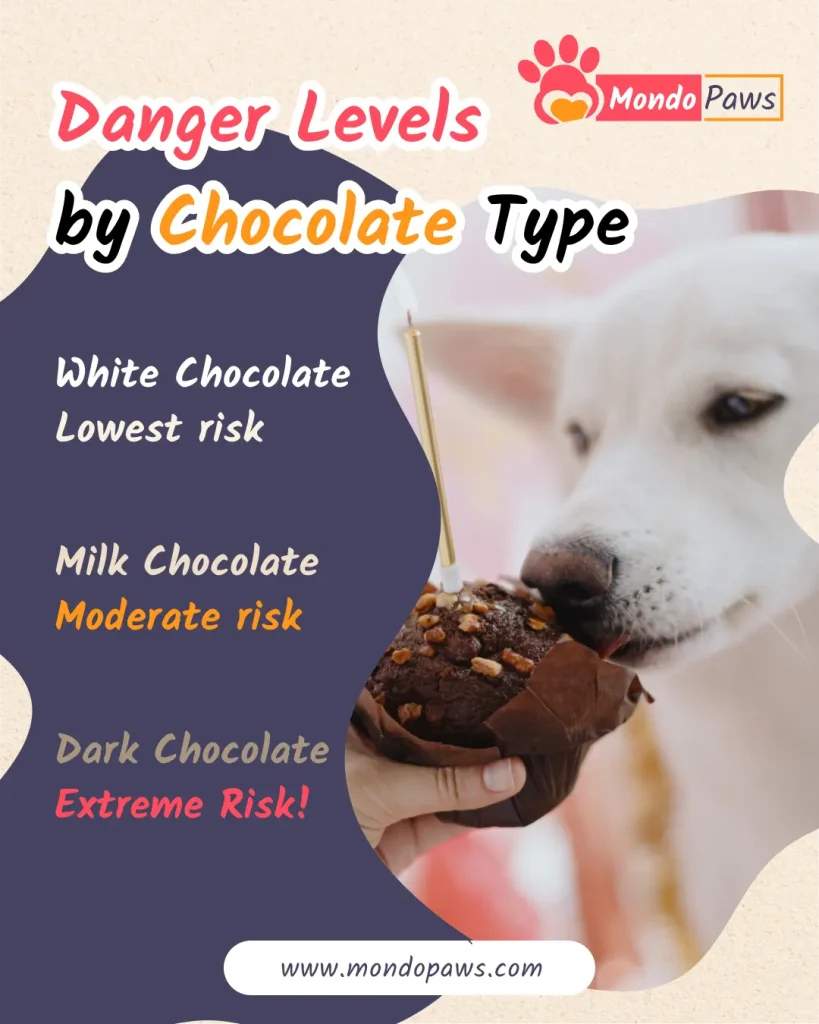
Theobromine in Common Chocolate Types
The darker and more bitter the chocolate, the more theobromine it contains. Published figures vary by brand and cocoa percentage, so our calculator uses representative values within the commonly cited ranges.
| Chocolate Type | Typical Theobromine (mg per oz) | Value Used in Calculator | Danger Level |
|---|---|---|---|
| White chocolate | Trace (under 1) | 1 mg/oz | Very low for toxicity; fat and sugar may still cause stomach upset or pancreatitis. |
| Milk chocolate | 44 – 58 | 58 mg/oz | Lowest real toxicity risk, but large amounts are dangerous to small dogs. |
| Semi-sweet chips | 150 – 160 | 155 mg/oz | About 2.5 to 3 times as potent as milk chocolate. |
| Dark chocolate (60–85%) | 130 – 450, varies widely | 228 mg/oz | High; a few squares can matter for a small dog. |
| Baking chocolate | 390 – 450 | 420 mg/oz | Very high; a single square can be a problem for small and medium dogs. |
| Cocoa powder | ~800 | 800 mg/oz | Highest; even a small amount can be dangerous. |
Dog Chocolate Toxicity Chart by Weight
This chart shows the amount of each chocolate, in ounces, that would deliver about 20 mg/kg of theobromine, the point where mild signs can begin. One ounce is roughly 28 grams. Eating this much or more means you should call your vet. To check a different amount, use the calculator above. To pair this with other health tracking, see our Water Intake Calculator for Dogs and Dog Calorie Calculator.
| Dog Weight (lbs / kg) | Milk Chocolate | Semi-Sweet | Baking Chocolate | Cocoa Powder |
|---|---|---|---|---|
| 5 lbs (2.3 kg) | 0.78 oz | 0.29 oz | 0.11 oz | 0.06 oz |
| 10 lbs (4.5 kg) | 1.6 oz | 0.59 oz | 0.22 oz | 0.11 oz |
| 20 lbs (9.1 kg) | 3.1 oz | 1.2 oz | 0.43 oz | 0.23 oz |
| 30 lbs (13.6 kg) | 4.7 oz | 1.8 oz | 0.65 oz | 0.34 oz |
| 40 lbs (18.1 kg) | 6.3 oz | 2.3 oz | 0.86 oz | 0.45 oz |
| 60 lbs (27.2 kg) | 9.4 oz | 3.5 oz | 1.3 oz | 0.68 oz |
| 80 lbs (36.3 kg) | 12.5 oz | 4.7 oz | 1.7 oz | 0.91 oz |
Dog Chocolate Poisoning Symptoms and Timeline
Signs usually begin within 6 to 12 hours of ingestion and can persist for up to 72 hours because theobromine is cleared slowly. Do not wait for symptoms before calling your vet, since treatment works best early.
Early (First Hours)
Vomiting, diarrhea, drooling, increased thirst, and restlessness. Some dogs show nothing at first.
Moderate (6–12 Hours)
Hyperactivity, panting, frequent urination, a racing heart, and an unsteady walk.
Severe (Emergency)
Muscle tremors, seizures, irregular heart rhythm, high body temperature, weakness, or collapse. Go to an emergency vet immediately.
What to Do If Your Dog Ate Chocolate
Stay calm and move quickly. These steps help your vet give the best advice:
1. Remove Access:
Take away any remaining chocolate and keep your dog from eating more.
2. Gather the Facts:
Note your dog’s weight, the chocolate type and brand, the estimated amount, and the time eaten. Keep the wrapper to check ingredients such as xylitol.
3. Call for Advice:
Contact your vet, an emergency clinic, the ASPCA Animal Poison Control Center at (888) 426-4435, or Pet Poison Helpline at (855) 764-7661. Fees may apply for hotline consultations.
4. Do Not Self-Treat:
Do not induce vomiting at home or give salt, milk, or medications unless a veterinary professional specifically tells you to. Done wrong, this can cause serious harm.
5. Follow Through:
Treatment may include induced vomiting by a vet, activated charcoal, IV fluids, and heart monitoring. Keep your dog calm and watch for signs for up to 72 hours.
Frequently Asked Questions
Mild signs can appear at about 20 mg of theobromine per kilogram of body weight, heart effects at around 40 to 50 mg/kg, and seizures at about 60 mg/kg or more. Because dark chocolate, baking chocolate, and cocoa powder contain far more theobromine than milk chocolate, a small amount of them can be dangerous to a small dog. Use the calculator above for your dog’s specific numbers.
Common signs include vomiting, diarrhea, excessive thirst, restlessness, panting, and a racing heart. Severe cases can progress to tremors, seizures, abnormal heart rhythm, and collapse.
Signs usually begin within 6 to 12 hours of eating chocolate, although they can start sooner with large doses. Theobromine is cleared slowly in dogs, so effects can last up to 72 hours. Do not wait for symptoms before contacting your vet.
White chocolate contains only trace amounts of theobromine, so chemical poisoning is unlikely. However, its high fat and sugar content can still cause vomiting, diarrhea, or pancreatitis, so call your vet if your dog ate a large amount.
Note the type and amount eaten, your dog’s weight, and the time, then call your veterinarian or a pet poison hotline right away. Do not induce vomiting at home unless a veterinary professional tells you to.
Behind the Research: How We Built This Dog Chocolate Calculator & Guide
At Mondo Paws, our mission is to empower pet owners with scientifically accurate, veterinary-reviewed tools. To create this calculator and chocolate toxicity guide:
- Applied Standard Toxicity Thresholds: Risk levels use the widely cited theobromine dose bands of about 20 mg/kg (mild signs), 40 to 50 mg/kg (cardiac effects), and 60 mg/kg or more (seizures).
- Cross-Referenced Veterinary Literature: Theobromine content by chocolate type and clinical signs were checked against the Merck Veterinary Manual and guidance from the ASPCA Animal Poison Control Center.
- Compiled Weight-Based Chart: Applied the 20 mg/kg threshold across seven common dog weights for milk, semi-sweet, baking, and cocoa powder to show how quickly small amounts become a concern.
Final Thoughts
The Dog Chocolate Calculator gives you a fast, weight-based estimate of how worrying a chocolate incident might be, which helps you decide how urgently to act. It is most useful for sorting a harmless nibble of milk chocolate from a situation that needs a vet right now.
Remember that no online calculator can replace professional advice. If your dog is small, has a heart condition, ate dark or baking chocolate, or is showing any signs, contact your veterinarian or a poison hotline immediately rather than waiting to see what happens. Prevention is simplest: store chocolate and cocoa products well out of reach, especially around holidays.