Table of Contents
Cat Water Intake Calculator · Daily Hydration Guide
How much water should your cat actually be getting each day? As a general guideline, healthy adult cats need about 40 to 60 milliliters of total water per kilogram of body weight per day, roughly 0.75 ounces per pound. Cats evolved from desert-dwelling ancestors and have a naturally weak thirst drive, so much of that water is meant to come from food. Knowing your cat’s target makes it far easier to spot a genuine change in drinking before it becomes a health problem.
40–60 ml/kg
Typical total daily water need per kg of body weight
~0.75 oz/lb
Simple imperial rule of thumb for total daily water
75–80%
Typical moisture content of wet cat food
~10%
Typical moisture content of dry kibble
100+ ml/kg
Sustained total intake generally considered excessive
24 Hours
Time without eating or drinking that warrants a vet call
Whether you’re monitoring a senior cat, managing a kidney condition, or simply wondering if your cat drinks enough, precision helps. Our interactive Cat Water Intake Calculator below estimates a daily target in milliliters, ounces, and cups, and splits it into the water your cat should get from food and the water it should drink from the bowl.
Interactive Cat Water Intake Calculator
Enter your cat’s weight, activity level, diet type, and any special situation below to calculate a personalized daily water target in real time.
How Much Water Should a Cat Drink a Day?
Daily water for cats is most commonly estimated with a milliliters-per-kilogram guideline, as referenced in veterinary nutrition resources from the WSAVA Global Nutrition Committee. The key detail is that this figure is total water, meaning drinking water plus the moisture in food. A cat on wet food may rarely visit the bowl and still be perfectly hydrated, while a cat on dry kibble needs to drink almost all of it.
| Method | Formula | Example (4 kg / 9 lb cat) | Best Used For |
|---|---|---|---|
| ml per kg (standard) | 40–60 ml × body weight (kg) | 160 – 240 ml/day | Quick daily estimates for healthy adult cats. |
| oz per lb (imperial) | ~0.75 fl oz × body weight (lb) | ~6.6 fl oz/day | A simple rule of thumb without converting units. |
| Calorie-based (RER) | ~1 ml water per kcal of daily energy need | ~200 – 240 ml/day | Cross-checking against a cat's calorie needs, especially for weight management. |
Clinical Note: Total water intake includes both drinking water and the moisture naturally present in food, as described in the Merck Veterinary Manual. Because cats have a low thirst drive, feeding some wet food is one of the simplest ways to support hydration, especially in cats prone to urinary problems.
Cat Water Intake Chart by Weight
This quick-reference chart answers common questions like "how much water should a 4 kg cat drink." Figures are total daily water for a healthy adult cat at moderate activity, using 40–60 ml/kg with 50 ml/kg as the midpoint. Subtract the moisture in your cat's food to estimate how much should come from the bowl.
| Cat Weight (kg / lbs) | Daily Water Range | Midpoint (ml) | Midpoint (fl oz) | Midpoint (cups) |
|---|---|---|---|---|
| 2 kg (4.4 lbs) | 80 – 120 ml | 100 ml | 3.4 oz | 0.4 cup |
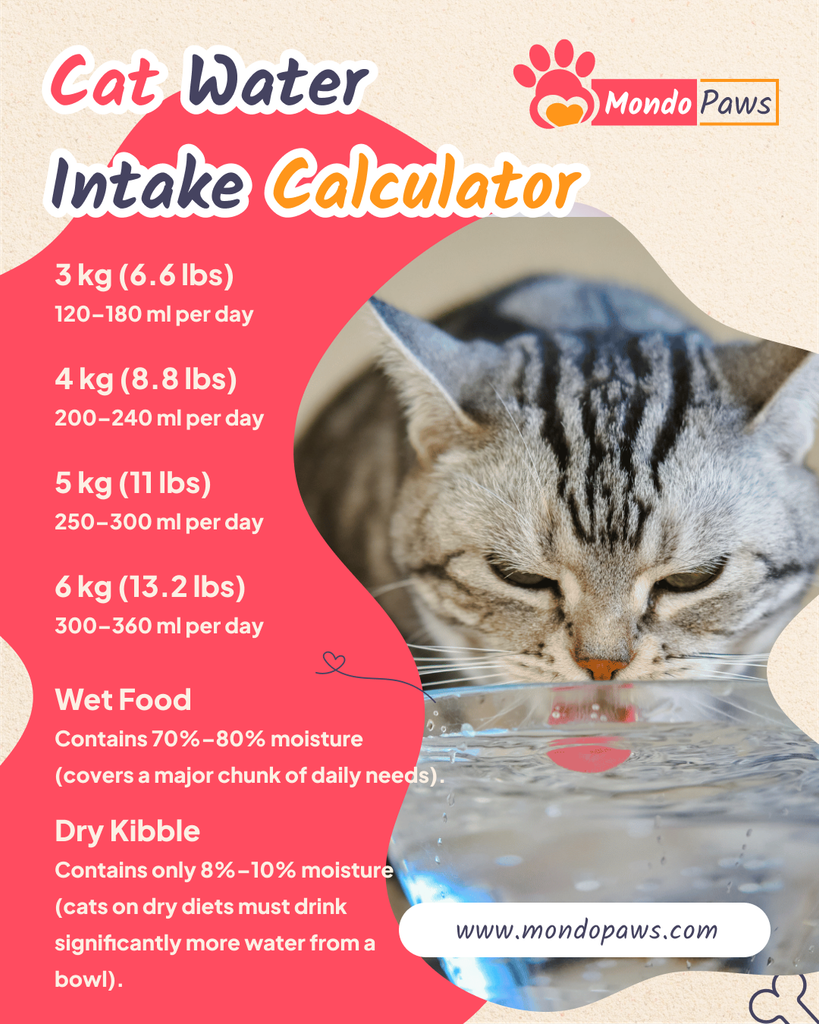
| 3 kg (6.6 lbs) | 120 – 180 ml | 150 ml | 5.1 oz | 0.6 cup |
| 4 kg (8.8 lbs) | 160 – 240 ml | 200 ml | 6.8 oz | 0.8 cup |
| 5 kg (11 lbs) | 200 – 300 ml | 250 ml | 8.5 oz | 1.0 cup |
| 6 kg (13.2 lbs) | 240 – 360 ml | 300 ml | 10.1 oz | 1.3 cups |
| 7 kg (15.4 lbs) | 280 – 420 ml | 350 ml | 11.8 oz | 1.5 cups |
| 8 kg (17.6 lbs) | 320 – 480 ml | 400 ml | 13.5 oz | 1.7 cups |
Cats drink in many small sips throughout the day and night, so a "per hour" figure is not very meaningful. For a rough sense, a 4 kg cat averages around 8 ml per hour across a full day, but real intake is uneven. Judge hydration on the 24-hour total instead.
Early and Severe Signs of Dehydration in Cats
Cats hide discomfort well, so dehydration is easy to miss. The skin-tent test is less reliable in cats than in dogs, particularly in older, thin, or overweight cats, so look at the whole picture rather than relying on one sign.
Mild
Slightly tacky gums, reduced appetite, a bit less energy than usual, and skin that returns a little slower when gently lifted.
Moderate
Dry, sticky gums, sunken eyes, clear lethargy, constipation, and skin that stays tented for several seconds.
Severe
Weakness, cold paws or ears, rapid heartbeat, collapse, or refusing all food and water. This is a veterinary emergency.
Water Needs by Life Stage and Lifestyle
A cat's relative water needs shift with age, lifestyle, and environment, largely driven by metabolic rate, kidney function, and how much heat the body needs to shed.
Kittens
Higher Relative Needs. Small bodies and fast metabolism mean kittens dehydrate faster than adults. Weaned kittens need constant access to fresh water.
Healthy Adults
Standard Baseline. The 40–60 ml/kg/day guideline applies most reliably here, adjusted for activity and diet.
Senior Cats
Watch More Closely. Kidney disease is common in older cats, so tracking drinking helps catch early changes before they become clinical.
Active & Outdoor Cats
Higher Than Baseline. Roaming, hunting, and heat exposure raise water needs, so make sure outdoor cats have reliable access to clean water.
Hot Weather
Evaporation Increases Loss. Cats pant less than dogs but still lose more water in heat. Add extra water stations and keep rooms cool.
Pregnant & Nursing
Elevated Throughout. Fluid needs rise through pregnancy and increase substantially during nursing, when milk production demands extra water.
Water Needs in Special Health Situations
Certain health conditions change how much water a cat needs and how closely intake should be watched. Also check cat calories calculator too.
| Situation | Typical Effect on Water Needs | Key Guidance |
|---|---|---|
| Kidney Disease | Often increases (sometimes significantly) | Never restrict water. Increased thirst is usually the body compensating. Follow your vet's fluid plan. |
| Diabetes | Often increases | Excessive thirst and urination are hallmark signs; report any sudden increase to your veterinarian. |
| Hyperthyroidism | Often increases | Increased thirst alongside weight loss despite a good appetite should prompt a vet visit. |
| Urinary Tract Problems | Higher intake is protective | Wet food and extra water help dilute urine. A cat straining to urinate with little or no output is an emergency, especially a male cat. |
| Pregnancy / Nursing | Increases steadily, then substantially during nursing | Free access to fresh water at all times, especially in late pregnancy and while nursing. |
| Post-Surgery | Slightly increases; offered gradually at first | Small, frequent sips are safer than large amounts right after anesthesia. Follow your vet's specific timeline. |
| Vomiting or Diarrhea | Increases, but intake must be managed carefully | Fluid loss is rapid; contact your vet if a cat can't keep water down or stops eating. |
Cat Breed Water Needs Reference Table
Below is our reference table listing 20 popular cat breeds with typical adult weight and an estimated total daily water range based on the standard 50 ml/kg midpoint at moderate activity. Individual cats vary widely within each breed.
| Breed | Adult Weight (lbs / kg) | Estimated Daily Water | Notes |
|---|---|---|---|
| Domestic Shorthair | 8 – 12 lbs (3.6 – 5.4 kg) | 180 – 270 ml | Typically falls right within the standard baseline. |
| Maine Coon | 10 – 25 lbs (4.5 – 11.3 kg) | 225 – 565 ml | Large breed; a bigger body and thick coat mean noticeably higher volumes. |
| Ragdoll | 10 – 20 lbs (4.5 – 9.1 kg) | 225 – 455 ml | Large, calm breed; track intake alongside weight. |
| Persian | 7 – 12 lbs (3.2 – 5.4 kg) | 160 – 270 ml | Prone to polycystic kidney disease, so changes in drinking deserve attention. |
| British Shorthair | 9 – 18 lbs (4.1 – 8.2 kg) | 205 – 410 ml | Stocky build; monitor weight and hydration together. |
| Siamese | 8 – 12 lbs (3.6 – 5.4 kg) | 180 – 270 ml | Lean, active breed; needs may run toward the higher end. |
| Bengal | 8 – 15 lbs (3.6 – 6.8 kg) | 180 – 340 ml | Very active breed; intake often runs above baseline. |
| Abyssinian | 6 – 10 lbs (2.7 – 4.5 kg) | 135 – 225 ml | Active; some lines are prone to kidney problems, so watch for changes. |
| Scottish Fold | 6 – 13 lbs (2.7 – 5.9 kg) | 135 – 295 ml | Typically falls right within the standard baseline. |
| Sphynx | 6 – 14 lbs (2.7 – 6.4 kg) | 135 – 320 ml | Hairless; loses heat quickly, so metabolism and intake may run higher. |
| Russian Blue | 7 – 15 lbs (3.2 – 6.8 kg) | 160 – 340 ml | Typically falls right within the standard baseline. |
| Norwegian Forest Cat | 9 – 18 lbs (4.1 – 8.2 kg) | 205 – 410 ml | Heavy coat; watch intake in warm weather. |
| American Shorthair | 8 – 15 lbs (3.6 – 6.8 kg) | 180 – 340 ml | Typically falls right within the standard baseline. |
| Birman | 6 – 15 lbs (2.7 – 6.8 kg) | 135 – 340 ml | Wide weight range; use your cat's actual weight in the calculator. |
| Burmese | 8 – 14 lbs (3.6 – 6.4 kg) | 180 – 320 ml | Some lines are prone to diabetes, so report any sudden increase in thirst. |
| Devon Rex | 6 – 9 lbs (2.7 – 4.1 kg) | 135 – 205 ml | Small, active breed; typically near the standard baseline. |
| Oriental Shorthair | 5 – 10 lbs (2.3 – 4.5 kg) | 115 – 225 ml | Lean and energetic; needs may run toward the higher end. |
| Savannah | 12 – 25 lbs (5.4 – 11.3 kg) | 270 – 565 ml | Large, very active hybrid; intake often runs above baseline. |
| Munchkin | 5 – 9 lbs (2.3 – 4.1 kg) | 115 – 205 ml | Small body size; monitor closely for early signs of dehydration. |
| Exotic Shorthair | 10 – 12 lbs (4.5 – 5.4 kg) | 225 – 270 ml | Related to the Persian and may share kidney concerns; track changes in drinking. |
How to Measure Your Cat's Water Intake
Measuring bowl intake is most useful when you suspect a change, such as a cat that seems to be drinking more or less than usual. A simple 24-hour check works well:
1. Measure the Start:
Pour a known amount of water into the bowl using a measuring cup or kitchen scale (1 g of water is about 1 ml).
2. Set a Control Bowl:
Place an identical bowl of water nearby that your cat can't reach. The amount it loses is evaporation, which you subtract later.
3. Wait 24 Hours:
Leave the bowl untouched, and avoid refilling it during the test so the math stays simple.
4. Measure What's Left:
Subtract the remaining amount from the start, then subtract the evaporation from the control bowl. The result is your cat's bowl intake.
5. Add Food Moisture:
If your cat eats wet food, add its moisture (about 75–80% of the food's weight) to get total water, then compare with the calculator above. Note that this method is unreliable in multi-cat homes or if your cat also drinks from other sources.
Signs You Need a Vet
Both drinking far too little and drinking far too much can signal an underlying problem. These three signs, especially in combination, warrant a same-week or same-day vet visit depending on severity:
Refusing Food and Water
A cat that won't eat or drink for 24 hours, especially with lethargy or vomiting, needs prompt veterinary attention.
Excessive Thirst
Noticeably more drinking and bigger litter clumps can signal kidney disease, diabetes, or hyperthyroidism, particularly in middle-aged and senior cats.
Straining to Urinate
Repeated litter box trips with little or no urine, crying, or licking the genitals can mean a urinary blockage. This is an emergency, especially in male cats.
A Daily Routine to Encourage Drinking
Because cats have a low thirst drive, small environmental changes make a real difference to how much they drink:
Morning:
Empty and refill bowls with fresh water, and offer a wet-food meal to boost moisture intake.
Bowl Setup:
Use wide, shallow bowls so whiskers don't touch the sides, and place them away from food and the litter box. Many cats prefer ceramic or glass over plastic.
More Stations:
Put water in several rooms, and consider a pet fountain, since many cats prefer moving water.
Evening:
Refresh the water, check litter box clumps for any big change, and log any noticeable increase or decrease in drinking.
Frequently Asked Questions
A healthy adult cat needs roughly 40 to 60 milliliters of total water per kilogram of body weight each day, or about 0.75 ounces per pound. That total includes the moisture in food, so cats eating wet food drink much less from the bowl than cats eating dry kibble.
A 4 kg (about 9 lb) cat needs roughly 160 to 240 milliliters of total water per day, with 200 ml (about 7 fluid ounces) as a typical midpoint. A cat on dry food will need to drink most of that from the bowl, while a cat on wet food gets most of it from its meals.
Fill the bowl with a measured amount of water, measure what is left after 24 hours, and subtract the difference from the starting amount. Use a control bowl to account for evaporation, and remember that this only works reliably if your cat is the only one drinking from that bowl.
A sustained increase in drinking can be a sign of kidney disease, diabetes, hyperthyroidism, or other conditions, although hot weather, a switch to dry food, or a change in routine can also be responsible. If the increase lasts more than a few days or comes with weight loss or other changes, see your veterinarian.
Yes. Wet cat food is typically 75 to 80 percent water, so cats eating mostly wet food can meet most of their daily fluid needs through meals and may rarely be seen at the water bowl. Cats on dry kibble get very little water from food and need to drink the rest.
Behind the Research: How We Built This Cat Water Intake Calculator & Guide
At Mondo Paws, our mission is to empower pet owners with scientifically accurate, veterinary-reviewed tools. To create this calculator and feline hydration guide:
- Applied Standard Hydration Guidelines: Daily water targets use the widely cited 40–60 ml per kg of body weight guideline (50 ml/kg midpoint), adjusted for activity level and special health situations. Diet moisture is used to split the total between food and the bowl.
- Cross-Referenced Veterinary Literature: Fluid guidance, dehydration signs, and special-situation notes were checked against resources from the Merck Veterinary Manual, the WSAVA Global Nutrition Committee, and International Cat Care.
- Compiled Breed-Specific Water Estimates: Applied the standard formula across typical adult weight ranges for 20 recognized cat breeds, noting breeds with known kidney or metabolic tendencies.
Final Thoughts
Knowing your cat's personalized daily water target makes it much easier to tell normal day-to-day variation from something that needs a vet's attention. Use our Cat Water Intake Calculator to set a baseline, then watch gums, energy, appetite, and litter box habits as part of your routine.
Remember that every cat is different. If you notice a sudden, unexplained increase or decrease in drinking, straining in the litter box, or any signs of moderate to severe dehydration, contact your veterinarian rather than waiting to see if it resolves on its own.