
Table of Contents
Wild-Look Designer Cat · California, USA
Serengeti cats are a striking, still-uncommon breed built to look like a miniature African serval without a single drop of wild blood in their pedigree. Created by crossing the Bengal with the Oriental Shorthair, the Serengeti trades the Bengal’s wildcat ancestry for a fully domestic temperament, wrapped in the same long legs, oversized ears, and bold spotted coat that make servals so instantly recognizable.
8–15 lbs
Serengeti Cat Size (Weight)
8–10″
Height at Shoulder
9–15 years
Serengeti Cat Lifespan
1994
Origin Year
TICA 2001
Recognition Status
Zero Wild Blood
Ancestry Note
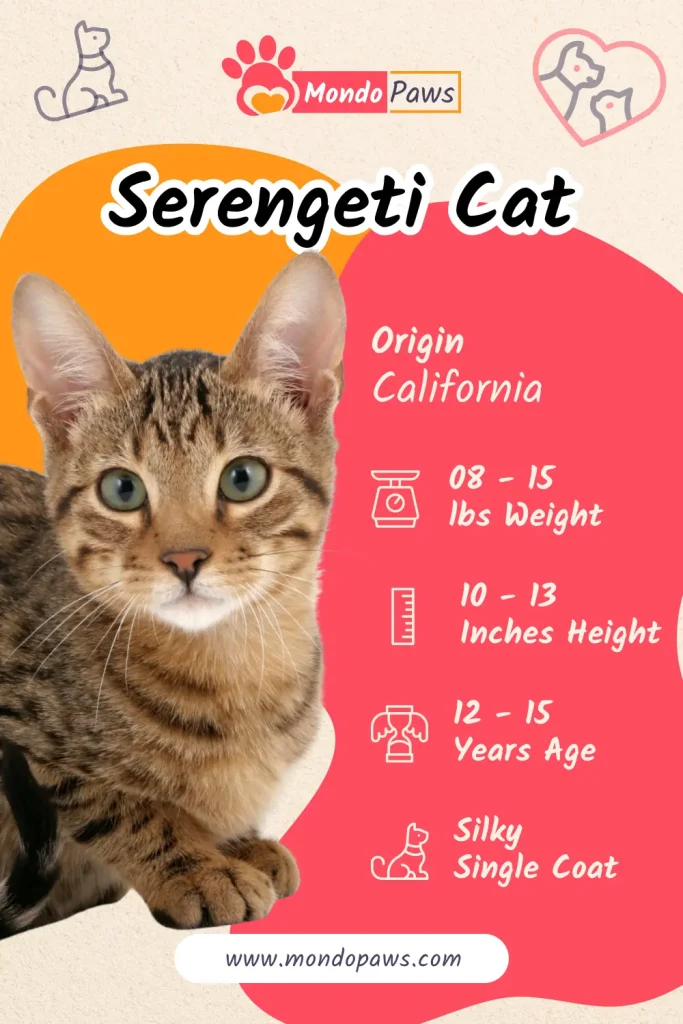
In terms of raw dimensions, the average Serengeti cat size is medium-to-large: males typically run 8 to 15 pounds and are noticeably more muscular than females, who usually settle between 8 and 12 pounds. What makes the breed look bigger and wilder than the scale suggests is its build — a long neck that flows straight into the skull, exceptionally long, straight legs, and enormous, rounded, upright-set ears.
The coat is short, dense, and boldly spotted, coming in shades from pale gold and warm tan to silver and smoke, with round black or dark brown spots (or “ghost spotting” on the solid ebony version). It’s a coat built purely for looks, not insulation, which is part of why the Serengeti sheds relatively little and needs almost no specialized grooming.
Temperament & Personality
Despite the wildcat looks, the Serengeti cat temperament is thoroughly domestic and, by most accounts, delightfully extroverted. These cats are outgoing, confident, and genuinely people-oriented — they tend to seek out laps and shoulders rather than avoid them, and many owners describe them as almost dog-like in how closely they follow their favorite humans from room to room.
Their Oriental Shorthair ancestry shows up clearly in their voice: Serengetis are chatty cats that “converse” through a mix of chirps, trills, and mews rather than a single flat meow. Their Bengal ancestry shows up in their athleticism — they are enthusiastic jumpers and climbers who will happily colonize the top of a bookshelf or refrigerator if given the chance, and they generally dislike being left alone for long stretches.
With Family
Devoted & Talkative
Bonds closely and “chats” throughout the day
With Strangers & Pets
Confident & Social
Rarely skittish; does well in multi-pet homes with slow intros
Energy Level
High
Athletic and always ready for a chase or a climb
Trainability
Quick Learner
Can learn leash walking, fetch, and clicker cues with patience
A Serengeti was built to look like it belongs on the savanna, but its heart is pure lap cat — outgoing, vocal, and happiest when it’s underfoot rather than out of sight.
Because of their high energy and curiosity, Serengetis do best in homes that can offer daily interactive play rather than a purely low-key, hands-off lifestyle. Bored Serengetis will find their own entertainment — usually by way of countertop patrols and open cupboard doors.
Trait Ratings
Personality Traits
Care Requirements
Serengeti Cat Summary Table
| Category | Verdict | Best for |
|---|---|---|
| Active, Engaged Owners | Excellent | Owners who enjoy daily interactive play and puzzle feeders |
| First-Time Cat Owners | Good | Trainable and affectionate, though high-energy for a beginner |
| Apartment Living | Good | Adapts well indoors given vertical space and enrichment |
| Homes Often Left Empty | Not Ideal | Dislikes prolonged solitude; benefits from a feline companion |
| Multi-Pet Households | Good | Social with other cats and dogs when introduced gradually |
| Allergy-Prone Households | Moderate | Short, low-shedding coat, but not a truly hypoallergenic breed |
| Families with Children | Good | Playful and tolerant; supervise rough handling of a lively cat |
| Budget-Conscious Owners | Moderate | Rare breed with a real purchase price, but low grooming upkeep |
Serengeti Cat Living Needs
Serengetis are indoor cats by design — their striking coat and rarity make outdoor roaming risky — but they need their indoor world set up to match their athleticism and curiosity.
Vertical Space
Tall Cat Trees
Loves height; provide climbing shelves or a sturdy cat tree
Children
Playful with Kids
Enjoys interactive games; supervise handling with very young children
Indoor Security
Indoor-Only Recommended
Consider a secure “catio” or harness walks for safe outdoor time
Companionship
Craves Company
Does best with an attentive owner or a compatible feline housemate
A Serengeti doesn’t need a savanna to feel at home — it needs tall places to survey its territory from, toys that move, and a person willing to talk back to all that chirping.
Play, Training & Enrichment Needs
The Serengeti’s Bengal ancestry gives it real athletic drive, and much of its daily exercise can come from self-directed running, jumping, and climbing around a well-equipped home. Even so, most Serengetis thrive on at least one or two dedicated interactive play sessions a day — wand toys, laser pointers, and puzzle feeders all tap into their strong hunting instinct in a constructive way.
Unusually for a cat, Serengetis are often described as genuinely trainable: many take well to leash and harness walks, and some owners successfully teach basic cues like “sit,” “come,” or simple fetch games using clicker training and food rewards. As with any cat, short, positive sessions work far better than repetition-heavy drilling.
Kitten Focus
Early Handling & Socialization
A Serengeti kitten benefits from early exposure to handling, carriers, and other pets to build its already-confident nature.
Adult Focus
Structured Daily Play
Redirects hunting instinct and counter-surfing curiosity into wand toys and puzzles.
for more guide about cats weight check out our weight calculator.
Grooming & Coat Care
One of the easiest parts of Serengeti ownership is the coat. Short, dense, and glossy, it needs very little intervention beyond the basics — a welcome contrast to its dramatic wild-cat looks.
Coat Type
Short & Low-Maintenance
Weekly brushing with a rubber curry or grooming glove is plenty
Coat Colors
Spotted Tabby or Solid
Gold, tan, silver, or smoke backgrounds with black or brown spots
Low Shedding
No undercoat to speak of; minimal seasonal blowout
Ears & Nails
Routine Checks
Large ears benefit from an occasional wipe; trim nails every few weeks
The Serengeti’s dramatic looks come from pattern and build, not from a demanding coat — this is a breed where the grooming bill stays refreshingly low.
Health & Common Concerns
Serengeti cats have a reputation as a generally hardy breed, with most sources reporting no breed-specific hereditary conditions identified so far and an average lifespan of roughly 9 to 15 years. As a relatively young, hybrid-origin breed, the Serengeti benefits from some hybrid vigor, though responsible breeders still screen for conditions known to affect its parent breeds.
Hypertrophic Cardiomyopathy (HCM)
Cardiac · Standard Screening in Pedigreed Cats
Dental Disease
Preventive · Common Across All Domestic Cats
Weight Gain
Metabolic · Risk if Play Needs Go Unmet
Kidney & Urinary Health
General Feline Concern · Benefits from Good Hydration
Is the Serengeti Cat a Recognized Breed?
The Serengeti is recognized by The International Cat Association (TICA), which accepted it in 2001 and continues to develop its breed standard, and it is acknowledged by France’s Livre Officiel des Origines Félines (LOOF) as a “new generation” breed. It is not currently recognized by the Cat Fanciers’ Association (CFA) or the UK’s Governing Council of the Cat Fancy (GCCF), so it remains classed as a developing rather than fully established breed in some registries.
Health Screening
Because the breed draws from Bengal and Oriental Shorthair lines, ethical breeders typically screen for conditions known in those parent breeds, including heart screening for HCM, alongside routine veterinary checkups throughout the cat’s life.
Nutrition & Feeding
Like all cats, the Serengeti is an obligate carnivore and does best on a high-quality diet built around real animal protein rather than heavy plant-based fillers. Their high activity level means they can generally handle a bit more food than a sedentary cat of the same size, but portion control still matters a bored or under-stimulated Serengeti can gain weight quickly.
High-Protein Diet
Measured Portions
Water Fountain Recommended
Many owners of active breeds like the Serengeti add a pet water fountain to encourage extra drinking, since cats naturally have a low thirst drive and good hydration supports long-term kidney and urinary health. As with any cat, check with a vet before making major diet changes, especially for kittens or seniors.
for more guide about cat food quantity check out our Food calculator.
Cost of Ownership & Kitten Price
The Serengeti cat price reflects its rarity: with only a small number of dedicated breeders worldwide, a Serengeti kitten typically costs somewhere between $600 and $2,000, with pricing influenced by coat color, lineage, and show quality. Because the breed is seldom seen in shelters, adoption opportunities are limited compared with more common breeds anyone hoping to adopt rather than buy should expect a longer search.
Ongoing costs are otherwise comparable to any active shorthaired cat: quality food, routine veterinary care, and a reasonable investment in enrichment (cat trees, puzzle feeders, wand toys) to keep a high-energy cat satisfied. Grooming costs stay low thanks to the short, low-maintenance coat.
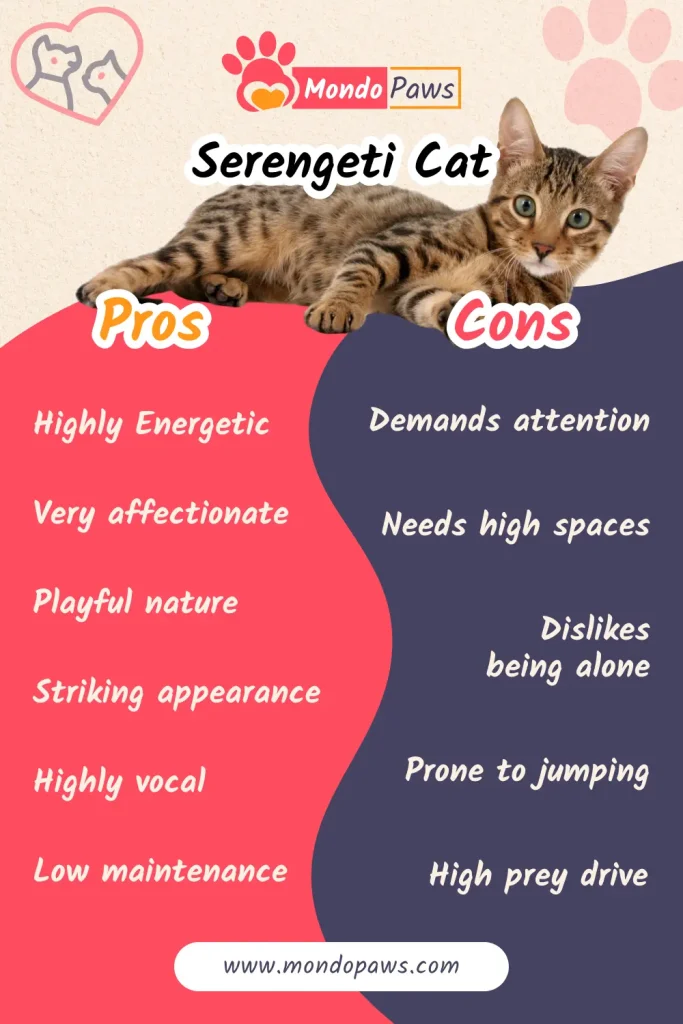
Strengths
- Striking, serval-inspired appearance with no wild ancestry to manage
- Low-maintenance short coat with minimal shedding
- Affectionate, people-oriented, and unusually trainable for a cat
- Generally healthy breed with no confirmed hereditary conditions
- Sociable with other cats and dogs given proper introductions
Challenges
- Rare and can be difficult and costly to source from a breeder
- High energy and play needs; not a low-maintenance lap cat
- Very vocal, which may not suit noise-sensitive households
- Dislikes being left alone for long periods
History of the Serengeti Cat
The Serengeti cat’s history is short but purposeful. In 1994, conservation biologist Karen Sausman of Kingsmark Cattery in California set out to create a domestic cat that captured the look of the African serval — the tall, spotted wildcat found in and around the Serengeti region — without introducing any actual wild blood into the breeding program.
To achieve the serval’s silhouette using only domestic genetics, Sausman crossed the Bengal (itself several generations removed from its own wild ancestor, the Asian leopard cat) with the Oriental Shorthair, which contributed the long legs, large ears, and svelte body type. The result, named after the Serengeti National Park, combined the Bengal’s bold spotted coat with the Oriental’s build and famously vocal personality.
1994
Karen Sausman begins the Serengeti breeding program at Kingsmark Cattery in California, crossing Bengal and Oriental Shorthair cats.
1995
An expanded breed development project widens the gene pool and brings more breeders into the program.
2001
The International Cat Association (TICA) formally recognizes the Serengeti as a breed with an official standard.
Today:
Serengetis are bred in small numbers across the USA, Europe, the UK, and Russia. The breed remains uncommon and is still classed as developing by some major registries, but it has built a loyal following among owners drawn to its wild look and outgoing personality.
Fun Facts
Zero Serval DNA
Despite the striking resemblance, no Serengeti cat has any serval blood in its pedigree — the wildcat look comes entirely from selective domestic breeding.
Born from Conservation Interest
Creator Karen Sausman was a conservation biologist who hoped the breed would spark interest in serval conservation and wildlife awareness.
Leash-Trainable
Serengetis are among the small number of cat breeds that often take well to harness and leash walks around the neighborhood.
Named for a National Park
The breed takes its name from the Serengeti National Park in Tanzania, home to one of the largest wild serval populations on earth.
A Chatty Companion
Thanks to its Oriental Shorthair ancestry, the Serengeti communicates with an unusually wide range of chirps, trills, and mews.
Frequently Asked Questions
Yes. Serengeti cats are outgoing, affectionate, and playful, which generally makes them a good match for families, including those with children who can play gently and respectfully with an energetic cat. They also tend to do well alongside other cats and dogs when introductions are handled gradually.
No. Serengeti cats have no serval or other wildcat ancestry at all. The breed was created purely from two domestic breeds — the Bengal and the Oriental Shorthair — deliberately selected to reproduce the serval’s look through domestic genetics alone.
Bengal cats descend from crosses with the wild Asian leopard cat several generations back, while the Serengeti has no wild ancestry at all — it was built from Bengal and Oriental Shorthair stock specifically to mimic the look of a serval. Serengetis also tend to have proportionally longer legs, larger rounded ears, and a longer neck than Bengals, along with a more vocal, Oriental-influenced personality.
No cat breed is truly hypoallergenic, but the Serengeti’s short, low-shedding coat means less loose hair and dander around the home than many long-haired breeds, which can make symptoms more manageable for some mildly allergic owners.
A Serengeti kitten from a reputable breeder typically costs between $600 and $2,000, with the exact price depending on lineage, coat color, and show quality. Because the breed is rare and adoption listings are uncommon, most owners source their cat directly from one of a small number of dedicated breeders.
An adult Serengeti cat typically weighs between 8 and 15 pounds, with males generally larger and more muscular than females, and stands roughly 8 to 10 inches at the shoulder with a notably long neck and legs. Their average lifespan runs from about 9 to 15 years, and the breed has no confirmed hereditary health conditions to date.
Behind the Research: How We Created This Serengeti Cat Guide
At Mondopaws, we believe breed profiles must be grounded in verifiable breeding history and current registry standards. To create this Serengeti cat guide, our editorial team:
- Reviewed official breed standards: Cross-checked size, weight, and coat descriptions against The International Cat Association (TICA), the breed’s official registering body.
- Consulted veterinary and feline breed resources: Drew on published lifespan and health data covering the Serengeti’s Bengal and Oriental Shorthair ancestry from Cats.com’s Serengeti breed profile.
- Traced documented breed history: Verified the founding role of biologist Karen Sausman, Kingsmark Cattery, and the breed’s TICA recognition timeline via the breed’s documented history.
Final Thoughts
Serengeti cats prove that you don’t need a single drop of wild blood to look like you belong on the savanna. Built entirely from domestic breeds yet echoing the serval’s long legs, oversized ears, and bold spotted coat, the Serengeti pairs showstopping looks with a genuinely affectionate, chatty, people-focused personality and a coat that asks almost nothing of its owner in return.
The trade-offs are real: this is a rare, sometimes pricey breed that wants daily engagement and dislikes being left to its own devices for long. But for an active household ready to keep pace with a curious, athletic cat, a Serengeti offers a striking, devoted companion unlike almost anything else in the domestic cat world.
Written by the Mondo Paws Team
At Mondo Paws, we are passionate about giving rare and lesser-known breeds the same rigorous, well-organized treatment as household names. For this guide, we combined official breed-standard documentation, feline veterinary data, and documented breeding history to present an accurate overview of the remarkable Serengeti cat.