Table of Contents
Companion & Working Breed · Germany/France
The Poodle is one of the most recognisable and intelligent dog breeds in the world — an elegant water retriever, originally developed in Germany and refined in France, that comes in three official sizes: Toy, Miniature, and Standard. Beneath the elaborate show clips is a sharp, athletic, endlessly trainable companion built to work alongside people.
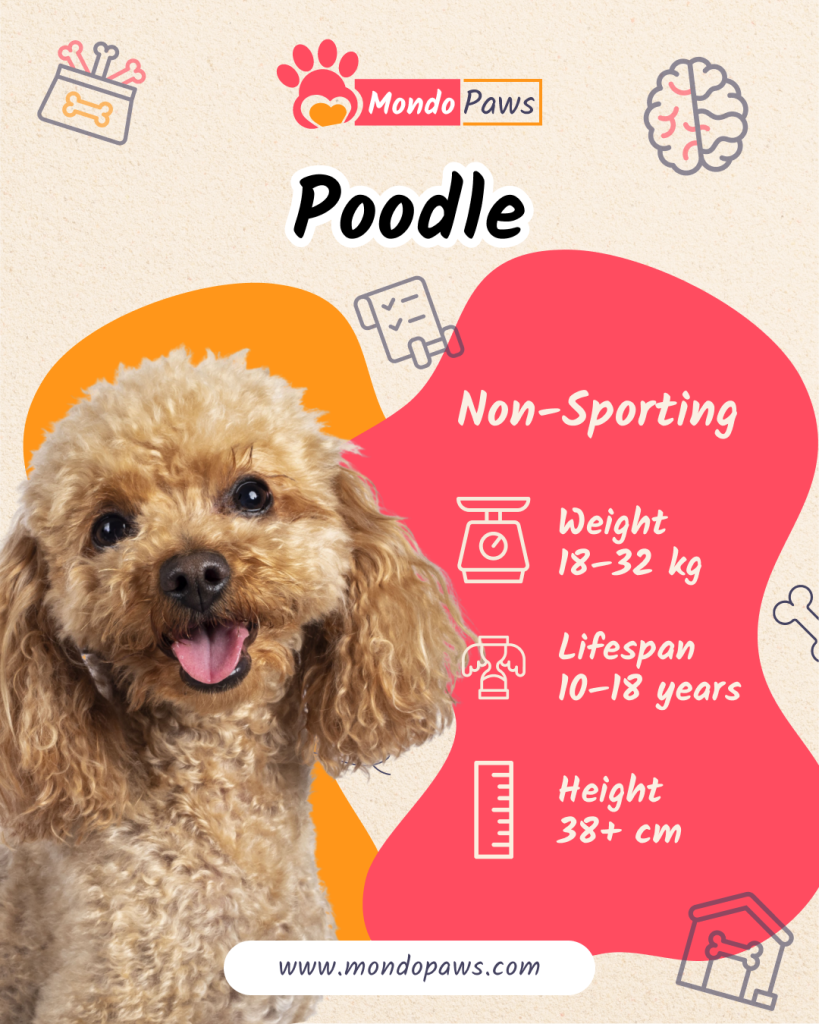
4–70 lbs
Weight (varies by size)
10–15″+
Height (varies by size)
12–15 years
Lifespan
30 mph
Top Speed (Standard)
1600s
Origin Era
Rank #2
Intelligence
Poodles have an athletic, square-proportioned build under all that coat — a proud head carriage, dark almond eyes, and long drop ears. The famous curly, non-shedding coat was originally clipped short over the body and left full around the joints and chest to protect a working water dog from cold lakes, not for looks.
They are whip-smart, eager to please, and genuinely playful — Poodles were bred to retrieve, think, and stay close to a handler, and they carry that partnership instinct into modern family life. They ask for mental engagement as much as physical exercise, and reward an active household with obedience, agility, or simple games of fetch.
Temperament & Personality
The Poodle personality is best described as sharp, sociable, and quietly proud. They are quick studies who bond closely with their family, generally polite with strangers once introduced, and happiest with a routine that includes both a walk and a puzzle. Toy and Miniature Poodles tend to be a little more vocal and clingy, while Standards are calmer and more independent-minded, carrying more of the breed’s original working drive.
Real Owner Insights: What Daily Life with a Poodle Is Actually Like
“People assume our Standard Poodle, ‘Juniper,’ is a fancy show dog, but she’s basically a Labrador in a curly coat — obsessed with tennis balls and will retrieve until your arm gives out. The grooming bill every six weeks is the real cost of owning her, not the food.”
— As shared by a Poodle owner on r/poodles on Reddit
“He picked up sit, stay, and leave-it in about a week as a puppy — almost too smart, honestly, because he gets bored fast without a job. A snuffle mat or short training session before dinner keeps him settled all evening.”
— Shared by a Poodle owner in a breed group on Facebook
Core Performance Metrics
Breed comparison data breakdown — Poodle vs. standard breed benchmark.
With Family
Eager Companion
Wants to be included in everything you do
With Strangers
Polite, Not Pushy
Alert and observant, warms up quickly once introduced
Energy Level
Moderate–High
Needs 30–60 mins daily activity plus mental work
Trainability
Exceptional
Picks up new commands and tricks in just a few repetitions
Behind the topknot is one of the sharpest minds in the dog world — a Poodle needs a job just as much as it needs a walk.
Reward-based training and daily mental enrichment are highly recommended. Resources from the American Kennel Club emphasize positive reinforcement and early socialization for best results.
Trait Ratings
Personality Traits
Care Requirements
Poodle Summary Table
| Category | Verdict | Best for |
|---|---|---|
| Families with kids | Good | Gentle and playful, especially Standard and Miniature sizes |
| First-time owners | Excellent | Highly trainable and eager to please |
| Apartment living | Moderate | Toy/Miniature adapt well; Standard needs more space |
| Allergy sufferers | Good | Low-shedding curly coat, often tolerated by mild allergy sufferers |
| Guard / watchfulness | Moderate | Alert and vocal, but not an intimidating guard dog |
| Quiet indoor lifestyles | Moderate | Needs daily mental stimulation to stay settled |
| Multi-pet households | Good | Sociable with other pets when raised together |
| Budget-conscious owners | Not Ideal | Frequent professional grooming is a real recurring cost |
Poodle Living Needs
Poodles adapt to almost any home as long as it offers daily activity, regular grooming, and enough mental engagement to match that big brain.
Space
Flexible by Size
Toy and Miniature suit apartments; Standard prefers a yard
Children
Great with Kids
Patient and playful, especially larger sizes around younger children
Heat Tolerance
Moderate
Dense curly coat needs a shorter summer clip and shade
Other Pets
Generally Easy
Sociable and non-confrontational with cats and other dogs
A Poodle does not need acres of space it needs a daily walk, a training game, and a grooming appointment on the calendar.
Training and Exercise Needs
Poodles are consistently ranked among the smartest dog breeds and learn new commands remarkably fast, but that same intelligence means an under-stimulated Poodle will find its own — often destructive — entertainment. Beyond 30–60 minutes of daily exercise (more for Standards, less for Toys), they thrive on obedience work, agility, nose work, or simple retrieving games that were literally bred into the breed as water retrievers.
Exercise Allocation Profile (Weekly Ideal)
With Family
Eager Companion
Learns household routines and cues almost immediately
With Strangers
Polite, Not Pushy
Settles quickly once introductions are made
Grooming & Coat Care
The Poodle coat is the single biggest commitment of the breed: dense, curly, and constantly growing rather than shedding out, it mats close to the skin within days if left unbrushed. Most owners settle into brushing every one to three days plus a professional groom every four to six weeks to keep the clip manageable.
Coat Type
Curly & Single-Layer
Brush every 1–3 days with a slicker brush and comb
Coat Colors
Many Solid Colours
Black, white, apricot, red, cream, silver, brown and more
Shedding
Minimal
Low-shed, low-dander coat often better tolerated by allergy sufferers
Other Needs
Ears, Eyes & Clips
Weekly ear checks, regular eye wiping, professional clip every 4–6 weeks
A few minutes of brushing every couple of days is far cheaper than one dematting session at the groomer.
Calm, positive grooming routines are highly recommended. Resources from the American Kennel Club emphasize early handling conditioning for best results.
Health & Common Concerns
The Poodle is a generally long-lived, sturdy breed, but each size carries its own predictable watch-points. The main areas to monitor are joints, hormones, eyes, and — for deep-chested Standards — bloat, all of which are far easier to manage with a responsibly bred, health-screened dog.
Hip Dysplasia
Orthopedic · Mainly Standard
Addison’s Disease
Endocrine · Genetic Predisposition
Progressive Retinal Atrophy
Ocular · DNA Testing Advised
Bloat (GDV)
Digestive · Standard Poodle Risk
American Kennel Club (AKC) Breed Standard
According to the official breed standard from the American Kennel Club (AKC), the Poodle is defined by its squarely built, well-proportioned frame, dense curly or corded coat, and dignified, intelligent expression, recognized in Standard, Miniature, and Toy varieties.
Orthopedic & Genetic Screening
Veterinary resources such as the Orthopedic Foundation for Animals (OFA) note that hip dysplasia, Addison’s disease, and inherited eye conditions have historically appeared across Poodle lines. Responsible breeders now screen breeding stock with hip evaluations, DNA panels, and thyroid testing, so puppies from tested lines carry a meaningfully lower risk.
Relative Health Risk by Condition
Regular veterinary checkups and responsible breeding help reduce these risks.
Nutrition & Feeding
Because the breed spans three very different sizes, portioning matters more than for most breeds — a Toy Poodle’s calorie needs are a fraction of a Standard’s, and each size has its own risk profile to feed around.
Size-appropriate protein
Coat-supporting omega fats
Bloat-conscious feeding
Toy and Miniature Poodles run a faster metabolism and benefit from small-breed kibble sized for their jaws, while deep-chested Standards do best on two smaller meals a day rather than one large one, with vigorous exercise avoided right around mealtimes to reduce bloat risk.
According to the American Kennel Club, controlled-calorie diets sized to the individual dog, omega-rich fats for coat quality, and consistent feeding schedules support healthy weight, digestion, and joint health across all three Poodle sizes.
to find out more about dogs weight visit Dog Weight Calculator.
Ownership Cost Calculator
Poodle puppies from registered breeders typically sell for $1,000–$3,000, depending on size and pedigree — professional grooming is the real long-term cost, not the purchase price. Adjust the inputs below for a personalised annual running-cost estimate. All figures are in USD and reflect US market averages.
Strengths
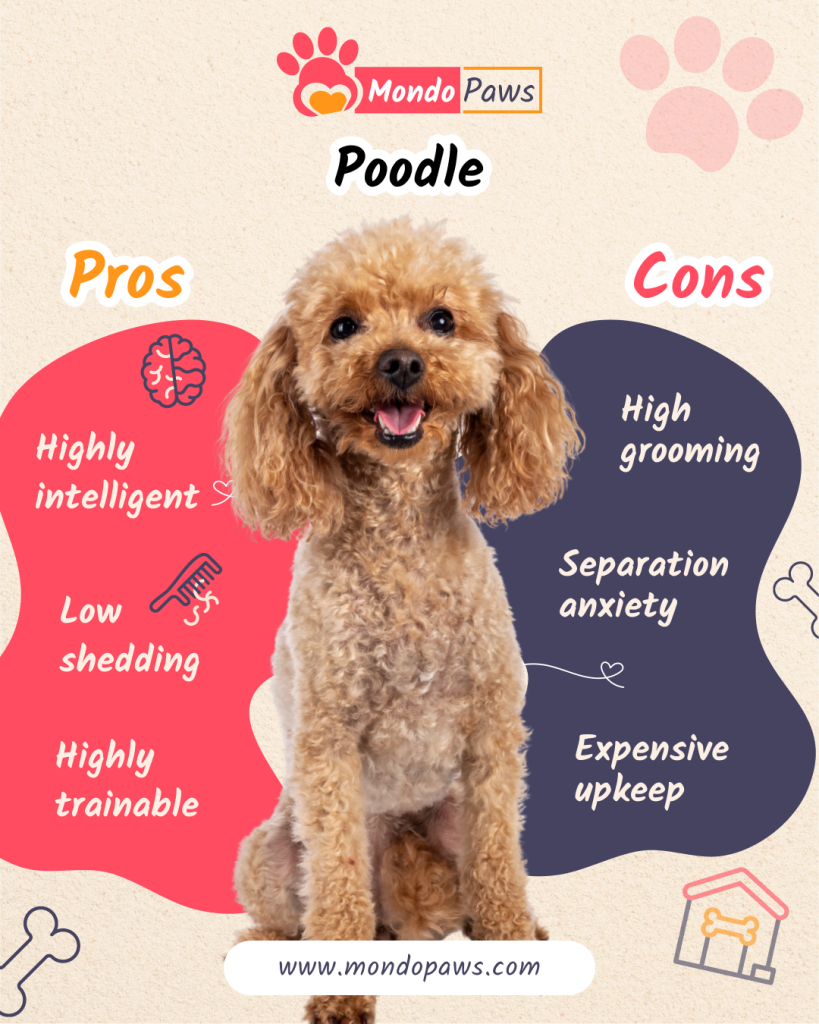
- Exceptionally intelligent and fast to train
- Low-shedding coat, often well tolerated by allergy sufferers
- Comes in three sizes to fit different homes and lifestyles
- Long-lived and generally sturdy for its size
- Playful, affectionate, and genuinely people-oriented
Challenges
- Professional grooming every 4–6 weeks is non-negotiable
- Needs real mental stimulation or can become bored and vocal
- Standard size is prone to bloat and needs careful feeding
- Grooming and vet costs add up quickly over a lifetime
History of the Poodle
The Poodle’s name traces back to the German word “Pudel,” meaning “to splash in water” — a nod to its original job as a duck and waterfowl retriever in the ponds and marshes of Germany. The breed was later refined in France, where it earned the name “Caniche,” derived from the French word for duck, and eventually became the country’s national dog.
The breed’s famous show clips were originally functional, not decorative. Historians generally credit the traditional trim to:
Hunters and retrievers who shaved the hindquarters for swimming speed while leaving hair over the joints, chest, and organs for warmth in cold water
As the breed’s intelligence and trainability became prized beyond hunting, French nobility took to the Poodle as a fashionable companion, and breeders began developing the smaller Miniature and Toy varieties for lap-dog and performance roles — Poodles became fixtures of European circuses thanks to how quickly they learned tricks.
Here is a brief timeline of the Poodle’s history:
1600s
Water-retrieving dogs resembling the modern Poodle are documented working alongside German and French hunters.
1700s–1800s
The Poodle becomes a fixture of French court life and travelling circuses, prized for its trainability.
1887
The American Kennel Club officially recognizes the Poodle as a breed.
Early-to-mid 1900s
Miniature and Toy varieties are formally established alongside the original Standard size, all recognized as one breed.
1950s–1980s
The Poodle becomes one of America’s most popular dog breeds, dominating AKC registration statistics for over 20 consecutive years.
Today:
The Poodle remains one of the world’s most recognized and intelligent breeds, and its low-shedding coat made it the foundation for popular crossbreeds such as the Labradoodle and Goldendoodle from the 1980s onward.
Modern breeding continues to prioritize health-tested lines and preserves the breed’s working retriever instincts alongside its companion role.
Fun Facts
Born to Swim
The name “Poodle” comes from the German “Pudel” — to splash in water
France’s National Dog
Officially recognized as the national dog breed of France
Functional Clips
Traditional show clips originated to protect joints and organs while swimming
Three Sizes, One Breed
Toy, Miniature, and Standard are all considered the same breed under a single standard
Second Smartest
Ranks #2 in canine working intelligence, behind only the Border Collie
Frequently Asked Questions
Poodle puppies from registered breeders usually cost between $1,000 and $3,000, depending on size and pedigree. Budget a further $1,500–$3,000 a year for food, professional grooming, and veterinary care — grooming is the biggest recurring expense.
Most Poodles need a professional groom every four to six weeks, plus brushing every one to three days at home to prevent matting close to the skin. Skipping grooming for too long usually means a costly shave-down rather than a routine trim.
No dog is truly 100% hypoallergenic, but the Poodle’s low-shedding, low-dander curly coat means less allergen is released into the home compared with heavy-shedding breeds. Many mild allergy sufferers tolerate Poodles well, though individual sensitivity varies.
All three are the same breed under one standard, differing mainly in size: Toy is under 10 inches at the shoulder, Miniature falls between 10 and 15 inches, and Standard is over 15 inches. Temperament is similar across all three, though Standards tend to be calmer and Toys more vocal.
Yes — their intelligence and eagerness to please make Poodles one of the easier breeds to train, even for first-time owners. For families, Standard and Miniature sizes are generally the most playful and tolerant with children, provided daily exercise and grooming needs are met.
Behind the Research: How We Created This Poodle Guide
At Mondopaws, we believe pet guides should be grounded in both hard science and real-world care. To compile this Poodle breed profile, our editorial team:
- Cross-referenced official breed standards: Analyzed official documentation and care guidelines directly from the American Kennel Club (AKC) and established Poodle breed clubs.
- Consulted veterinary & clinical research: Verified breed-relevant conditions (such as hip dysplasia, Addison’s disease, and progressive retinal atrophy) using material from the Orthopedic Foundation for Animals (OFA) along with clinical insights from AKC and PetMD.
- Gathered authentic owner experiences: Evaluated real feedback, grooming routines, and temperament observations shared by verified Poodle owners across active pet forums and social media communities.
Final Thoughts
The Poodle is one of the smartest, most versatile pedigreed dogs you can live with: quick to learn, low-shedding, playful, and available in a size to fit nearly any household. The trade-offs are real — frequent professional grooming, daily mental stimulation, and the orthopedic, hormonal, and bloat risks that come with poorly bred or careless feeding of larger lines.
For people who want an intelligent, active companion and are ready to commit to a regular grooming schedule, a health-tested Poodle — in whichever size suits your home — is one of the most rewarding dogs in the world.
Written by the Mondo Paws Team
At Mondo Paws, we simply love pets! For this guide, we gathered and cross-checked key data on this breed from across the web, organizing everything in the clearest, most practical way possible so you can find what you need at a glance.