
Table of Contents
Dog Behaviour Explainer · Energy & Rest
Why do dogs become lazy? In most cases it isn’t laziness at all. A dog that suddenly sleeps more, drags on walks, or ignores the ball is usually telling you something about its age, weight, routine, boredom level, the weather — or its health. Dogs are hardwired to conserve energy, so “doing less” is their first and cheapest response to almost any change in the body or the household.
12–14 hrs
Normal adult sleep per day
18–20 hrs
Normal for puppies & seniors
48–72 hrs
Slump lasting longer = vet call
#1 Cause
Excess weight & under-exercise
Sudden
Onset matters more than amount
7+ years
Age when energy naturally dips
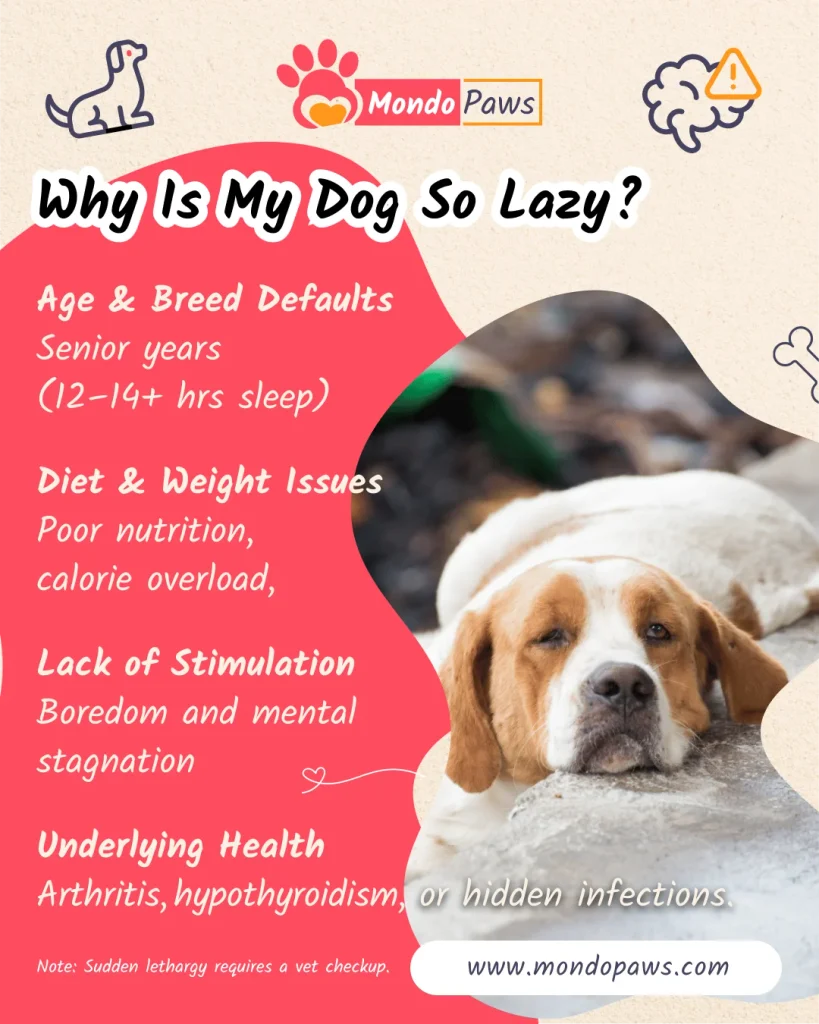
There are two very different pictures owners describe with the same word. The first is a dog who has always been mellow and is simply built that way — a Basset Hound who naps through the afternoon is not unwell, that is the breed. The second is a dog whose energy has changed: the same dog, the same walk, but less interest, slower recovery, more lying down. The second picture is the one worth investigating, and this guide walks through every likely reason in order of how common it is.
Throughout, keep one rule in mind: a dog that is tired still wants things. It will still lift its head for food, still greet you, still wag. A dog that has stopped wanting things is not lazy — it is unwell, and that distinction is the whole subject of the next section.
Lazy or Lethargic? The Difference That Matters
Vets don’t use the word “lazy”. They separate low activity (a normal, reversible state) from lethargy (a clinical sign). The table below is the fastest way to work out which one you’re looking at before you decide whether to change the routine or book an appointment.
| What you see | Normal low energy | Lethargy (see a vet) |
|---|---|---|
| Response to food | Instant, keen | Slow, disinterested, or refuses |
| Greeting you | Gets up, tail wags | Stays down, eyes follow only |
| Walks | Starts slow, warms up | Starts slow, gets worse, wants home |
| Onset | Gradual, over months | Sudden, over hours or days |
| Recovery | Bright again after rest | Flat even after a full night’s sleep |
| Other signs | None | Panting, limping, vomiting, drinking more, weight change |
A lazy dog chooses rest. A lethargic dog has no choice. If your dog still wants dinner, the door, and the ball — just less often — you are usually looking at lifestyle, not illness.
How Much Sleep Is Actually Normal?
Most owners who ask “why has my dog become so lazy?” are comparing their dog to a human schedule. Dogs sleep in short polyphasic bursts and spend a large part of the day dozing by design. Before treating low energy as a problem, check it against the normal range for your dog’s life stage.
Daily Rest & Activity by Life Stage (24 hrs)
(0–6 mo)
(1–7 yrs)
Dog
(8+ yrs)
Indicative ranges only. Individual dogs vary by breed, climate and household routine.
If your adult dog is sleeping 16–18 hours and was previously on 12–13, that is a real change and worth reading the rest of this guide carefully. If your senior has drifted from 13 to 15 hours across a year, that is ordinary ageing.
Why Dogs Become Lazy: The 9 Main Causes
Almost every case of new low energy traces back to one of nine causes — and frequently to two or three of them stacked together (an overweight, under-walked dog in a hot summer, for example). Work through them in this order.
Cause frequency
Lifestyle & Routine Causes
Body & Health Causes
Cause 1
Extra Weight
Every extra kilo raises the effort of standing, walking and cooling down so the dog moves less, and gains more
Cause 2
Lost Fitness
Weeks of short walks de-condition muscle and stamina fast; the dog isn’t unwilling, it’s unfit
Cause 3
Boredom
Same route, same toys, no jobs — dogs switch off mentally and sleep through the empty hours
Cause 4
Silent Pain
Arthritis, hip dysplasia, dental disease and back pain rarely make dogs cry — they make them stop
Cause 5
Heat
Thick-coated and flat-faced dogs shut down in humidity; energy returns the moment it cools
Cause 6
Stress & Change
A move, a new baby, a lost companion or a schedule change can flatten a dog for weeks
Cause 7
Diet Gaps
Low-protein filler foods, too many treats, or a sudden food change can blunt energy and digestion
Cause 8
Illness
Thyroid disease, anaemia, infection, heart disease and tick-borne illness all present as “he’s gone lazy”
Cause 9
Medication
Sedating antihistamines, pain relief, behaviour medication and post-vaccine days cause short slumps
Medical Reasons Behind Sudden Low Energy
When the change is sudden, or the dog is young, medical causes move to the top of the list. These are the conditions vets check first, and the pattern that usually gives each one away.
Hypothyroidism
Classic combination of new sluggishness, weight gain on the same food, thinning coat and heat-seeking. Common in middle-aged Golden Retrievers, Dobermans and Cocker Spaniels; confirmed with a blood test and managed with daily medication.
Arthritis & Joint Pain
Stiff after rest, slow on stairs, reluctant to jump into the car, lagging at the end of walks. Dogs mask pain well, so reduced activity is often the only sign for months.
Anaemia & Parasites
Heavy worm or flea burdens, and tick-borne infections, drain red cells. Look for pale gums, fast breathing after mild effort, and a dull coat alongside the tiredness.
Heart Disease
Tires quickly, coughs at night, breathes faster while resting. Cavaliers, Boxers and Dobermans are over-represented; early detection changes the outcome significantly.
Dental Disease
Badly underrated. Chronic mouth pain and low-grade infection leave dogs quiet, slower to eat, and reluctant to play with toys — often reversed within days of a dental.
Infection or Fever
Any fever produces a flat, withdrawn dog with a poor appetite. If low energy arrives with warm ears, shivering or off food, treat it as urgent rather than lazy.
Age and Breed: When “Lazy” Is Just Normal
Some dogs were never meant to be busy. Breeds developed as companions, guardians or short-burst sprinters spend most of the day resting by design, and comparing them to a Border Collie will always make them look lazy.
| Group | Typical daily exercise | Expected rest |
|---|---|---|
| Herding & working (Collie, Malinois, Husky) | 90–120+ min plus a job | Low — restless without work |
| Sporting (Labrador, Pointer, Spaniel) | 60–90 min | Moderate |
| Terrier & small active (Jack Russell, Beagle) | 45–60 min | Moderate |
| Giant breeds (Great Dane, Mastiff, Saint Bernard) | 30–45 min, low impact | High — naturally sedate |
| Brachycephalic (Bulldog, Pug, Shih Tzu) | 20–30 min, cool hours only | High — heat limited |
| Companion & scent-hound (Basset, Cavalier, Chow) | 30–45 min | High — bred to be calm |
Puppies
Burst & Crash
Twenty wild minutes then two hours flat out — completely normal up to 18–20 hrs sleep a day
Adolescents
The Teen Dip
Around 8–14 months many dogs settle noticeably; often mistaken for illness
Seniors
Gradual Slowdown
Expect shorter walks and longer naps from 7+; a sudden senior change is still a vet visit
Diet, Weight and the Energy Spiral
Excess weight is the single most common reversible reason dogs become lazy, and it works as a loop: extra weight makes movement harder, less movement burns fewer calories, and the weight climbs again. Breaking the loop restores energy faster than almost any other change you can make at home.
use our dog weight calculator to find out your pet average weight.
- Run a body condition check. You should feel ribs easily under a thin fat layer, see a waist from above, and see a tuck from the side. If not, the dog is carrying extra.
- Count treats honestly. Training treats, chews and table scraps routinely add 20–30% of daily calories without anyone noticing.
- Measure meals with a cup or scale instead of pouring by eye, and feed to the dog’s target weight, not its current one.
- Check protein quality. Low-protein, filler-heavy food leaves some dogs full but flat; a named meat first ingredient is a reasonable baseline.
- Split the day’s food into a slow feeder or snuffle mat so eating becomes activity rather than a ten-second event.
Losing even 5–10% of body weight is often enough to visibly change how willingly an overweight dog gets up, walks and plays.
Boredom, Stress and Environment
Dogs are problem-solving animals. Given nothing to solve, many simply power down — and owners read the result as a calm, lazy dog rather than an under-employed one. Mental work tires and satisfies dogs in a way that repeating the same pavement loop does not.
Real Owner Insights: When a “Lazy” Dog Turned Out to Be Something Else
“We spent about six months joking that our Lab had ‘retired’ at five. He’d flop halfway through walks and stopped meeting us at the door. Bloodwork came back as hypothyroidism. Three weeks on medication and he was stealing socks again.”
— As shared by a dog owner on r/dogs
“Our girl wasn’t lazy, she was bored out of her mind. Same route twice a day for two years. We swapped one walk for scent games and a food puzzle and her whole personality came back within a fortnight.”
— Shared by an owner in a dog training group on Facebook
Enrichment
Scent Work
Ten minutes of nose games tires most dogs more than a thirty-minute walk
Routine
New Routes
Novel smells and surfaces re-engage a dog that has stopped caring about the usual loop
Stress
Household Change
Moves, new pets, grief and noise phobia all present as withdrawal and extra sleeping
Dog Energy Checker
Answer six quick questions about your dog to see whether the low energy looks like lifestyle, ageing, or something that needs a vet. This is a guidance tool, not a diagnosis.
Red Flags: When to Call a Vet
Call the Same Day
- Collapse, wobbling, or unwilling to stand
- Pale, white or blue-tinged gums
- Laboured breathing or fast breathing at rest
- Refusing all food and water for 24 hours
- Repeated vomiting, a swollen belly, or crying out
Book Within the Week
- Low energy lasting more than 48–72 hours
- Weight gain or loss without a diet change
- Stiffness after rest, or reluctance on stairs
- Drinking or urinating noticeably more
- Coat changes, bad breath, or a young dog slowing down
Take a short phone video of your dog walking and getting up from lying down. Subtle stiffness and effort are far easier for a vet to spot on video at home than in a two-minute consult room assessment.
A 7-Day Plan to Rebuild Your Dog’s Energy
Once medical causes are ruled out, energy comes back with structure rather than intensity. Build slowly — a de-conditioned or overweight dog pushed too hard will be sorer and less willing the next day.
Days 1–2
Measure everything: food, treats, walk minutes and sleep hours. You cannot fix a routine you haven’t recorded.
Day 3
Add one short extra walk at the coolest hour of the day rather than lengthening the existing one.
Day 4
Replace one bowl feed with a snuffle mat, scatter feed or puzzle toy so the dog works for part of its dinner.
Day 5
Cut treats to 10% of daily calories and swap high-value biscuits for pieces of the dog’s own kibble ration.
Day 6
Introduce five minutes of scent work — hide treats around a room and let the dog find them.
Day 7
Take a new route with unfamiliar smells, and compare the dog’s engagement to day one.
Week 2 onward:
Increase total activity by no more than 10% a week, keep the food measured, and re-weigh the dog every fortnight. Most lifestyle-driven low energy visibly improves within three to four weeks.
Frequently Asked Questions
A sudden change over hours or days is rarely behavioural. The most common explanations are pain (especially joints, back or teeth), fever or infection, a reaction to medication or vaccination, hot weather, or an internal problem such as anaemia or heart disease. If it lasts beyond 48–72 hours, or comes with appetite loss, vomiting, limping or heavy breathing, book a vet appointment rather than waiting it out.
Yes. Adult dogs typically sleep 12–14 hours a day, and puppies, giant breeds and seniors often reach 18–20 hours. What matters is the pattern, not the total: a dog that sleeps a lot but is bright, hungry and enthusiastic when awake is healthy. A dog whose sleeping has clearly increased and who is dull while awake is not.
Absolutely. Under-stimulated dogs sleep through empty hours, and dogs going through grief, a house move, a new baby or a change in their owner’s schedule often withdraw and rest more for several weeks. Enrichment — scent games, puzzle feeders, training sessions, new walking routes — usually produces a visible change within one to two weeks. If nothing improves, treat it as a possible medical issue.
Large and giant breeds often show an energy drop from around five to six years, medium breeds around seven, and small breeds closer to nine or ten. The slowdown should be gradual. A young or middle-aged dog that slows noticeably within weeks deserves a check-up, because thyroid disease, joint pain and heart problems all appear at these ages.
Bulldogs, Basset Hounds, Pugs, Shih Tzus, Great Danes, Mastiffs, Saint Bernards, Chow Chows, Cavalier King Charles Spaniels and Greyhounds are all known for long rest periods. Greyhounds are the classic surprise — sprinters that sleep most of the day. In these breeds, a calm dog is normal; a change in that dog’s usual baseline is still worth checking.
Rule out pain and illness first, then rebuild gradually: measure food and cut treats to 10% of daily calories, add short frequent walks rather than one long one, walk in cooler hours, feed part of each meal through a puzzle or snuffle mat, add five to ten minutes of scent work daily, and increase total activity by about 10% per week. Most healthy dogs show a clear difference inside a month.
Behind the Research: How We Created This Dog Energy Guide
At Mondopaws, we believe pet guides should be grounded in both hard science and real-world care. To compile this explainer on why dogs become lazy, our editorial team:
- Reviewed veterinary guidance on lethargy and exercise intolerance: Cross-referenced owner-facing material from the American Veterinary Medical Association, the RSPCA, and the American Kennel Club.
- Checked the medical causes individually: Verified how hypothyroidism, osteoarthritis, anaemia, dental disease and heart conditions typically present in dogs using published veterinary teaching-hospital and clinical resources, then described only the signs owners can reasonably observe at home.
- Gathered authentic owner experiences: Reviewed real accounts of “my dog got lazy” from active dog forums and social communities to identify the patterns that most often turned out to be lifestyle, and the ones that turned out to be medical.
Final Thoughts
Dogs don’t become lazy for no reason. Behind almost every “he just doesn’t want to move any more” there is a cause you can name: extra weight, lost fitness, an empty routine, hot weather, quiet joint pain, an ageing body, or an illness that hasn’t announced itself yet. The useful question is never “is my dog lazy?” but “what changed, and how fast?”
Rule out pain and illness first, then rebuild the routine slowly with measured food, shorter and more frequent walks, and real mental work. Most dogs whose low energy is lifestyle-driven are visibly brighter within a month — and the ones who aren’t are exactly the dogs a vet needs to see.
Written by the Mondo Paws Team
At Mondo Paws, we simply love pets! For this guide, we gathered and cross-checked veterinary guidance and real owner experiences on canine energy, organizing everything in the clearest, most practical way possible so you can find what you need at a glance.