Table of Contents
Dog Behaviour Explainer · Bond & Body Language
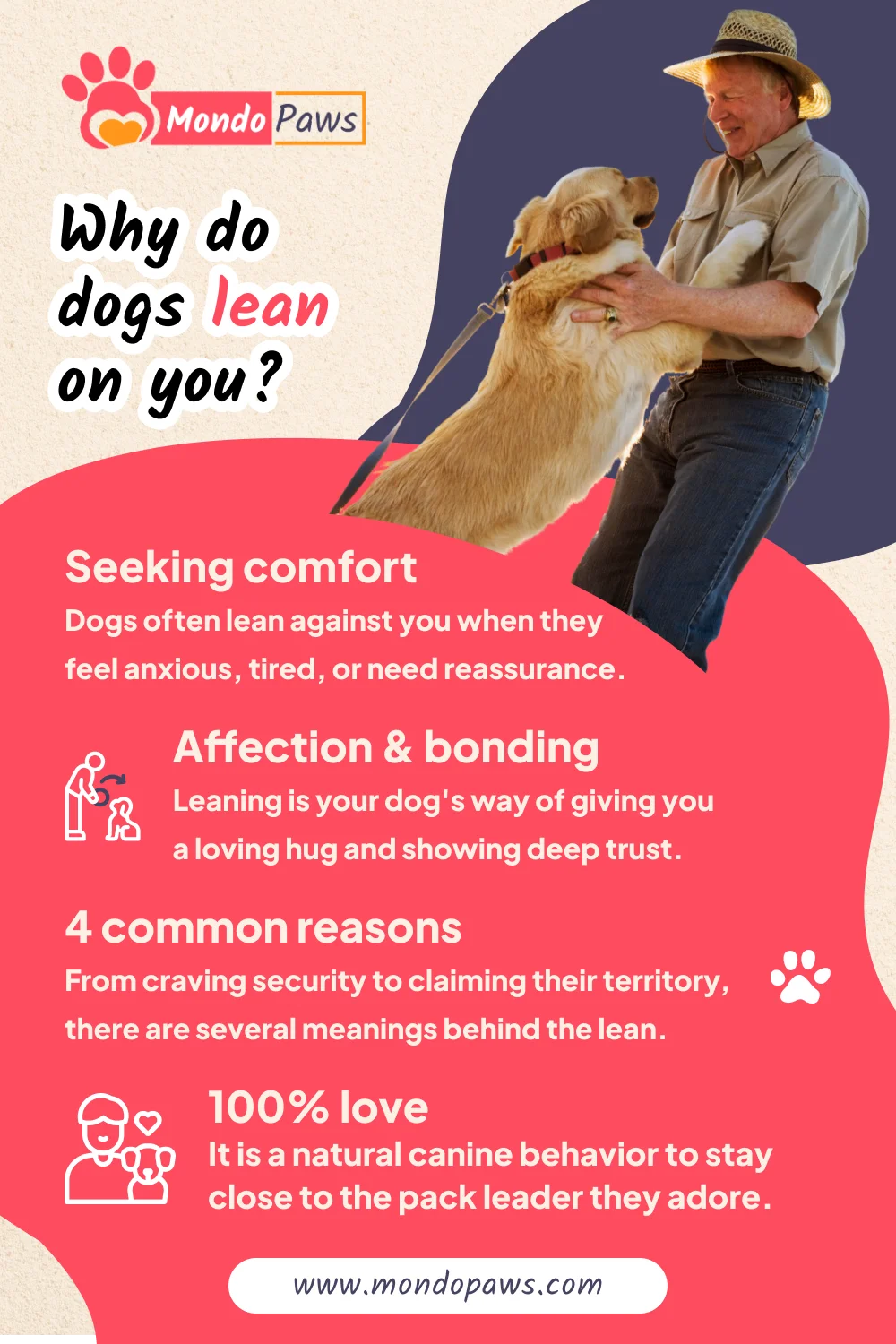
Why do dogs lean on you? Mostly, it’s affection but leaning is one of the most misread signals in dog body language. A dog pressing its full weight against your leg, leaning its backside into your shin, or slumping sideways against you on the sofa is almost always seeking contact, comfort or reassurance, not trying to control you. The “dominance” explanation has been dropped by modern behaviourists; what’s left is a genuinely sweet, trust-based habit that’s worth understanding properly.
Contact-Seeking
Physical touch triggers the same bonding hormone as petting
Not Dominance
Modern behaviourists reject leaning as a control tactic
Breed-Linked
Some breeds are genetically primed to lean far more than others
8 Common Triggers
From petting sessions to thunderstorms to greeting strangers
Security Signal
Leaning rises sharply around loud noises, vets and new people
Puppy Origin
Litter-pile pressure behaviour that never really goes away
You’re standing in the kitchen, and suddenly there’s forty pounds of dog pressed against your calf. You sit down and a warm weight slumps sideways into your ribs. You crouch to say hello to a dog at the park and it leans its whole body into your hands instead of jumping around. Leaning is one of the most common and most charming things dogs do to people, and it turns out to be a genuinely reliable window into how a dog is feeling.
This guide covers the science behind the lean, the eight most common reasons dogs do it, which breeds lean the hardest, how to tell affectionate leaning from anxious leaning, and when a sudden new leaning habit is actually worth a vet visit.
Affection or Anxiety? The Difference That Matters
Almost every dog leans sometimes, and most of it is nothing to worry about. But leaning can also be a stress response, and the two look similar enough that owners regularly miss the difference. The table below is the fastest way to tell a contented lean from a worried one.
| What you see | Affectionate leaning | Anxious leaning (watch closely) |
|---|---|---|
| Body | Loose, relaxed, soft muscles, often a wagging tail or a sigh | Stiff, trembling, tucked tail, whale eye (whites showing) |
| Timing | During petting, on the sofa, greeting you at the door | Thunderstorms, fireworks, vet waiting rooms, arguments in the house |
| Duration | Settles after a minute or two, then wanders off | Won’t stop leaning or pawing until the trigger is gone |
| Breathing | Normal, relaxed panting if any | Fast, shallow panting even at rest |
| Response to being moved | Shifts or resettles easily | Leans harder, follows, resists moving away |
| Where it happens | Wherever you are — kitchen, sofa, garden | Consistently in one “safe” spot, like against your legs near an exit |
A dog leaning out of affection is loose and happy about it, and it stops on its own. A dog leaning out of anxiety is stiff and can’t stop, because the lean is the only tool it has to feel safer. Same posture, completely different message — the body tells you which one you’re looking at.
The Science: Why Dogs Lean on People
Leaning is a form of what behaviourists call contact-seeking — deliberate physical pressure against another body to gain comfort or closeness. It isn’t unique to dogs; many social mammals do it, but dogs have refined it into a very specific way of asking for reassurance from a person they trust. Oxytocin — the same “bonding hormone” released during petting, eye contact and reunions — rises in both dog and owner during sustained physical contact, which is very likely part of why a lean so often earns a lean back.
Origin 1
The Litter Pile
Puppies sleep pressed against littermates for warmth and security from day one — the habit of leaning into a trusted body never fully disappears
Origin 2
Thigmotaxis
The instinct to seek out touch against a solid, trusted surface, which many animals rely on to self-soothe under mild stress
Origin 3
Working Instincts
Herding and guarding breeds were bred to physically position themselves against livestock or people — leaning is a soft echo of that job
Leaning is also a low-effort, low-risk way for a dog to check in. Unlike jumping up or pawing, a lean doesn’t demand anything and rarely gets corrected, so it becomes a default move whenever a dog wants closeness but isn’t sure it will be welcomed enthusiastically — a quiet knock rather than a shout. That’s part of why so many dogs lean during calm moments (a lap of the sofa) as much as stressful ones (a vet’s waiting room): it’s a flexible tool for a dog that wants contact but is reading the room first.
Leaning also has a practical, physical dimension that owners often overlook. Dogs use their weight to communicate in ways humans mostly don’t — a gentle lean can be a request to move, a nudge toward a door, or simply the most efficient way to get as much of their body touching yours as possible in a small space. None of this requires a theory of dominance; it’s closer to how a toddler holds onto a parent’s leg in a crowded room.
8 Reasons Dogs Lean on You
Leaning isn’t one behaviour — it’s a family of related habits that show up in different situations for slightly different reasons. Here are the eight you’re most likely to recognise.
Lean reason frequency
Everyday, Affectionate Leaning
Situational or Attention-Seeking Leaning
Reason 1
Leaning While You Pet
Pure contentment — your dog is maximising skin-to-fur contact while the good chemicals are flowing
Reason 2
The Full-Weight Lean
A dog that puts its entire body weight against you is usually asking for reassurance, not testing your patience
Reason 3
The Backside Lean
Pressing their rear into your legs is a soft, submissive-style greeting borrowed from how puppies approach adult dogs
Reason 4
Leaning While Asleep
Slumping against you at rest mirrors litter-pile sleeping and signals total trust, not a need for anything
Reason 5
Leaning on Your Legs
Common while you cook, work or stand at the counter — a low-key way to stay physically close without demanding attention
Reason 6
Fear & Noise Leaning
Thunder, fireworks and vet visits push many dogs to press hard against the nearest trusted leg
Reason 7
Leaning on Guests
A confident, social dog will lean on a new person almost as readily as its own owner — it’s rarely about you specifically
Reason 8
The Attention Lean
Some dogs learn that leaning reliably gets a hand on their head — a trained, low-pressure way to ask for attention
How Hard Your Dog Leans, by Situation
Not all leans carry the same weight — literally. Owners who track it on camera or just by feel tend to notice the same rough pattern: gentle contact during calm affection, and much harder, more sustained pressure when something stressful is happening nearby.
Lean Pressure by Situation
on the sofa
at the door
or dog nearby
or the vet
A general pattern noted by behaviourists and owners tracking their dogs on camera: lean pressure and duration climb with perceived stress, while calm, affectionate leaning tends to be lighter and briefer.
Real Owner Insights: What Leaning Looks Like at Home
“Our Boxer leans on me like a parked car every single evening — full weight, sighs, doesn’t move until I sit down. It took months to realise it’s basically her version of a hug and not her trying to herd me to the sofa.”
— Shared by an owner on r/dogs
“During fireworks our Lab mix leans so hard against my legs I nearly lose balance. Any other night of the year she barely touches us. The vet said it’s a totally normal comfort-seeking response, not a training issue.”
— Shared by an owner in a dog training group on Facebook
Why Do Dogs Lean on Strangers?
It can feel like a betrayal when a dog leans on a total stranger with the same enthusiasm it reserves for you at home — but for most dogs, leaning isn’t a loyalty statement, it’s a generalised social habit. A confident, well-socialised dog reads calm body language, a lowered hand or a friendly voice as an invitation, and leaning is simply the move it defaults to with any person who feels safe. Some dogs are also natural “greeters” who lean on new people specifically to gather scent information — sniffing indirectly through prolonged contact rather than a formal nose-to-hand sniff.
- Confidence, not confusion. Dogs that lean on strangers easily are usually the most socially secure dogs in the room, not the most anxious.
- Breed plays a role. Naturally people-oriented breeds — retrievers, spaniels, many designer breeds — tend to extend leaning to anyone who’ll accept it.
- It can still mean seeking reassurance. A nervous dog may lean on the calmest adult in an unfamiliar room, stranger or not, simply because that person feels like the safest anchor present.
- It isn’t a substitute for consent. Not every stranger wants a dog leaning on them — it’s worth teaching a reliable “off” or redirecting to a mat, especially with a large dog.
Dog Breeds That Lean on You the Most
Leaning isn’t exclusive to any one breed, but some are famous for it — often the same breeds nicknamed “Velcro dogs” for how closely they shadow their owners. If your dog belongs to one of these, the leaning habit is genuinely built in rather than a quirk you created.
Greyhounds & Whippets
Famous for the “greyhound lean” — sighthounds seek out warm, solid contact almost constantly indoors
Great Danes
Often called “the world’s biggest lap dog” — huge, gentle and prone to leaning full weight against people
Boxers
Bred for close human partnership — many Boxers lean hard as a default greeting and affection style
Pit Bull Terriers
Known among owners as devoted “lean-on-you” dogs that treat leaning as a core affection ritual
Vizslas & Weimaraners
Nicknamed “Velcro Vizslas” for good reason — bred to stay in constant physical contact with their handler
Dobermans & Rottweilers
Guarding-breed instincts often show up as a dog leaning against your leg while surveying a room
Breed sets the tendency, but individual personality and early handling matter just as much — plenty of mixed-breed and “non-leaning” breeds turn into devoted leaners once they trust a particular person.
The Lean-O-Meter
Answer six quick questions about how your dog leans to get a read on whether it’s affectionate bonding, mild attention-seeking, or a pattern worth watching more closely. This is a guidance tool, not a diagnosis.
for more pets guide tools and calculators visit our pet guide page.
When Leaning Is Worth a Closer Look
Worth a Vet Check
- Sudden new leaning in a dog that never used to do it
- Leaning that seems to be for balance or support rather than affection
- Wobbliness, head tilt or stumbling alongside the leaning
- Leaning paired with reluctance to jump, climb stairs or lie down
- Whimpering or flinching when you touch the area being leaned
Worth a Behaviourist
- Leaning that escalates into pawing, nipping or blocking your path
- Leaning that only appears alongside panting, drooling or trembling
- A dog that can’t be moved or redirected once it starts leaning
- Leaning tied to a specific fear that’s getting worse over time
- Leaning combined with other new anxiety signs — pacing, hiding, house soiling
A useful rule of thumb: affectionate leaning is a dog choosing to be close to you. A leaning problem is a dog that seems to need to be pressed against something to cope. If the leaning is new, sudden, and paired with anything physical — wobbliness, pain response, reluctance to move — treat it as a possible medical issue first, since older dogs in particular can lean for balance rather than for love.
How to Respond to Leaning
Most leaning deserves exactly what it’s asking for: a hand, a moment of contact, and then life continuing as normal. A few simple habits help keep it a healthy part of the bond rather than letting it slide into a demand.
- Reward the calm version. A gentle lean during petting is worth reinforcing with attention — it’s a polite, low-pressure way to ask for closeness.
- Redirect the heavy version. If a full-weight lean is knocking you off balance, calmly step aside and invite the dog to sit instead, rather than pushing back, which can read as a game.
- Give fearful leaning somewhere to go. A dog leaning hard during a storm benefits more from a calm, quiet space and steady touch than from being picked up or fussed over dramatically.
- Teach an alternative for big dogs. A “sit” or “place” cue gives a large dog a polite way to be close without the physical impact of a full lean, useful around guests or small children.
- Never punish a lean. Pushing a dog away firmly or scolding it for leaning teaches it that closeness is risky, which can undermine trust rather than fix the habit.
Frequently Asked Questions
Mostly affection and comfort-seeking. Leaning is a low-effort way for a dog to maximise physical contact with someone it trusts, rooted in puppyhood habits of pressing against littermates for warmth and security. It can also spike around stress — storms, vet visits, new people — as a way of self-soothing against a familiar, solid body.
A backside lean is a soft, deferential greeting style borrowed from how puppies approach adult dogs — rear-first contact rather than a face-on approach. Most dogs use it as an affectionate, non-confrontational way to say hello, and it’s especially common right after you’ve been away or first thing in the morning.
Petting already triggers oxytocin release, and leaning in increases the surface area of contact, extending that pleasant feeling. It’s the canine equivalent of leaning into a hug — a way of saying “more of this, please” rather than a request for anything beyond the affection already happening.
A full-weight lean is usually a dog’s way of maximising reassurance, especially in a bigger or heavier breed with a naturally strong contact-seeking instinct. It’s most often affectionate, but if it appears suddenly in an older dog, or comes with wobbliness or reluctance to move, it’s worth ruling out a balance or joint issue with a vet, since dogs can also lean to physically steady themselves.
No. Dominance theory as an explanation for everyday dog behaviour has largely been set aside by modern behaviourists, and leaning specifically doesn’t fit it well — dogs lean on people they trust, not people they’re trying to control. It’s much closer to a hug than a power move.
Confident, well-socialised dogs generalise their affection habits to any calm, friendly person, not just their owner. Leaning on a stranger is usually a sign of social confidence rather than confusion about who’s “in charge,” though a nervous dog may also lean on whichever adult in an unfamiliar room feels safest, stranger included.
This echoes the litter-pile habit of sleeping pressed against warm, familiar bodies, and it’s generally the clearest sign of total trust a dog can show. A dog that slumps against you to sleep has, in effect, decided you’re the safest possible place to switch off.
Legs are simply the most accessible part of a standing person, so leaning on them is a practical, low-effort way to stay close while you cook, work or chat. It’s common, harmless, and usually just means your dog wants to be near you without asking for anything more involved.
Greyhounds and Whippets are famous for the “greyhound lean,” and Great Danes, Boxers, Pit Bull Terriers, Vizslas, Weimaraners, Dobermans and Rottweilers are all commonly reported as heavy leaners. The trait shows up most in sighthounds and close-working or guarding breeds, though any individual dog can develop a strong leaning habit regardless of breed.
Behind the Research: How We Created This Dog Leaning Guide
At Mondopaws, we believe pet guides should be grounded in both hard science and real-world care. To compile this explainer on why dogs lean on their owners, our editorial team:
- Reviewed canine body language and behaviour resources: Looked at contact-seeking behaviour, breed temperament profiles, and owner-facing guidance from the American Kennel Club and the RSPCA.
- Separated affectionate leaning from anxious leaning: Cross-checked how veterinary behaviour resources and organisations such as the ASPCA describe stress-related body pressure, so owners can tell a contented lean from a worried one.
- Gathered authentic owner experiences: Reviewed real accounts of leaning habits — during petting, storms and stranger greetings — from active dog forums and social communities to show what the behaviour actually looks like day to day.
Final Thoughts
Leaning is one of the clearest, most consistent ways a dog tells you it trusts you from the gentle press of a backside greeting to the full-weight slump of a dog falling asleep against your side. The “dominance” myth doesn’t hold up; what’s actually happening is a mix of puppyhood habit, bonding chemistry and, sometimes, a request for a little extra reassurance.
The one distinction worth keeping in mind is body language: loose and brief means affection, stiff and relentless means stress. Get that right, respond with a calm hand rather than a push, and leaning stays exactly what it should be one of the nicest compliments your dog can pay you.