Table of Contents
Feline Nutrition & Portions · Clinical Feeding Guide
How much should you feed your cat each day? Feeding guidelines printed on commercial cat food bags are broad estimates that routinely overestimate caloric requirements by 20% to 35%. Because cats are obligate carnivores with compact digestive tracts, even 20 to 30 excess calories a day can lead to feline obesity, hepatic lipidosis, and diabetes.
200–250
Average daily kcal for 10 lb adult cat
50–60 ml
Daily water need per kg body weight
10% Max
Strict limit on daily calories from treats
59%
Of domestic cats are overweight or obese
±20% Error
Average cup error vs gram kitchen scale
1.2x RER
Standard neutered adult energy multiplier
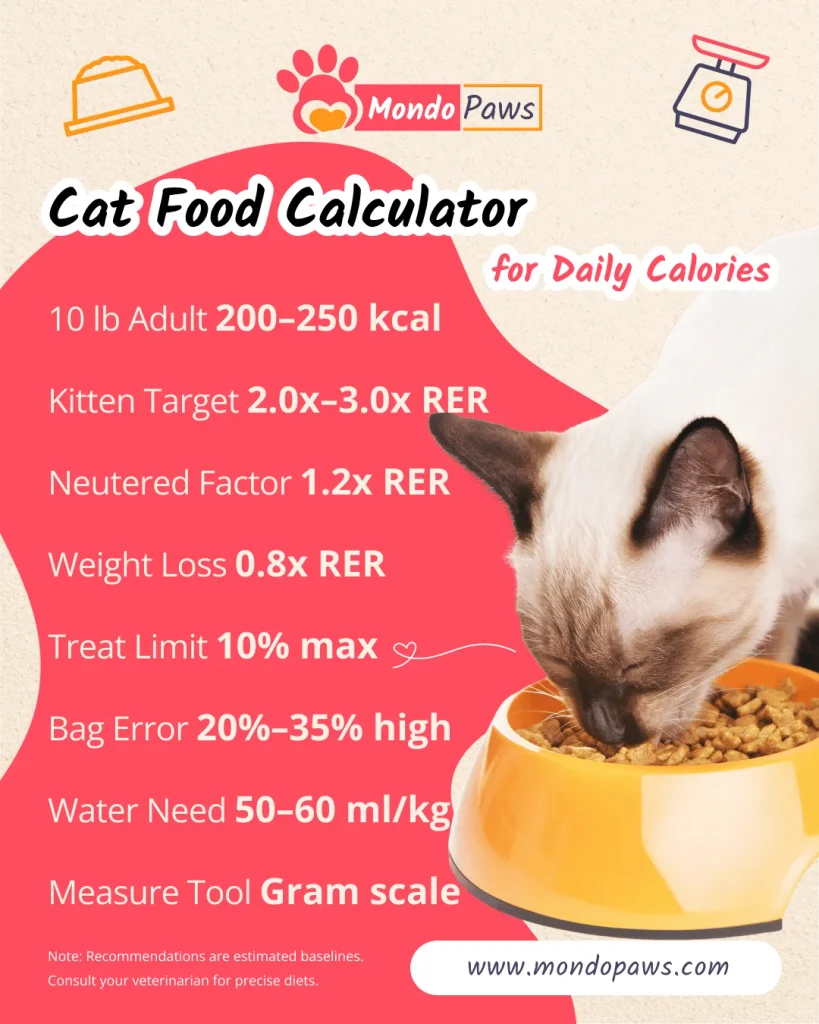
Whether you are feeding dry kibble, canned wet pâté, or a combination mixed diet, precision is paramount. Our interactive Cat Food Calculator below computes your feline’s exact Resting Energy Requirement (RER) and Daily Energy Requirement (DER) according to veterinary standards published by the World Small Animal Veterinary Association (WSAVA) and the National Research Council (NRC).
Interactive Cat Food Calculator
Select your cat’s weight, life stage, body condition, and feeding preferences below to calculate exact daily calories, dry cups/grams, wet cans, and water requirements in real time.
How Many Calories Does a Cat Need Daily?
Unlike dogs, who have broad metabolic adaptability, feline metabolism is strictly carnivorous with little room for error. A domestic cat's caloric requirement is governed by its lean muscle mass, neuter status, age, and indoor activity level.
| Cat Weight (lbs / kg) | Inactive / Senior (1.0x RER) | Neutered Adult (1.2x RER) | Intact / Active (1.4x RER) | Growing Kitten (2.0x RER) |
|---|---|---|---|---|
| 5.0 lbs (2.27 kg) | 128 kcal | 153 kcal | 179 kcal | 255 kcal |
| 7.5 lbs (3.40 kg) | 173 kcal | 207 kcal | 242 kcal | 345 kcal |
| 10.0 lbs (4.54 kg) | 213 kcal | 255 kcal | 298 kcal | 426 kcal |
| 12.5 lbs (5.67 kg) | 251 kcal | 301 kcal | 351 kcal | 502 kcal |
| 15.0 lbs (6.80 kg) | 287 kcal | 344 kcal | 402 kcal | 574 kcal |
| 18.0 lbs (8.16 kg) | 328 kcal | 394 kcal | 460 kcal | 657 kcal |
Clinical Nutrition Tip: Over 90% of indoor domestic cats in North America and Europe are neutered. Neutering lowers a cat's basal metabolic rate by approximately 20% to 25% while simultaneously increasing appetite. Feeding an unneutered adult allowance to a neutered indoor cat is the #1 trigger for rapid weight gain.
The Veterinary Feline Calorie Formula Explained
Veterinary nutritionists calculate feline energy intake using a two-step formula recommended by the World Small Animal Veterinary Association (WSAVA):
Step 1: Calculate RER
Resting Energy Requirement (RER) represents the calories burned at complete rest to power organs, respiration, and circulation:
RER = 70 × (Weight in kg)^0.75
Step 2: Apply DER Factor
Daily Energy Requirement (DER) adjusts RER for activity, life stage, and physiological state:
DER = RER × Life Stage Factor
Life Stages and Growth Multipliers
A kitten's energy demands triple those of a sedentary senior cat of equal weight. Matching the correct multiplier ensures proper skeletal and muscle growth without triggering juvenile obesity.
Kittens (0–4 Months)
Factor: 2.5x–3.0x RER
Rapid bone elongation and neural development require high-density kitten formula split into 4 to 5 small meals daily.
Kittens (4–12 Months)
Factor: 2.0x RER
Growth stabilizes. Transition to 3 meals daily. Continue kitten food until 12 months (or 18–24 months for large breeds like Maine Coons).
Senior Cats (10+ Years)
Factor: 1.0x–1.1x RER
Digestive absorption of proteins and fats can decrease in geriatric cats. High biological value, easily digestible wet protein is recommended.
Dry Kibble vs. Wet Canned Food: Caloric Density & Hydration
The biggest difference between dry kibble and canned wet food is moisture content and caloric density. Dry kibble contains only 8% to 10% water and averages 350–450 kcal per cup, while wet food is 75% to 82% water and averages 70–90 kcal per 3 oz can.
| Metric | Dry Kibble Only | Wet Canned Food Only | Mixed Feeding (50/50) |
|---|---|---|---|
| Moisture Content | 8% – 10% (Low) | 75% – 82% (Optimal) | ≈ 45% (Balanced) |
| Urinary Tract Protection | Low (Requires heavy water bowl drinking) | High (Naturally flushes bladder) | Moderate to High |
| Dental Stimulation | Minimal (Kibbles shatter quickly) | Low (Soft texture) | Moderate |
| Portion Satiety | Small volume, high calories | Large volume, low calories (cats feel full) | Excellent balance |
| Cost / Convenience | Most economical, shelf-stable | Higher cost, requires refrigeration after opening | Cost-effective combo |
Cat Breeds Calorie, Weight & Water Master Table
Below is our comprehensive reference table listing 34 popular cat breeds with their typical healthy adult weight, average daily caloric requirement (neutered adult baseline), daily water intake needs, and breed-specific dietary considerations.
| Breed | Adult Weight (lbs / kg) | Daily Calorie Range | Daily Water Need | Activity & Nutrition Focus |
|---|---|---|---|---|
| Abyssinian | 6 – 10 lbs (2.7 – 4.5 kg) | 170 – 240 kcal | 140 – 230 ml | High energy athlete; requires higher protein density to maintain lean muscle. |
| American Shorthair | 8 – 15 lbs (3.6 – 6.8 kg) | 190 – 300 kcal | 180 – 340 ml | Moderate activity; prone to middle-age weight gain. Weigh portions strictly. |
| Balinese | 6 – 11 lbs (2.7 – 5.0 kg) | 165 – 245 kcal | 140 – 250 ml | Very active & slender; fast metabolism burns calories rapidly. |
| Bengal | 9 – 15 lbs (4.1 – 6.8 kg) | 230 – 340 kcal | 210 – 340 ml | Extremely active; requires high animal protein and mental puzzle feeders. |
| Birman | 8 – 14 lbs (3.6 – 6.4 kg) | 190 – 280 kcal | 180 – 320 ml | Calm & affectionate; moderate exercise needs with focus on hairball prevention. |
| British Shorthair | 9 – 16 lbs (4.1 – 7.3 kg) | 210 – 315 kcal | 210 – 360 ml | Stocky & calm; very prone to obesity. Stick to 1.0x–1.2x RER multiplier. |
| Burmese | 8 – 12 lbs (3.6 – 5.4 kg) | 190 – 260 kcal | 180 – 270 ml | Playful & muscular; monitor for feline diabetes susceptibility. |
| Chartreux | 8 – 14 lbs (3.6 – 6.4 kg) | 190 – 280 kcal | 180 – 320 ml | Heavy-boned and quiet; avoid high-carbohydrate filler kibble. |
| Cornish Rex | 6 – 9 lbs (2.7 – 4.1 kg) | 160 – 225 kcal | 140 – 200 ml | High body temp & metabolism; higher caloric intake per pound of weight. |
| Devon Rex | 5 – 9 lbs (2.3 – 4.1 kg) | 150 – 220 kcal | 120 – 200 ml | Fast metabolism; active jumper requiring balanced fat and omega oils. |
| Domestic Shorthair (Moggy) | 8 – 11 lbs (3.6 – 5.0 kg) | 185 – 245 kcal | 180 – 250 ml | Baseline domestic standard; ideal reference for our Cat Food Calculator. |
| Egyptian Mau | 7 – 11 lbs (3.2 – 5.0 kg) | 180 – 250 kcal | 160 – 250 ml | Fastest domestic breed; high sprint output requires quality taurine & protein. |
| Exotic Shorthair | 7 – 13 lbs (3.2 – 5.9 kg) | 170 – 265 kcal | 160 – 290 ml | Brachycephalic; feed wide, shallow bowls and wet food for hydration. |
| Himalayan | 7 – 12 lbs (3.2 – 5.4 kg) | 170 – 250 kcal | 160 – 270 ml | Sedate lap cat; hairball management diet and strict portion control essential. |
| Japanese Bobtail | 6 – 10 lbs (2.7 – 4.5 kg) | 160 – 230 kcal | 140 – 230 ml | High energy and curious; thrives on mixed dry and wet moisture feeding. |
| Maine Coon | 13 – 20+ lbs (5.9 – 9.1+ kg) | 270 – 380+ kcal | 300 – 450 ml | Giant breed; slow growth over 3–4 years. Joint and heart support (taurine) key. |
| Manx | 8 – 13 lbs (3.6 – 5.9 kg) | 190 – 270 kcal | 180 – 300 ml | Sturdy build; keep lean to avoid pressure on spine and rear joints. |
| Munchkin | 5 – 9 lbs (2.3 – 4.1 kg) | 140 – 210 kcal | 120 – 200 ml | Short legs make extra weight dangerous for spinal health. Keep strictly lean. |
| Norwegian Forest Cat | 10 – 18 lbs (4.5 – 8.2 kg) | 225 – 345 kcal | 230 – 410 ml | Large heavy-coated climber; requires high-protein ancestral diet. |
| Oriental Shorthair | 6 – 10 lbs (2.7 – 4.5 kg) | 165 – 230 kcal | 140 – 230 ml | Slender frame with high vocal energy; thrives on frequent small meals. |
| Persian | 7 – 12 lbs (3.2 – 5.4 kg) | 170 – 250 kcal | 160 – 270 ml | Low activity; flat face requires specialized kibble shape or easy wet loaf. |
| Ragdoll | 10 – 18 lbs (4.5 – 8.2 kg) | 220 – 340 kcal | 230 – 400 ml | Docile and large; slow metabolism means portion control is critical. |
| Russian Blue | 7 – 12 lbs (3.2 – 5.4 kg) | 170 – 250 kcal | 160 – 270 ml | Quiet indoor cat; loves routine feeding times. Watch for overeating boredom. |
| Savannah (F2–F4) | 12 – 22 lbs (5.4 – 10.0 kg) | 280 – 420 kcal | 270 – 500 ml | Hybrid genetics; extraordinary energy requires biological raw/high meat diet. |
| Scottish Fold | 6 – 11 lbs (2.7 – 5.0 kg) | 160 – 240 kcal | 140 – 250 ml | Osteochondrodysplasia risk; keep lean to prevent cartilage stress. |
| Selkirk Rex | 8 – 15 lbs (3.6 – 6.8 kg) | 190 – 300 kcal | 180 – 340 ml | Heavily built curly coat; monitor weight underneath thick fur via tactile BCS. |
| Siamese | 6 – 10 lbs (2.7 – 4.5 kg) | 165 – 230 kcal | 140 – 230 ml | High metabolism and agile; burns energy quickly with interactive play. |
| Siberian | 10 – 17 lbs (4.5 – 7.7 kg) | 220 – 330 kcal | 230 – 385 ml | Athletic heavy breed; water fountain recommended for heavy hydration needs. |
| Singapura | 4 – 7 lbs (1.8 – 3.2 kg) | 115 – 170 kcal | 90 – 160 ml | Smallest domestic cat; requires nutrient-dense micro-portions. |
| Somali | 6 – 11 lbs (2.7 – 5.0 kg) | 165 – 245 kcal | 140 – 250 ml | Bushy-tailed fox cat; agile jumper needing balanced energy density. |
| Sphynx | 7 – 12 lbs (3.2 – 5.4 kg) | 220 – 300 kcal | 160 – 270 ml | No insulating coat; burns 20–30% more calories just to maintain body heat! |
| Tonkinese | 6 – 12 lbs (2.7 – 5.4 kg) | 165 – 260 kcal | 140 – 270 ml | Acrobatic companion; thrives on a structured morning & evening feeding plan. |
| Turkish Angora | 6 – 11 lbs (2.7 – 5.0 kg) | 160 – 240 kcal | 140 – 250 ml | Silky-coated active cat; maintain lean muscle with wet food rotation. |
| Turkish Van | 9 – 16 lbs (4.1 – 7.3 kg) | 210 – 320 kcal | 210 – 360 ml | Loves water and active play; muscular shoulders require high-protein diet. |
How to Check Your Cat's Body Condition Score (BCS 1–9)
Because thick coats can disguise obesity or emaciation, veterinarians use the 9-point Body Condition Score (BCS) system based on touch and profile viewing:
BCS 1–3: Underweight
Ribs, spine, and pelvis are easily visible with no palpable fat cover. Obvious abdominal tuck and loss of muscle mass.
BCS 4–5: Ideal Weight
Ribs easily felt with slight fat cover. Waist visible behind ribs from above. Minimal abdominal fat pad.
BCS 6–9: Overweight / Obese
Ribs difficult or impossible to feel under thick fat layer. Broad back, no waist, pronounced sagging primordial belly fat pad.
A 7-Day Plan to Transition Cat Food Safely
Switching brands or transitioning from dry kibble to wet food too quickly can trigger gastrointestinal distress, vomiting, or feline food refusal. Follow this 7-day veterinary transition protocol:
Days 1–2:
Feed 75% old food mixed with 25% new food. Watch for soft stools or hesitancy.
Days 3–4:
Feed 50% old food mixed with 50% new food. Digestion begins adapting to new protein sources.
Days 5–6:
Feed 25% old food mixed with 75% new food. Appetite and energy should remain steady.
Day 7 Onward:
Feed 100% new food at the calculated daily portion from our calculator.
Frequently Asked Questions
Bag guidelines are generalized averages calculated for intact, active cats. Because over 90% of household cats are neutered and live indoors with lower energy expenditure, bag charts frequently overestimate portion sizes by 20% to 35%. Using our calculator's WSAVA formula ensures personalized caloric accuracy.
Always weigh food with a digital kitchen scale in grams whenever possible. Dry kibble shapes and densities vary widely; a standard measuring cup can vary by up to ±20% depending on settling, which translates to 40–80 accidental excess calories every day.
In the wild, felines are opportunistic hunters that consume 8 to 12 small rodent or bird meals across 24 hours. For domestic cats, feeding 2 to 4 small measured meals per day prevents gastric acid buildup, reduces post-meal blood sugar spikes, and curbs begging behavior.
Hairless breeds like the Sphynx lack an insulating fur coat to trap body heat. As a result, their basal metabolic rate is 20% to 30% higher to maintain their normal core body temperature (100.5°F–102.5°F). Our breed table reflects this heightened caloric requirement.
Behind the Research: How We Built This Cat Food Calculator & Guide
At Mondo Paws, our mission is to empower pet owners with scientifically accurate, veterinary-reviewed nutrition tools. To create this calculator and feline feeding guide:
- Implemented WSAVA & NRC Mathematical Formulas: Calculations use the exponential Resting Energy Requirement formula (\(RER = 70 \times \text{Weight}_{\text{kg}}^{0.75}\)) rather than linear approximations, ensuring precision across cats weighing from 2 lbs up to 25 lbs.
- Verified Feline Caloric Multipliers: Cross-referenced life-stage multipliers with clinical veterinary textbooks and publications from the WSAVA Global Nutrition Committee and the Association of American Feed Control Officials (AAFCO).
- Compiled Breed-Specific Baseline Data: Analyzed standard breed weights and metabolic energy variations across 34 recognized cat breeds to construct our comprehensive master nutrition table.
Final Thoughts
Calculating the exact daily portion for your cat is one of the single most impactful steps you can take to prevent diabetes, arthritis, and urinary disease. Rather than relying on guesswork or generic packaging guidelines, use our Cat Food Calculator to establish a baseline, weigh daily kibble with a digital gram scale, incorporate moisture-rich wet food, and monitor your cat's Body Condition Score every two weeks.
Remember that every cat is an individual. If your cat is gaining or losing weight unintentionally, adjust their daily caloric intake by ±10% and consult your veterinarian for specialized bloodwork or diet evaluation.
Written by the Mondo Paws Team
At Mondo Paws, we simply love pets! For this guide, we gathered and cross-checked veterinary clinical nutrition guidelines and real-world feline feeding protocols, organizing everything in the clearest, most practical way possible so you can care for your cat with confidence.