Table of Contents
Companion Breed · Iran (Persia)
The Persian cat is the world’s best-known longhaired breed — a round-faced, plush-coated companion first brought to Europe from Persia (modern-day Iran) in the 1600s. Bred for centuries purely as a companion, it is calm, quiet, affectionate on its own terms, and famous for the flowing coat that defines the breed.
7–12 lbs
Weight
10–15″
Height
12–17 years
Lifespan
20 mph
Top Speed
1600s
Origin Era
Rank #15
Intelligence
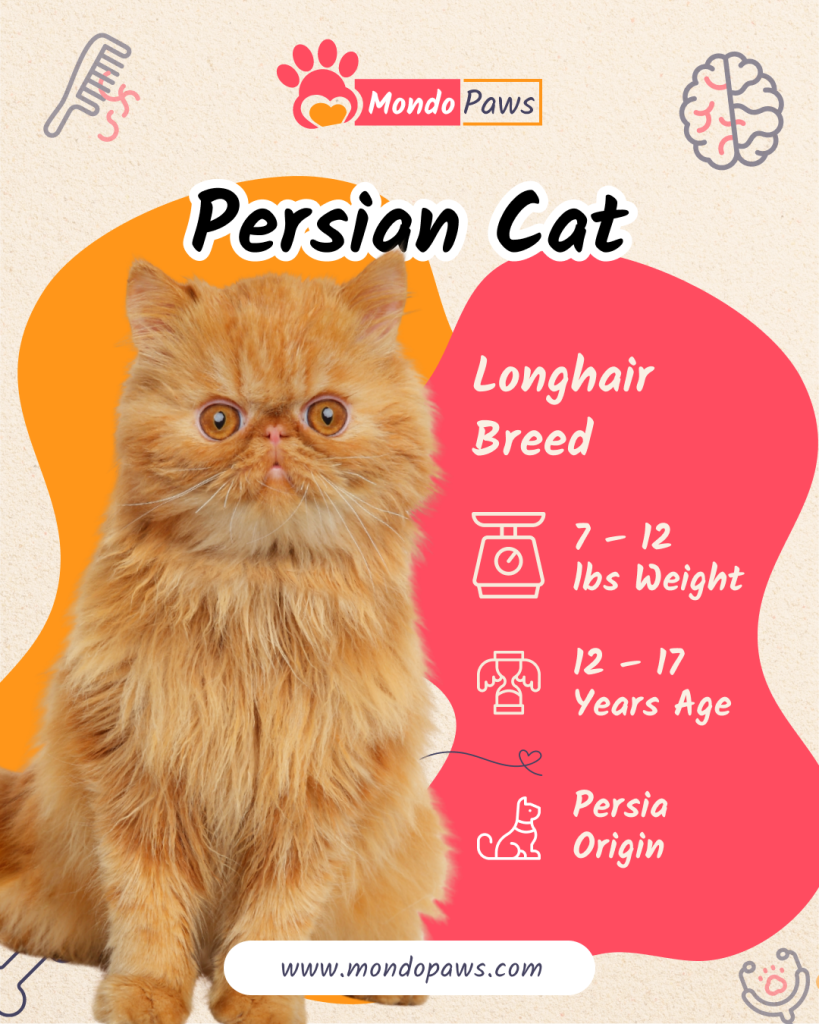
Persians have a “cobby” build — a broad, low-set body with short thick legs, a full ruff around the neck, and a heavily boned frame carried under an enormous long coat. The round head, small ears, and large expressive eyes give the breed its unmistakable sweet expression.
They are gentle, undemanding, and firmly attached to the ground — Persians prefer a sunny cushion to a bookshelf. They ask for affection softly, dislike chaos, and reward a calm household with quiet, constant company.
Temperament & Personality
The Persian cat personality is best described as serene, sweet-natured, and selectively social. They are placid, quiet-voiced, and happiest in a predictable home, choosing a few trusted laps rather than greeting every visitor. Female Persians are often a little more reserved and particular about routine, while males tend to be more openly cuddly and easygoing.
Real Owner Insights: What Daily Life with a Persian Is Actually Like
“Nobody tells you the grooming is a daily job, not a weekly one. Skip two days with our Persian, ‘Saffron,’ and there are mats behind her ears. Ten minutes with a metal comb every evening and she’s perfect — miss a week and you’re paying a groomer.”
— As shared by a Persian owner on r/cats on Reddit
“Ours is the calmest animal I’ve ever lived with — he has never knocked anything off a counter because he doesn’t jump on counters. But the eye wiping is real. Two minutes morning and night or the tear stains set in.”
— Shared by a Persian cat owner in a breed group on Facebook
Core Performance Metrics
Breed comparison data breakdown — Persian Cat vs. standard breed benchmark.
With Family
Gentle Lap Cat
Seeks quiet company and long cuddles
With Strangers
Shy but Sweet
Retreats from noise, warms up slowly
Energy Level
Low
Needs 15–20 mins daily play
Trainability
Moderate
Learns routines and handling, not tricks
Behind the famous face is a cat that asks for very little except calm, routine, and a warm place beside you.
Calm, positive routines are highly recommended. Resources from the American Society for the Prevention of Cruelty to Animals emphasize low-stress handling for best results.
Trait Ratings
Personality Traits
Care Requirements
Persian Cat Summary Table
| Category | Verdict | Best for |
|---|---|---|
| Families with kids | Good | Gentle and tolerant, but prefers calm older children |
| First-time owners | Moderate | Easy temperament, demanding daily grooming |
| Apartment living | Excellent | Low energy, quiet voice, indoor-only breed |
| Allergy sufferers | Not Suitable | Heavy shedding long double coat |
| Guard / watchfulness | Poor | Placid and unbothered by activity |
| Quiet indoor lifestyles | Excellent | Content on a cushion for most of the day |
| Multi-pet households | Good | Peaceful with calm cats and gentle dogs |
| Budget-conscious owners | Not Ideal | Grooming and eye/airway vet care add up |
Persian Cat Living Needs
Persians suit almost any home as long as it is indoors, calm, climate-controlled, and low on surprises.
Space
Small Spaces Fine
Ground-level comfort matters more than climbing height
Children
Calm Kids Best
Tolerant and gentle, but dislikes rough handling
Heat Tolerance
Low
Flat face plus dense coat means cool rooms are essential
Other Pets
Generally Easy
Non-confrontational; avoid boisterous housemates
A Persian does not need a big home — it needs a quiet room, a cool corner, and ten minutes of grooming a day.
Training and Exercise Needs
Persians are not performance cats. They learn names, litter routines, and — most importantly — to accept daily combing, nail trims, and face cleaning if these are introduced in kittenhood. Because they are low-energy and prone to weight gain, aim for 15–20 minutes of gentle play daily, split into short floor-level sessions with wand toys and rolling balls.
Exercise Allocation Profile (Weekly Ideal)
With Family
Gentle Lap Cat
Accepts grooming and handling when started young
With Strangers
Shy but Sweet
Settles quickly once the room is quiet again
Grooming & Coat Care
The Persian coat is the single biggest commitment of the breed: long, dense, and double-layered, it mats within days if it is not combed. Most owners settle into a daily ten-minute routine plus a professional groom or sanitary trim every six to eight weeks.
Coat Type
Long & Double
Comb daily with a wide-tooth steel comb
Coat Colors
Nearly All Colours
Solid, tabby, bicolour, himalayan, chinchilla and more
Shedding
Year-Round
Heavy and constant, heaviest in spring
Other Needs
Eyes & Face Folds
Daily eye wiping, fortnightly nails, regular dental care
Ten minutes of combing every day is cheaper and kinder than one shave-down at the groomer.
Calm, positive routines are highly recommended. Resources from the American Society for the Prevention of Cruelty to Animals emphasize low-stress handling for best results.
Health & Common Concerns
The Persian is a long-lived breed, but its flat face and heavy coat create predictable issues. The main watch-points are breathing, kidneys, eyes, and coat condition — all of which are far easier to manage with a responsibly bred, moderately built “doll-face” cat.
Brachycephalic Airway Syndrome
Respiratory · Structural
Polycystic Kidney Disease
Genetic · DNA Testing Advised
Excessive Tearing
Ocular · Very Common
Matting & Hairballs
Coat & Digestive · Care-Sensitive
Cat Fanciers’ Association (CFA) & TICA Standards
According to official breed standards from the Cat Fanciers’ Association (CFA) and The International Cat Association (TICA), the Persian is defined by its cobby body, round massive head, small ears, large round eyes, short thick legs, and a long flowing coat that stands off the body.
Veterinary Genetics & Kidney Screening
Feline health resources such as the Cornell Feline Health Center note that polycystic kidney disease has historically been common in Persians and Persian-derived breeds. Responsible breeders now DNA-test and ultrasound their breeding cats, so kittens from tested lines should come with documented PKD-negative parents.
to find out more about Feline weight visit cat-weight-calculator.
Relative Health Risk by Condition
Regular veterinary checkups and responsible breeding help reduce these risks.
Nutrition & Feeding
Persians are low-activity cats that swallow a lot of hair, so calorie control, coat-supporting fats, and moisture matter more than for most breeds.
High-quality protein
Hairball control fibre
Kidney-friendly hydration
Flat-faced Persians often struggle with standard kibble shapes, so many owners use wedge-shaped kibble or wet food in a shallow, wide bowl.
Measured meals beat free-feeding for this breed. According to PetMD, controlled-calorie diets, omega-rich fats, and constant fresh water support coat quality, digestion, and long-term kidney health in indoor cats.
to find out more about nutrition visit cat food calculator.
Ownership Cost Calculator
Persian kittens from registered breeders typically sell for $1,200–$3,000, with show-quality and rare-colour lines running higher — grooming is the real long-term cost, not the purchase price. Adjust the inputs below for a personalised annual running-cost estimate. All figures are in USD and reflect US market averages.
Pros & Cons
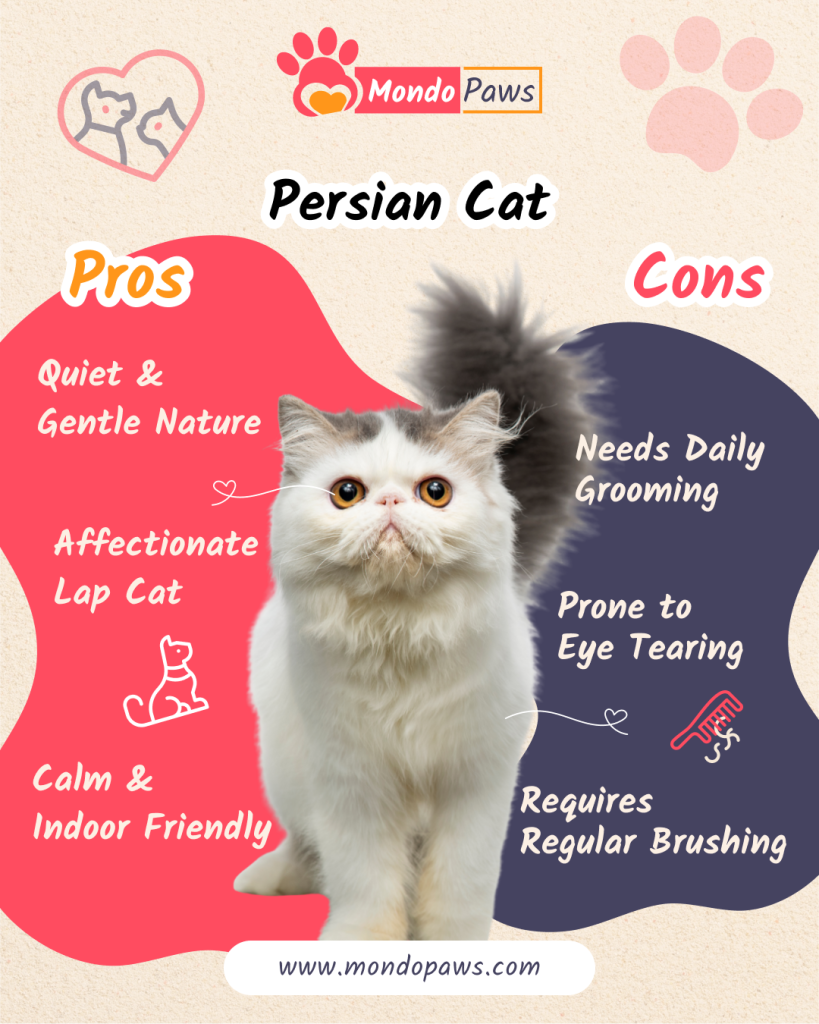
Strengths
- Exceptionally calm — rarely climbs, jumps, or knocks things over
- Soft-voiced and affectionate without being demanding
- Ideal apartment and quiet-household companion
- Long-lived, often reaching 15+ years
- Available in almost every colour and pattern
Challenges
- Daily grooming is non-negotiable — mats form fast
- Flat-faced lines can have breathing and tearing problems
- Heavy year-round shedding around the home
- Poor heat tolerance and a real tendency to gain weight
History of the Persian Cat
The Persian’s origins trace back to Persia (modern-day Iran), where longhaired cats were reportedly collected by European travellers and carried west in the 1600s — the Italian traveller Pietro della Valle is usually credited with the earliest recorded imports.
Early “Persians” were mixed with other longhaired imports before the modern breed was fixed. Historians generally credit longhaired cats arriving in Europe from:
Persia, Turkey (Angora stock), the Caucasus, and Ottoman trade routes
Refined in Victorian Britain and later in America, the Persian became the defining show cat of the modern cat fancy. Selective breeding in the 20th century produced the extreme flat-faced “peke-face” look, alongside the traditional doll-face type many breeders still prefer today.
Here is a brief timeline of the Persian Cat’s history:
1600s
Longhaired cats from Persia are brought to Italy and France by European travellers and merchants.
1871
Persians appear at the first modern cat show at London’s Crystal Palace and are an instant favourite.
1900s
The breed reaches America, where breeders develop a heavier, rounder, more profusely coated type.
1950s–1990s
The flat “peke-face” look emerges and becomes dominant in show rings, while doll-face lines continue alongside it.
2000s
DNA testing for polycystic kidney disease becomes standard practice among responsible Persian breeders.
Today:
The Persian remains one of the world’s most popular pedigreed cats, admired for its coat and calm nature and kept historically by figures such as Queen Victoria and Florence Nightingale.
Modern breeding increasingly favours moderate, open-nostrilled faces and health-tested lines, keeping the classic look while improving breathing and eye comfort.
Fun Facts
Two Faces
Persians come in “doll-face” (traditional, longer nose) and “peke-face” (flat) types — doll-faces usually breathe more easily
1871
Exhibited at the world’s first organised cat show at London’s Crystal Palace
Queen Victoria
Royal ownership in Victorian Britain turned the Persian into an international status symbol
100+ Colours
From solid white to himalayan points and chinchilla silver — the Himalayan is a colourpoint Persian
Top Breed
The Persian held the CFA’s most-registered breed title for decades and inspired the Exotic Shorthair
Frequently Asked Questions
Persian kittens from registered breeders usually cost between $1,200 and $3,000, with show-quality and rare colours higher. Budget a further $1,500–$2,500 a year for food, grooming, and veterinary care — grooming is the biggest ongoing expense.
Daily. A Persian’s long double coat mats within two or three days without combing, and the face needs wiping every day to prevent tear staining. Most owners also book a professional groom or sanitary trim every six to eight weeks.
Females are often slightly more reserved, particular about routine, and selective about who they sit with. Males tend to be larger, more relaxed, and more openly affectionate — though both sexes are quiet, gentle, and low-energy.
Doll-face Persians keep the traditional, longer muzzle seen in early photographs, while peke-face (extreme) Persians have a very flat profile with the nose set between the eyes. Both are the same breed, but doll-face cats generally have fewer breathing and tear-duct problems.
Yes for apartments — they are quiet, low-energy, and strictly indoor cats. For families, they suit calm households and gentle, older children better than noisy homes, and they need an owner who will keep up the daily grooming routine.
Behind the Research: How We Created This Persian Cat Guide
At Mondopaws, we believe pet guides should be grounded in both hard science and real-world care. To compile this Persian cat profile, our editorial team:
- Cross-referenced official breed standards: Analyzed official documentation and care guidelines directly from the Cat Fanciers’ Association (CFA), The International Cat Association (TICA), and long-established Persian breed clubs.
- Consulted veterinary & clinical research: Verified breed-relevant conditions (such as polycystic kidney disease, brachycephalic airway syndrome, and chronic tearing) using material from the Cornell Feline Health Center along with clinical insights from the ASPCA and PetMD.
- Gathered authentic owner experiences: Evaluated real feedback, grooming routines, and temperament observations shared by verified Persian owners across active pet forums and social media communities.
Final Thoughts
The Persian cat is one of the calmest, most affectionate pedigreed cats you can live with: quiet, undemanding, content indoors, and beautiful in almost every colour. The trade-offs are real — daily grooming, daily eye care, heavy shedding, and the breathing and kidney issues that come with poorly bred flat-faced lines.
For people who want a serene, low-energy companion and genuinely enjoy grooming, a health-tested Persian cat — ideally a moderate doll-face type — is one of the most rewarding cats in the world.
Written by the Mondo Paws Team
At Mondo Paws, we simply love pets! For this guide, we gathered and cross-checked key data on this breed from across the web, organizing everything in the clearest, most practical way possible so you can find what you need at a glance.