
Table of Contents
Companion Breed · France
The French Bulldog is one of the world’s most popular companion dogs — a compact, muscular little bulldog with trademark bat ears, a smushed face, and a personality far larger than its size. Originally developed as a miniature bulldog for city workers in 19th-century France, the Frenchie has become the ultimate urban pet: affectionate, adaptable, and endlessly entertaining. It thrives on human company, does not need much space, and has a gift for making ordinary moments feel comic.
16–28 lbs
Weight
11–12″
Height
10–12 years
Lifespan
15 mph
Top Speed
1800s
Origin Era
Very Popular
Global Availability
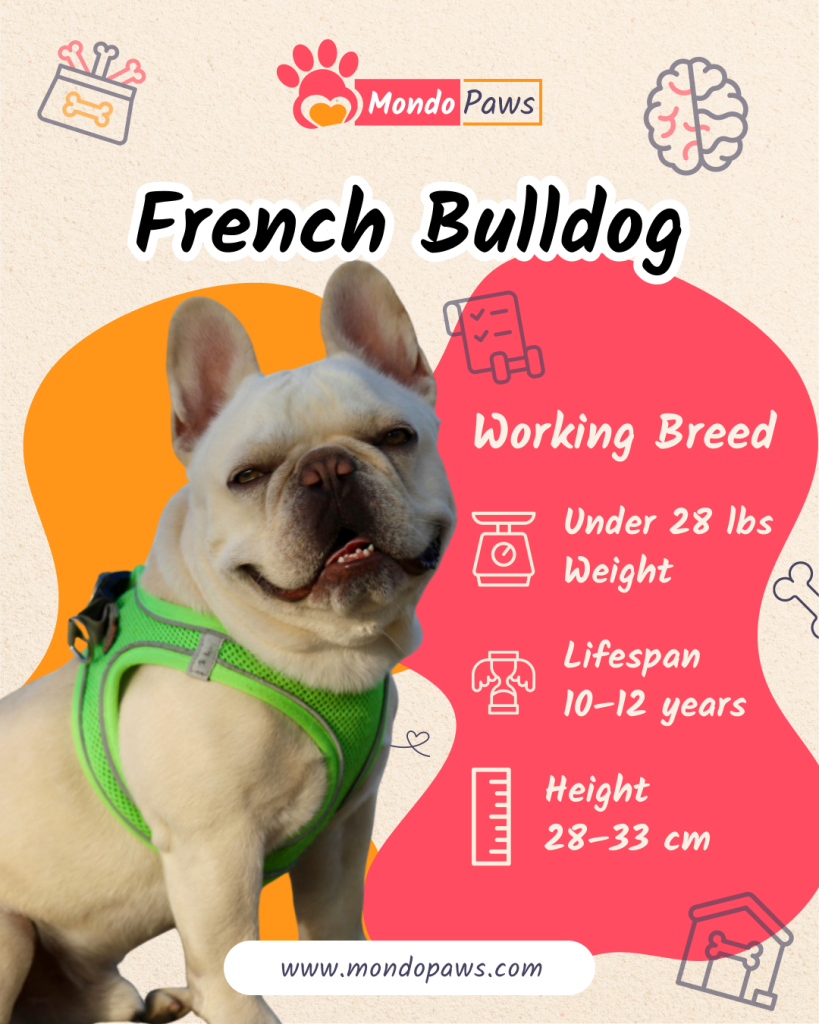
French Bulldogs are small but substantial, with a heavy bone structure, broad chest, short back, and the famous upright “bat ears” that are now a defining breed feature. Their coat is short and smooth, coming in brindle, fawn, cream, white, and pied patterns, with occasional rarer colours. The flat face gives them an almost human expression and makes them instantly recognisable.
They are clowns at heart — playful, mischievous, and deeply people-oriented. A Frenchie does not want to be left alone for long stretches; it wants to be on the sofa, in your lap, or following you from room to room. That combination of compact size, low exercise needs, and big personality has made it one of the most registered breeds in the United States and beyond.
Temperament & Personality
The French Bulldog personality is best described as affectionate, comical, and stubbornly charming. They are companion dogs first and foremost, happiest when involved in whatever their humans are doing. They are generally friendly with strangers, tolerant of children, and surprisingly adaptable to apartments, city noise, and other pets — as long as they get enough attention.
Real Owner Insights: What Daily Life with a French Bulldog Is Actually Like
“He snores like a truck, farts without shame, and acts like he owns the couch — but I have never met a dog that makes me laugh this much. He greets every delivery driver like a long-lost friend.”
— As shared by a French Bulldog owner on r/dogs on Reddit
“She doesn’t need long walks, but she needs to be near you. If I work from home, she sleeps on my feet. If I leave, she stares at the door like I betrayed her. Training took patience — she is smart, but only when food is involved.”
— Shared by a French Bulldog owner in a breed group on Facebook
Core Performance Metrics
Breed comparison data breakdown — French Bulldog vs. standard breed benchmark.
With Family
Lovable Clown
Affectionate, playful, and devoted to every family member
With Strangers
Friendly & Curious
Usually greets new people with a wag and a sniff
Energy Level
Low to Moderate
Short walks and indoor play are usually enough
Trainability
Food-Motivated
Smart but willful; keep sessions short and fun
A French Bulldog does not obey to please you — it obeys because you finally made the lesson interesting enough.
Short, reward-based sessions with plenty of praise and treats work far better than long drills. Resources from the American Society for the Prevention of Cruelty to Animals emphasize positive reinforcement and patience for brachycephalic, food-motivated breeds.
Trait Ratings
Personality Traits
Care Requirements
French Bulldog Summary Table
| Category | Verdict | Best for |
|---|---|---|
| Families with kids | Excellent | Playful, sturdy, and affectionate with respectful children |
| First-time owners | Good | Small size and easygoing nature, but health homework is essential |
| Apartment living | Excellent | Low exercise needs and minimal barking make them ideal city dogs |
| Allergy sufferers | Moderate | Short coat, but sheds year-round and can have skin allergies |
| Guard / watchfulness | Moderate | Will alert bark, but too friendly to be a serious guard dog |
| Off-leash freedom | Not Ideal | Brachycephalic build and selective hearing make recall risky |
| Multi-pet households | Good | Usually gets along with other pets if socialised early |
| Budget-conscious owners | Not Ideal | High purchase price and potential respiratory/orthopedic vet costs |
French Bulldog Living Needs
A French Bulldog suits an indoor-oriented home with air conditioning, a comfy spot on the sofa, and plenty of human company.
Space
Apartment Friendly
Thrives in small spaces as long as there is daily interaction
Children
Great With Kids
Playful and sturdy, but teach children to respect their flat face
Climate
Cool & Climate-Controlled
Brachycephalic dogs overheat quickly; avoid hot midday walks
Other Pets
Generally Social
Usually good with cats and dogs when introduced properly
A French Bulldog does not need a yard — it needs a lap, a cool room, and someone who thinks its snoring is charming.
Training and Exercise Needs
French Bulldogs are low-energy companion dogs, but they still need short daily walks, mental stimulation, and consistent training. Their flat faces mean they tire quickly and overheat easily, so exercise should be gentle and happen during cooler parts of the day. Training sessions should be brief, fun, and reward-heavy Frenchie’s are famously food-motivated and just as famously stubborn.
Exercise Allocation Profile (Weekly Ideal)
Training Style
Positive & Short
5–10 minute sessions with treats and praise work best
Exercise Caution
Heat Sensitive
Walk early or late; never exercise in hot, humid weather
Grooming & Coat Care
Grooming a French Bulldog is refreshingly simple. The short, smooth coat only needs a weekly brush to remove loose hair and distribute skin oils. The bigger grooming priorities are keeping facial folds clean and dry, wiping the ears, and trimming nails regularly.
Coat Type
Short & Smooth
Weekly brush with a soft bristle or rubber mitt
Coat Colours
Brindle, Fawn, Cream, Pied
Standard colours plus rarer blues, chocolates, and lilacs
Shedding
Moderate, Year-Round
Short hairs stick to clothing and upholstery
Skin Folds
Keep Clean & Dry
Wipe facial wrinkles daily to prevent infection
You will spend more time cleaning between a French Bulldog’s wrinkles than you will brushing its coat.
Calm, positive handling routines are highly recommended. Resources from the American Society for the Prevention of Cruelty to Animals emphasize low-stress nail and ear handling introduced in puppyhood.
Health & Common Concerns
The French Bulldog’s popularity has brought increased attention to its health profile. The flat face that gives the breed its cute expression also predisposes it to brachycephalic obstructive airway syndrome (BOAS). Responsible breeders now prioritise dogs with more open nostrils and less extreme features, and buyers should ask for health testing and meet the parents when possible.
BOAS
Respiratory · Screen Breathing
Hip Dysplasia
Orthopedic · Screening Recommended
IVDD
Spinal · Avoid High Jumps
Skin Allergies
Dermatologic · Common
AKC & Breed Club Standards
According to official breed documentation from the American Kennel Club and the French Bulldog Club of America, the French Bulldog is defined by its compact, muscular body, heavy bone, smooth coat, and the distinctive “bat ears” that stand erect. The breed standard calls for an alert, affectionate, and well-behaved companion.
Veterinary & Puppy Screening
Canine health resources and breed-specific guidance recommend screening for BOAS, hip dysplasia, patellar luxation, eye conditions such as cherry eye, and spinal issues including hemivertebrae and IVDD. Reputable breeders provide health clearances for both parents and puppies. Because French Bulldogs often cannot swim and overheat easily, owners should also plan for water safety and climate control.
Relative Health Risk by Condition
Regular veterinary checkups, climate control, and responsible breeding help reduce these risks.
Nutrition & Feeding
French Bulldogs are prone to weight gain, which worsens breathing problems and joint stress. Most adults do well on roughly 1 to 1½ cups of quality food a day, split into two measured meals. Because the breed loves food and can be persuasive, measured portions and limited treats are essential.
High-quality protein
Moderate fat & carbs
Weight control
Because the breed is prone to allergies and sensitive digestion, sudden diet changes or low-quality fillers can trigger itchy skin or upset stomachs. Slow feeders and raised bowls can help reduce gas and bloat risk. According to PetMD, measured portions, age-appropriate formulas, and constant fresh water support healthy weight and long-term health in French Bulldogs.
to find out more about dogs weight visit Dog Weight Calculator.
Ownership Cost Calculator
French Bulldog puppies from registered, health-screened breeders typically sell for $2,500–$8,000+, with rare colours and show lines commanding premium prices. The real long-term costs are veterinary care — especially respiratory, skin, and spinal issues — and climate control. Adjust the inputs below for a personalised annual running-cost estimate. All figures are in USD and reflect US market averages.
Pros & Cons
Strengths
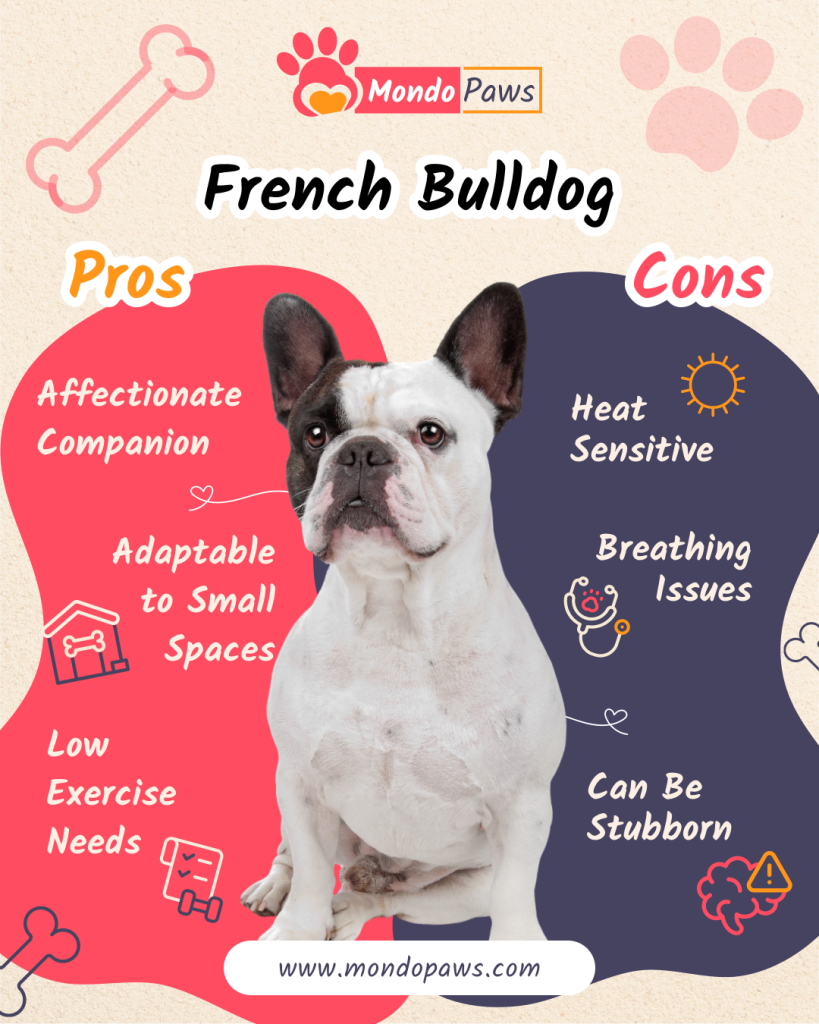
- Compact size and low exercise needs suit apartments and city life
- Affectionate, playful, and deeply bonded to family
- Minimal grooming and easy coat care
- Generally quiet; not a nuisance barker
- Great with children and usually good with other pets
Challenges
- Brachycephalic health issues can mean costly vet bills
- Overheats quickly and cannot swim; needs climate control
- Stubborn streak requires patient, reward-based training
- Prone to weight gain, allergies, and skin fold infections
- High purchase price from responsible breeders
History of the French Bulldog
The French Bulldog’s story begins in 19th-century England, not France. English lace makers in Nottingham kept small bulldogs as lap warmers and ratters. When the Industrial Revolution threatened their trade, many relocated to northern France — taking their miniature bulldogs with them. In France, the breed was crossed with local ratters and other small dogs, developing the compact body and upright ears that define the modern Frenchie.
Parisian society soon embraced the little dogs. Artists, cabaret owners, and fashionable women kept them as companions, and American tourists fell in love with them during visits to France. The breed’s signature bat ears were actually controversial at first — English and European fanciers preferred rose ears, but American breeders championed the erect ears, and the bat ear became part of the official standard.
Key historical milestones include:
1800s
English lace makers keep small bulldogs as companions and ratters in Nottingham.
Mid-1800s
Lace workers relocate to France, bringing their toy bulldogs; the breed develops in Normandy and Paris.
Late 1800s
Parisians adopt the Bouledogue Français as a fashionable city companion; American visitors begin importing dogs to the United States.
1897–1898
The bat-ear controversy divides breeders; American fanciers establish the erect ear as the breed ideal. The AKC recognises the French Bulldog in 1898.
Early 1900s
The French Bulldog Club of America is formed, and the breed gains popularity among wealthy American families.
2010s–Present
The Frenchie explodes in popularity, becoming one of the most registered breeds in the United States and worldwide.
Today:
The French Bulldog is a global companion breed. Modern breeding conversations focus heavily on health — especially reducing BOAS severity, improving skin and spinal health, and moving away from the most extreme facial structures. Responsible breeders and veterinary organisations continue working to ensure the breed’s future is as lovable as its present.
Enthusiasts are drawn to its compact size, comic personality, and unmatched devotion to family life.
Fun Facts
Bat Ears
The upright “bat ear” was once controversial; American breeders made it the breed standard
Not Really From France
Ancestors were English toy bulldogs; the breed was perfected in Paris
Can’t Swim
Heavy head and short legs make swimming dangerous; life jackets are a must near water
#1 in the US
The French Bulldog overtook the Labrador Retriever as the most popular AKC breed in 2022
Celebrity Favorite
Famous Frenchie owners have included Lady Gaga, Hugh Jackman, and Leonardo DiCaprio
Frequently Asked Questions
French Bulldog puppies from registered, health-screened breeders usually cost between $2,500 and $8,000+, with rare colours and imported lines at the higher end. Budget a further $2,000–$3,500 a year for food, insurance, routine vet care, and potential allergy or respiratory expenses.
Yes. French Bulldogs are generally excellent family dogs — affectionate, playful, and patient with children. They are small enough not to overwhelm kids but sturdy enough to handle gentle play. Supervision is still important, especially with very young children.
They are moderately trainable. Frenchies are smart and food-motivated, but they also have a stubborn streak. Short, positive sessions with treats and games work best. Harsh corrections usually backfire.
No dog is truly hypoallergenic, and French Bulldogs are not a low-allergy breed. They shed year-round and are prone to skin allergies that can increase dander. Allergy sufferers should spend time with the breed before committing.
French Bulldogs are generally quiet. They may bark to announce visitors or when excited, but they are not known as nuisance barkers. Their vocalisations also include snorts, grunts, and the occasional “Frenchie scream.”
Behind the Research: How We Created This French Bulldog Guide
At Mondopaws, we believe pet guides should be grounded in both hard science and real-world care. To compile this French Bulldog breed profile, our editorial team:
- Cross-referenced official breed standards: Analyzed official documentation and care guidelines directly from the American Kennel Club (AKC), FCI, and the French Bulldog Club of America.
- Consulted veterinary & clinical research: Verified breed-relevant conditions (such as BOAS, hip dysplasia, IVDD, skin allergies, and cherry eye) using material from veterinary genetics resources, OFA screening guidance, and clinical insights from the ASPCA and PetMD.
- Gathered authentic owner experiences: Evaluated real feedback, training struggles, socialisation advice, and temperament observations shared by verified French Bulldog owners across active pet forums and social media communities.
Final Thoughts
The French Bulldog is one of the most charming companion dogs in the world: compact, affectionate, hilarious, and perfectly suited to modern city life. The trade-offs are real — potential health issues related to the flat face, heat sensitivity, and a purchase price that reflects the breed’s popularity and breeding challenges.
If you can provide a cool home, measured meals, gentle exercise, and a whole lot of lap time, the French Bulldog repays you with a level of devotion and entertainment that few breeds can match. Just be prepared to share your sofa, your heart, and possibly your dinner.
Written by the Mondo Paws Team
Explore More Companion & Brachycephalic Dog Breeds