Table of Contents
Why do dogs follow you everywhere? Mostly because you are their person: following reflects attachment and social instinct, and it keeps paying off because you control food, walks, play, and attention. Dogs also learn what your movements predict and follow out of curiosity or boredom. Occasionally, sudden or anxious clinginess points to stress or a health problem. This page gives you six free interactive tools to work out what your own dog means.
Attachment
Following is often a sign of trust and a strong bond
Rewards
You control food, walks, play, and attention
Routine
Dogs learn what your movements predict
Breed
Herding, sporting, and companion breeds stay close
Velcro vs Panic
Calm when you leave is velcro; panic is a different issue
Sudden Means Vet
New clinginess deserves a health check
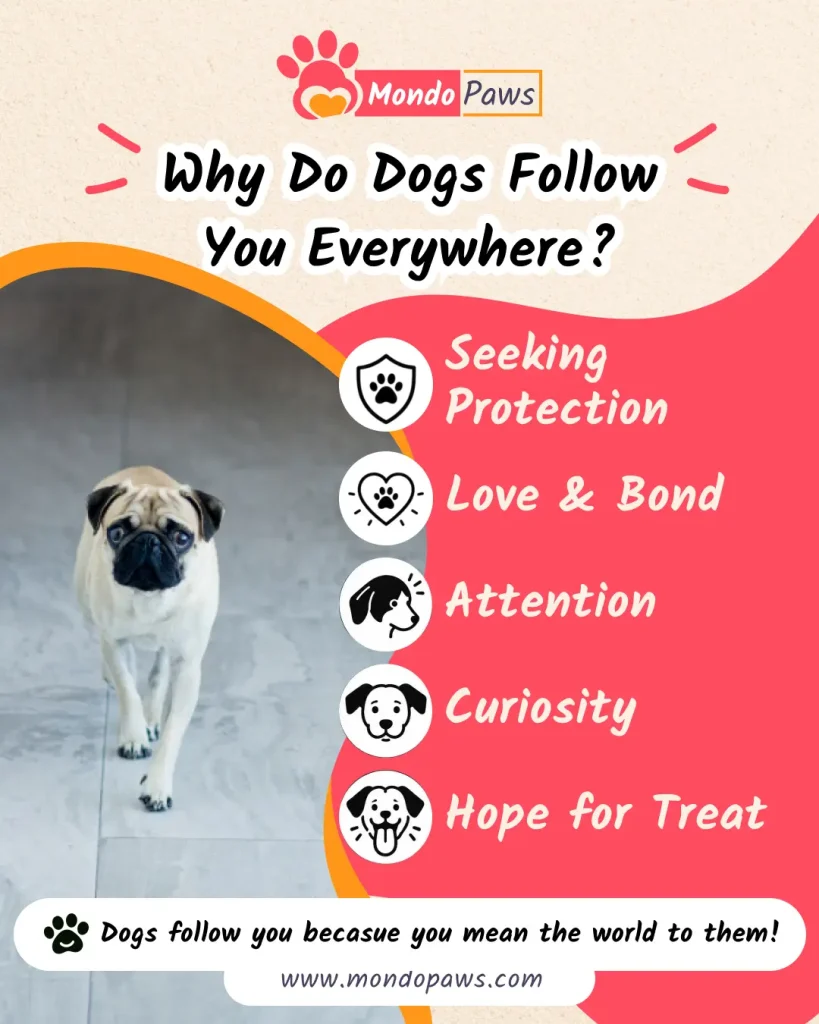
Quick answer: Dogs follow you everywhere because of attachment and social instinct, because following is rewarded with food, walks, play, and attention, because they learn your routines, and out of curiosity or boredom. Some breeds, rescue dogs, puppies, and older dogs with sensory changes stay especially close. See your vet if the clinginess is sudden, comes with physical symptoms, or your dog panics when you are apart.
The American Kennel Club’s guide on why dogs follow you everywhere points to pack instinct, puppy imprinting, positive reinforcement, and breed. PetMD and WebVet add the key line between a velcro dog and separation anxiety, and the health causes worth ruling out. The tools below turn that guidance into something you can click through with your own dog in mind.
Following sits alongside other ways your dog talks to you. See why dogs put their paw on you, why dogs lick you, and the dog stress signals visual guide. For time apart and boredom, try the dogs alone time calculator and the dog exercise calculator.
Why Do Dogs Follow You Everywhere? Free Follow Reason Decoder
Choose your dog’s age group, then describe where your dog follows you, when it happens, what it looks like, how your dog behaves when you leave, and how long it has been going on. The decoder scores nine common reasons and shows the best matches, a suggested response, and whether a vet check is worth considering. It is a guide for reading context, not a diagnosis.
🐕🦺 Follow Reason Decoder
Why Does My Dog Follow Me to the Bathroom? Interactive House Route Map
Where your dog follows you changes the likely reason. Tap the rooms your dog follows you into, in the order they usually do. The map draws your dog's shadow route, rates how closely your dog follows, and explains each room.
🏠 House Route Map
9 Reasons Dogs Follow You Everywhere
These are the nine reasons the decoder above scores, with the signs that separate them. Veterinarian Dr. Rachel Barrack told the AKC that puppies from birth to about six months may imprint on their owners as they would on their mother, and trainer Erin Kramer notes that dogs focus on the person who gives them access to good things. Use the table as a checklist, not a verdict.
| Reason | Signs to Look For | What to Do |
|---|---|---|
| 1. Bond & Affection | Relaxed, settles near you, calm when you leave. | Enjoy it and keep up social time with others. |
| 2. Social Instinct | Stays with "the group," especially puppies. | Reassure, and build in short independent time. |
| 3. Routine | Follows on cue: keys, shoes, mealtimes, bedtime. | Practice the cues without following through. |
| 4. Reward Learning | Gets petting, treats, or play when close. | Stop paying off the follow, and reward settling. |
| 5. Curiosity | Peeks in at the bathroom, wants to see what you are doing. | Give a chew and a settle spot. |
| 6. Boredom | Hovers when you are busy; restless. | Add exercise, sniffing, and puzzle toys. |
| 7. Breed & Temperament | Herding, sporting, or companion breeds; always been this way. | Give a job and a place cue. |
| 8. Stress or Insecurity | Worried body language; rescue history; panics when apart. | Build confidence gradually; ask your vet or a behaviorist. |
| 9. Health or Age Change | Sudden onset, senior dog, vision or hearing loss, disorientation. | See your vet before assuming it is behavior. |
The Follow Loop: How Clinginess Gets Learned
PetMD notes that clinginess is often learned: giving food or petting when a dog follows you teaches that following pays off. The AKC adds that rewarding clinginess tells a dog the behavior is welcome. The loop below shows how a harmless habit gets stronger, and where you can break it.
What Your Dog Is Saying When They Follow You
Timing is the biggest clue. Here is how the most common moments usually read, with a first step to try.
| When It Happens | Likely Meaning | First Thing to Try |
|---|---|---|
| Every time you get up | Routine, curiosity, and attachment. | Reward a settle on a mat when you move. |
| To the bathroom | Curiosity, routine, and group instinct. | Teach a calm wait with a chew outside the door. |
| Around mealtimes | Food, and a learned reward. | Keep meal times steady and ask for a mat settle. |
| While you work | Boredom or attention-seeking. | Offer a puzzle toy and a sniff break. |
| When you are upset | Bond, or sensing your stress. | Take a breath and stay calm; dogs pick up on your mood. |
| When you get ready to leave | Routine cues, or worry about being left. | Practice keys and shoes without leaving. |
| When visitors come | Insecurity, or social excitement. | Offer a safe spot and reward calm. |
| At night | Closeness, routine, or discomfort. | Check comfort; mention new night restlessness to your vet. |
Breeds and Life Stages That Follow the Most
Some dogs are simply built for closeness. The AKC notes that Herding and Working Group breeds were bred to work closely with people, and PetMD lists lap breeds like Shih Tzus and Cavalier King Charles Spaniels and sporting dogs like Vizslas, Labrador Retrievers, and Golden Retrievers. Individual dogs vary, so treat these as tendencies, not rules.
| Group | Examples | Why They Stay Close | Tip |
|---|---|---|---|
| Herding and Working | Border Collies, many shepherd types. | Bred to work closely with people; the trait is prized. | Give a job: training games, puzzles, structured exercise. |
| Sporting and Retrievers | Vizslas, Labradors, Golden Retrievers. | Bred to stay close to people. | Teach a settle cue and give plenty of exercise. |
| Companion and Lap | Shih Tzus, Cavalier King Charles Spaniels. | Bred for company. | Practice short, calm separations early. |
| Guardian | German Shepherds, Dobermans. | May seem clingy because they are protective. | Balance closeness with confidence-building and social time. |
| Rescue and Mixed | Any breed. | Past experience can create a fear of abandonment. | Build trust slowly, and ask a behaviorist if anxiety shows up. |
| Life Stage | What Following Often Means | What to Do |
|---|---|---|
| Puppy | Relies on you for guidance; may imprint on you. | Mix closeness with short, positive alone time. |
| Adult | Attachment, routine, and rewards. | Reward calm settling and keep needs on a schedule. |
| Senior | Staying close to navigate with vision or hearing loss, or cognitive changes. | See your vet for new clinginess. Add night-lights and keep furniture in the same place. |
Velcro Dog or Separation Anxiety? The Balance Seesaw
PetMD and WebVet draw the same line: a velcro dog wants to stay close but stays calm when you leave, while a dog with separation anxiety panics when left alone, with signs such as whining, pacing, drooling, destruction at doors and windows, house-soiling, self-injury, and escape attempts. WebVet adds that velcro behavior can be a risk factor for separation anxiety, but most velcro dogs never develop it. Tick what you see and watch the seesaw tip. This is a guide, not a diagnosis.
⚖️ Velcro vs Anxiety Seesaw
What Kind of Shadow Is Your Dog? Take the Quiz
Answer six quick questions about your dog and find your dog's "shadow type," with what it likely means and what to do next. It is a fun, practical way to read your own dog. It is not a clinical test.
🔮 Shadow Type Quiz
How to Stop a Dog Following You Everywhere: Independence Plan Builder
The advice from the AKC, PetMD, and Ellevet is consistent: rule out health problems, add exercise and mental stimulation, give your dog a comfortable place of their own, teach a "place" or "settle" cue, practice short and calm separations, and never punish following. The builder below turns that into a step-by-step distance ladder. The week estimates are our own planning numbers, so go at your dog's pace. If your dog panics when you are apart, skip the drills and see your vet.
🪜 Independence Plan Builder
Give a Place of Their Own:
A comfortable bed or crate in a quiet corner, with a favorite toy, gives your dog somewhere to settle. Reward them for going there.
Add Exercise and Enrichment:
Bored or restless dogs tend to follow more. Interactive toys, puzzles, and daily exercise help. See the dog exercise calculator.
Share the Care:
Have other adults in the home walk, feed, and play with your dog so they bond with more than one person.
Desensitize the Cues:
Pick up your keys or head to the kitchen without following through, so these movements stop triggering your dog to follow.
Never Punish Following:
It is a natural behavior. Redirect your dog to another activity or a cue like "place" instead.
Sudden Clinginess: Vet Red-Flag Checker
Dr. Jerry Klein, the AKC's Chief Veterinary Officer, advises a vet checkup if a dog suddenly becomes clingy, since it may signal a physical ailment. WebVet lists pain, nausea or stomach upset, hormonal changes, and vision or hearing loss as possible causes, and notes that in senior dogs clinginess, disorientation, pacing, or night restlessness may suggest cognitive dysfunction, which is diagnosed only after other causes are ruled out. Tick anything that matches your dog right now.
🩺 Vet Red-Flag Checker
Sudden Change
Abrupt new clinginess can be a non-specific sign of pain or illness.
Older Dogs
Sensory loss or cognitive changes can make a dog stay close to feel safe.
Emergency Signs
Collapse, sudden disorientation, or a hard, swollen belly with retching need immediate care.
Frequently Asked Questions
Dogs follow you because of attachment and social instinct, because following pays off with food, walks, play, and attention, because they learn routines and are curious, and sometimes because of boredom, stress, or health or age-related changes. Most following is normal. Sudden new clinginess is worth a vet check. Try the follow reason decoder for your own dog.
Common reasons are curiosity about what you are doing, routine, and a wish to stay with their group. It is usually harmless. If the habit is new and sudden, or your dog panics when you are out of sight, talk to your vet. Tap the bathroom on the house route map for more.
Often, yes. Following is commonly a sign of attachment and trust, although it can also be about rewards, routine, or insecurity. A relaxed dog that settles near you usually has a secure bond, while a dog that looks worried may be seeking reassurance.
A velcro dog is a dog that wants to stay physically close to a person, often following them from room to room. Velcro dogs are generally calm when you leave, while dogs with separation anxiety panic when left alone. Velcro behavior can be a risk factor for separation anxiety, but most velcro dogs never develop it. Check yours on the velcro vs anxiety seesaw.
Sudden clinginess can signal pain, illness, stress, or changes in the home. In senior dogs it can come with vision or hearing loss or cognitive decline. See your vet for any sudden change in behavior, and seek emergency care for collapse, sudden disorientation, or a hard, swollen belly with unproductive retching. Use the vet red-flag checker.
Herding and working breeds, sporting breeds such as Vizslas, Labrador Retrievers, and Golden Retrievers, and companion breeds such as Shih Tzus and Cavalier King Charles Spaniels are often described as clingy because they were bred to stay close to people. Individual dogs vary, and a rescue dog's history matters too.
Rule out health problems first, then add exercise and mental stimulation, teach a place or settle cue and reward staying on a bed, practice short calm separations, and avoid rewarding following with attention or treats. Never punish following. Redirect your dog instead, and involve a professional trainer if it persists. The independence plan builder turns this into a week-by-week ladder.
Not by itself. Clingy dogs want to be near you at home but stay calm when you leave, while dogs with separation anxiety panic when alone, with signs such as whining, pacing, drooling, destruction, or house-soiling. If you see those signs, talk to your vet or a veterinary behaviorist.
Behind the Research: How We Built These Follow Tools & This Guide
At Mondo Paws, our mission is to give pet owners clear, research-based tools. To create this guide and its interactive tools:
- Reviewed Veterinary and Behavior Sources: Reasons, breed tendencies, warning signs, and training steps were cross-checked against the American Kennel Club, PetMD, WebVet, and Ellevet.
- Editorial Scoring Models: The decoder weights, the seesaw scores, the shadow types, and the week estimates in the independence plan are our own editorial models built from those sources. They are teaching and planning aids, not clinical tests.
- Simplified Graphics: The house map and the follow loop are simplified illustrations. Every home and dog is different.
- Not a Diagnosis: No tool here can diagnose separation anxiety or any medical or behavioral condition. If your dog's behavior changes suddenly or your dog panics when apart, see your veterinarian.
Final Thoughts
A dog that follows you everywhere is usually telling you that you are the center of their world. Use the Follow Decoder to read the reason, the House Route Map to see where your shadow goes, the Seesaw to check that closeness stays calm, the Shadow Type Quiz for a quick read of your dog, and the Independence Plan to build confidence gently. Pair them with the dog exercise calculator, the dogs alone time calculator, and the dog sleep calculator.
Remember that your dog's own normal is the best benchmark. If the clinginess is sudden, comes with physical symptoms, or your dog panics when you are apart, contact your veterinarian rather than waiting to see if it passes.