
Table of Contents
Vermin-Hunting Terrier · Czechoslovakia
The Cesky Terrier (pronounced “chess-key,” and also known as the Bohemian Terrier) is one of the rarest purebred dogs on earth — a low-slung, silky-coated hunting terrier deliberately engineered by a single geneticist to be a calmer, quieter, more biddable alternative to the era’s scrappier terriers. Built to work underground on badger and fox, yet gentle enough to curl up on a lap by evening, the Cesky blends working-terrier grit with an unusually mellow, family-friendly disposition.
13–22 lbs
Cesky Terrier Size (Weight)
10–13″
Height
12–15 years
Cesky Terrier Lifespan
Top 6 Rarest
Global Breed Ranking
1949
Origin Year
Low-Shed
Coat Shedding Level
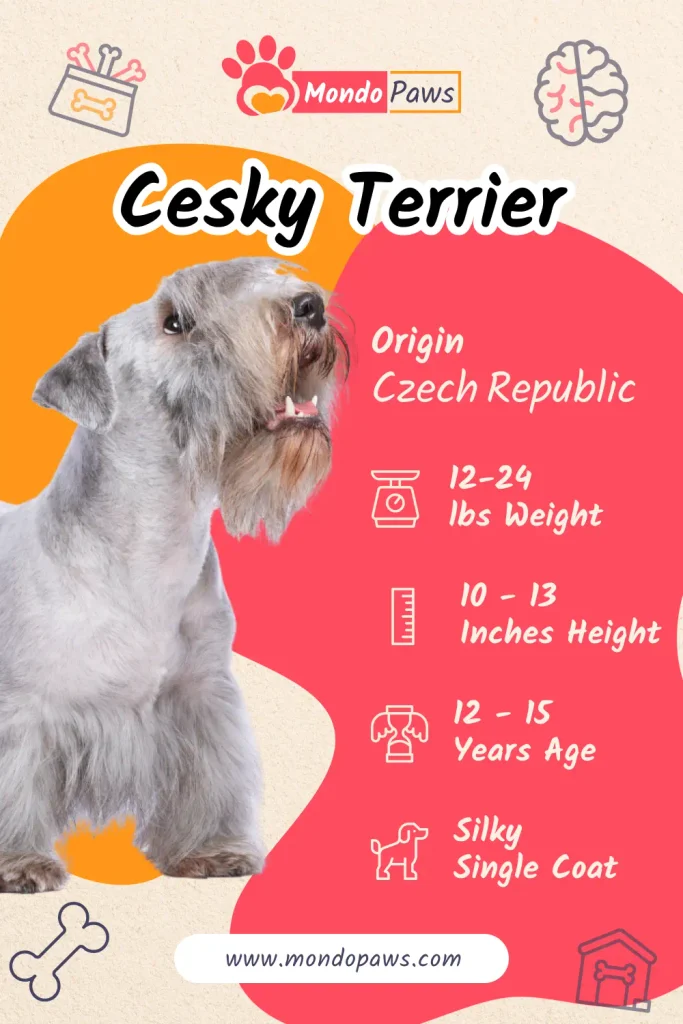
In terms of Cesky Terrier size, this is a genuinely small dog — long-bodied, short-legged, and built low to the ground so it could squeeze into badger setts and dense forest undergrowth without getting stuck. The FCI standard calls for an ideal height at the withers of about 11.5 inches for males and 10.5 inches for females, with a body roughly one-and-a-half times as long as it is tall.
The signature feature is the coat: long, fine, and slightly wavy, with a silky beard, moustache, and eyebrows that give the Cesky its distinctive whiskered look. Coat color is famously deceptive — every Cesky Terrier puppy is born solid black or dark brown, and the coat gradually clears over roughly the first two years into its true adult shade of charcoal-to-platinum grey, or the rarer coffee-brown.
Temperament & Personality
The Cesky Terrier temperament is often described as the “gentleman of the terrier world.” Compared with the fiery, high-strung reputation many terriers carry, the Cesky is calm, reserved, and even-tempered indoors, while still holding onto the alertness and prey drive of a working hunting dog outdoors. It was deliberately bred to be less combative and more biddable than its Scottish and Sealyham Terrier ancestors, and it shows: aggression toward people or other dogs was actively selected against from the breed’s earliest litters.
Ceskys are typically affectionate and devoted to their families, good with children in homes where handling is supervised, and — unusually for a terrier — comfortable living alongside other dogs, since they were originally hunted in small packs rather than worked solo. They tend to be reserved rather than outgoing with strangers, so early socialization is important to prevent wariness from tipping into shyness.
With Family
Devoted & Affectionate
Forms close bonds and enjoys quiet lap time
With Strangers
Reserved but Watchful
Polite once socialized; makes a decent alert barker
Energy Level
Moderate
A brisk daily walk plus playtime is usually enough
Trainability
Smart, Sometimes Stubborn
Learns quickly but has classic terrier independence
Outdoors, the Cesky is still every inch a terrier — curious, alert, and quick to chase — but indoors it settles into a calm, cuddly companion that many owners compare more to a lapdog than a hunting dog.
Because Ceskys retain a genuine prey drive from generations of hunting rodents, foxes, and badgers, they should not be trusted off-leash around small animals without training, and homes with cats or pocket pets need a careful, gradual introduction. Positive, reward-based training works best; harsh corrections tend to make the breed’s stubborn streak worse rather than better.
Trait Ratings
Personality Traits
Care Requirements
Cesky Terrier Summary Table
| Category | Verdict | Best for |
|---|---|---|
| First-Time Dog Owners | Good | Calmer than most terriers and reasonably easy to train |
| Apartment Living | Excellent | Small size, moderate energy, and low shedding suit close quarters |
| Families with Children | Good | Affectionate and playful; best with older, gentle children |
| Homes with Cats/Small Pets | Caution | Real hunting-terrier prey drive; needs early, careful introductions |
| Multi-Dog Households | Excellent | Bred to hunt in small packs; sociable with other dogs |
| Allergy-Prone Households | Good | Low-shedding coat, though still requires regular clipping |
| Guard Dog Duties | Moderate | Alert and will bark at strangers, but not a protection dog |
| Budget-Conscious Owners | Not Ideal | Rare breed with high puppy prices and ongoing grooming costs |
Cesky Terrier Living Needs
The Cesky Terrier is one of the more adaptable terriers when it comes to living situations, but it still carries some breed-specific quirks worth planning around.
Yard & Fencing
Secure, Dig-Proof Yard
Short legs limit jumping, but digging instinct is strong
Children
Best with Older Kids
Small stature means rough handling by toddlers should be supervised
Climate Tolerance
Average Tolerance
Long single-length coat isn’t built for extreme cold or heat
Companionship
Highly People-Oriented
Prefers company to long stretches alone; can be prone to separation anxiety
A Cesky Terrier doesn’t need acres of land to be happy; it needs a securely fenced garden to dig in, a warm lap to finish the evening on, and people nearby most of the day.
Training and Exercise Needs
Unlike its higher-octane terrier cousins, the Cesky Terrier does not need hours of vigorous daily activity — a brisk 30 to 45 minute walk plus some structured play or a training session is usually enough to keep an adult content. That said, “moderate exercise” does not mean “no exercise”: without an outlet, Ceskys can turn to digging, chewing, or barking out of boredom.
Training benefits from patience. Ceskys are intelligent and pick up cues quickly, but their terrier ancestry gives them an independent streak, and they respond far better to consistent, reward-based methods than to forceful correction. Because of their strong scenting and chasing instincts, reliable off-leash recall should never be assumed around wildlife, squirrels, or unfamiliar small animals.
Puppy Training Focus
Early Socialization
A Cesky Terrier puppy should meet plenty of people, dogs, and everyday sounds early to offset natural reserve toward strangers.
Adult Focus
Impulse Control
Recall and “leave it” cues help manage the breed’s hunting-bred prey drive.
Grooming & Coat Care
Grooming is where the Cesky Terrier asks the most of its owner. The coat grows continuously rather than shedding on a seasonal cycle, which is great news for low-mess households but means it needs consistent upkeep to stay healthy and mat-free.
Coat Type
Long, Silky, Wavy
Brush 1–2 times weekly; professional clip every 4–6 weeks
Coat Colors
Grey or Coffee-Brown
Charcoal to platinum grey is most common; brown (liver) is rare
Born Black, Fades with Age
Coat lightens to its true adult shade over roughly two years
Ears & Face
Beard & Ear Checks
Wipe facial furnishings daily; check drop ears weekly for wax and debris
Skipping professional clips doesn’t save money in the long run — an unmaintained Cesky coat mats quickly at the legs, belly, and beard, which can lead to skin irritation underneath.
Health & Common Concerns
The Cesky Terrier is generally a robust, long-lived small breed, with an average lifespan of 12 to 15 years. Its relatively young gene pool and careful early breeding for temperament have kept most serious hereditary disease uncommon, though a handful of conditions are worth screening for.
Scottie Cramp
Neuromuscular · Serotonin-Linked Gait Disorder
Patellar Luxation
Orthopedic · Kneecap Slippage in Small Breeds
Primary Lens Luxation
Genetic · DNA-Testable Eye Condition
Hip Dysplasia
Orthopedic · Uncommon but Screenable
Are Cesky Terriers a Recognized Breed?
Yes — unlike some working-type dogs, the Cesky Terrier is a fully recognized purebred with a closed studbook. It was recognized by the Fédération Cynologique Internationale (FCI) in 1963, by the UK Kennel Club in 1990, and by the American Kennel Club in 2011, making it one of the AKC’s more recently admitted Terrier Group members.
Health Screening
Reputable breeders typically screen breeding stock for Scottie Cramp, primary lens luxation, and patellar and hip health before mating, along with routine cardiac and thyroid checks — steps that have helped keep the breed largely free of the more severe hereditary disorders seen in some longer-established terrier breeds.
Nutrition & Feeding
Given their small frame and moderate activity level, Cesky Terriers do not need huge portions — but they do have hearty appetites for their size, and owners should watch calorie intake closely to prevent obesity, which puts extra strain on a small dog’s joints.
Small-Breed Formula
Careful Portion Control
Joint-Supportive Diet
A high-quality small-breed kibble formulated to the dog’s age and activity level generally covers a Cesky’s needs; two measured meals a day, rather than free-feeding, makes it easier to catch weight gain early. Treats used during training should be factored into the daily calorie total rather than added on top.
for more guide about dogs weight check out our dog weight calculator.
Cost of Ownership & Puppy Price
Rarity drives the Cesky Terrier price up compared with most small terriers. With only a few hundred registered in the United States and a small litter size (typically two to four puppies), waiting lists from reputable breeders are common, and prices frequently run from roughly $1,500 to $3,000+ depending on lineage and location, with UK breeders often pricing from around £1,200. Ongoing costs are dominated by grooming: regular professional clips add up over a dog’s lifetime in a way that shorter-coated breeds don’t require.
Beyond the purchase price, budget for routine veterinary care, a quality small-breed diet, and — most distinctively for this breed — a recurring grooming bill every four to six weeks. Owners considering a Cesky should also be prepared for a longer search or waiting list than they might expect with more common breeds.
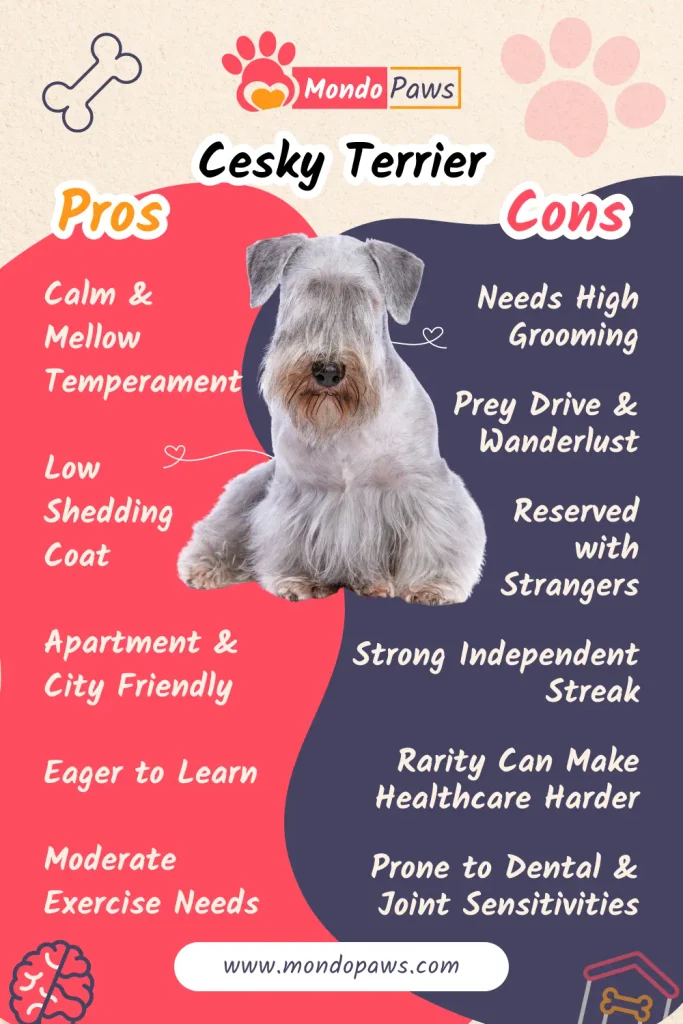
Strengths
- Calm, biddable temperament rare among terrier breeds
- Low-shedding coat, well suited to allergy-sensitive households
- Good with other dogs thanks to its pack-hunting background
- Compact size and moderate exercise needs suit apartment living
- Affectionate, devoted companion once bonded to its family
Challenges
- High purchase price and long waiting lists due to genuine rarity
- Frequent, non-negotiable professional grooming costs
- Retains a real prey drive toward small pets and wildlife
- Can be reserved with strangers without early socialization
History of the Cesky Terrier
Unlike most dog breeds, which emerged gradually over centuries of regional working use, the Cesky Terrier has a documented, deliberate origin story tied to a single person: Czech geneticist and avid hunter František Horák. In 1948–49, Horák set out to create a terrier better suited to hunting in the dense forests of Bohemia than the terriers then available, wanting a dog small and calm enough to work cooperatively in a pack underground, yet still an effective hunter of fox, badger, and vermin.
Horák crossed a Scottish Terrier named Buganier Urquam with a Sealyham Terrier named Darba von Vlčinec, keeping meticulous genetic and temperament records across subsequent generations — an unusually scientific approach to breed development. The first litter arrived in 1949–1950, and Horák continued to refine the line specifically for lower aggression, a calmer working style, and the coat and low-set body that would let the dogs squeeze into burrows.
1948–1950
František Horák begins deliberately crossing Scottish and Sealyham Terriers in Czechoslovakia to found the breed.
1963
The Fédération Cynologique Internationale (FCI) formally recognizes the Cesky Terrier as a distinct breed.
1989–1990
The breed is introduced to the UK and gains recognition from the Kennel Club (UK) shortly after.
2011
The American Kennel Club fully recognizes the Cesky Terrier as a member of its Terrier Group.
Today:
The Cesky Terrier remains one of the rarest purebred dogs in the world, with only a few hundred registered in the United States, but it has a devoted following among owners drawn to its calm nature and striking silky coat.
Fun Facts
Born Black, Grow Grey
Every Cesky Terrier puppy is born solid black or dark brown; the coat lightens gradually, sometimes passing through a brindled or striped phase, before settling into its final grey or coffee-brown shade around age two.
One of the Six Rarest Breeds
The Cesky Terrier is frequently listed among the world’s rarest purebred dogs, with only a few hundred individuals registered in the United States.
A Breed Built by One Man
Rather than developing informally over generations, the breed’s traits were mapped out deliberately by geneticist František Horák, who tracked pedigrees and temperament with scientific precision.
A Point of National Pride
The Cesky Terrier is closely associated with Czech national identity and has appeared on postage stamps celebrating native Czech dog breeds.
A Pack-Hunting Terrier
Most terriers were bred to hunt alone; Ceskys were unusually developed to work cooperatively in small groups, which helps explain their sociability with other dogs today.
Frequently Asked Questions
Yes. The Cesky Terrier was deliberately bred to be calmer and more affectionate than most terriers, and it typically does well in families, including those with older, gentler children. Because of its small size, interactions with very young children are best supervised, and homes with cats or small pets should introduce them gradually given the breed’s hunting-derived prey drive.
The Cesky Terrier was founded by crossing a Scottish Terrier with a Sealyham Terrier in Czechoslovakia in the late 1940s. Geneticist František Horák then selectively bred the resulting dogs over several generations specifically for a calmer temperament, a low-slung digging body, and the breed’s signature long, silky coat.
No dog breed is truly hypoallergenic, but Cesky Terriers shed very little compared with most breeds, which makes them a popular choice for allergy-sensitive households. Regular grooming and clipping further reduces loose hair and dander around the home.
Every Cesky Terrier puppy is born solid black or dark brown due to the genetics governing its coat color. As the puppy matures, a graying gene gradually lightens the coat — sometimes passing through a brindled or striped stage — until it settles into its final adult shade of grey or coffee-brown, usually by around two years of age.
Because the breed is genuinely rare and litters are typically small, a Cesky Terrier puppy from a reputable breeder often costs somewhere in the range of $1,500 to $3,000 or more in the US (roughly £1,200 and up in the UK), and waiting lists are common. Ongoing costs are also higher than average due to the need for professional coat clipping every four to six weeks.
An adult Cesky Terrier typically stands 10 to 13 inches at the shoulder and weighs between 13 and 22 pounds, with a long, low body roughly one-and-a-half times as long as it is tall. Its average lifespan is 12 to 15 years, and the breed is generally healthy when bred from screened parent stock.
Behind the Research: How We Created This Cesky Terrier Guide
At Mondopaws, we believe breed profiles must be grounded in verifiable history and current breed standards. To create this Cesky Terrier guide, our editorial team:
- Reviewed official breed standards: Cross-checked height, weight, and coat descriptions against the Fédération Cynologique Internationale (FCI) breed standard and Kennel Club records.
- Consulted veterinary breed resources: Drew on published health and lifespan data covering known Cesky Terrier concerns such as Scottie Cramp and primary lens luxation.
- Traced documented breed history: Verified the founding role of geneticist František Horák and the breed’s FCI, UK Kennel Club, and AKC recognition dates.
Final Thoughts
The Cesky Terrier is proof that a working terrier doesn’t have to be a live wire. Deliberately engineered for a calmer, more cooperative temperament without sacrificing hunting instinct, it offers a rare combination: the compact size and low-shed coat that suit apartment life, alongside genuine affection and sociability that make it an easy dog to love. Its rarity and grooming demands are real trade-offs, but for owners willing to plan for both, the Cesky rewards them with a loyal, good-natured companion.
If you can commit to regular coat maintenance, patient training, and a securely fenced space to dig, a Cesky Terrier will settle happily into family life — quiet and composed indoors, alert and game outdoors, and devoted to its people the whole way through.
Written by the Mondo Paws Team
At Mondo Paws, we are passionate about giving lesser-known breeds the same rigorous, well-organized treatment as household names. For this guide, we combined breed-standard documentation, veterinary breed data, and documented breed history to present an accurate overview of the remarkable Cesky Terrier.